
At a glance: Rusted steel, rotted wood and deteriorated concrete roof decks are usually found at tear-off, after the bid is signed. This article explains how each deck type fails under a Florida roof, the repair options and where each falls short, what moves deck cost and schedule, how OSHA and the Florida Building Code treat deck removal, including the 30 percent diaphragm trigger, and a role-by-role checklist for pricing and protecting deck work on an occupied building.
Commercial roof deck replacement is the change order most Florida reroofs are least prepared for, and its cost is largely set before the tear-off crew finds the first rusted flute or soft plank. A deck that is assessed, priced and scheduled as a contingency costs a measured amount per square foot. A deck discovered with the building open to the sky costs that amount plus idle crews, rushed material and an exposed interior. This article explains how decks fail, what the code and OSHA require once deck comes out, and how to carry the risk in the contract; whether a specific deck is structurally adequate is a call for the engineer of record.
Why does roof deck damage show up during a reroof instead of before it?
Roof deck damage usually surfaces at tear-off because the roof system hides the top of the deck for its entire life, and on many retail, office and medical buildings a finished ceiling hides the underside too. The National Roofing Contractors Association’s Roof Deck Integrity Assessment Tool (Version 2.0, April 2025) separates accessible decks, where the underside can be inspected, from inaccessible ones, where the estimator has to infer condition from wet insulation, interior staining, deflection, soft spots and core samples.
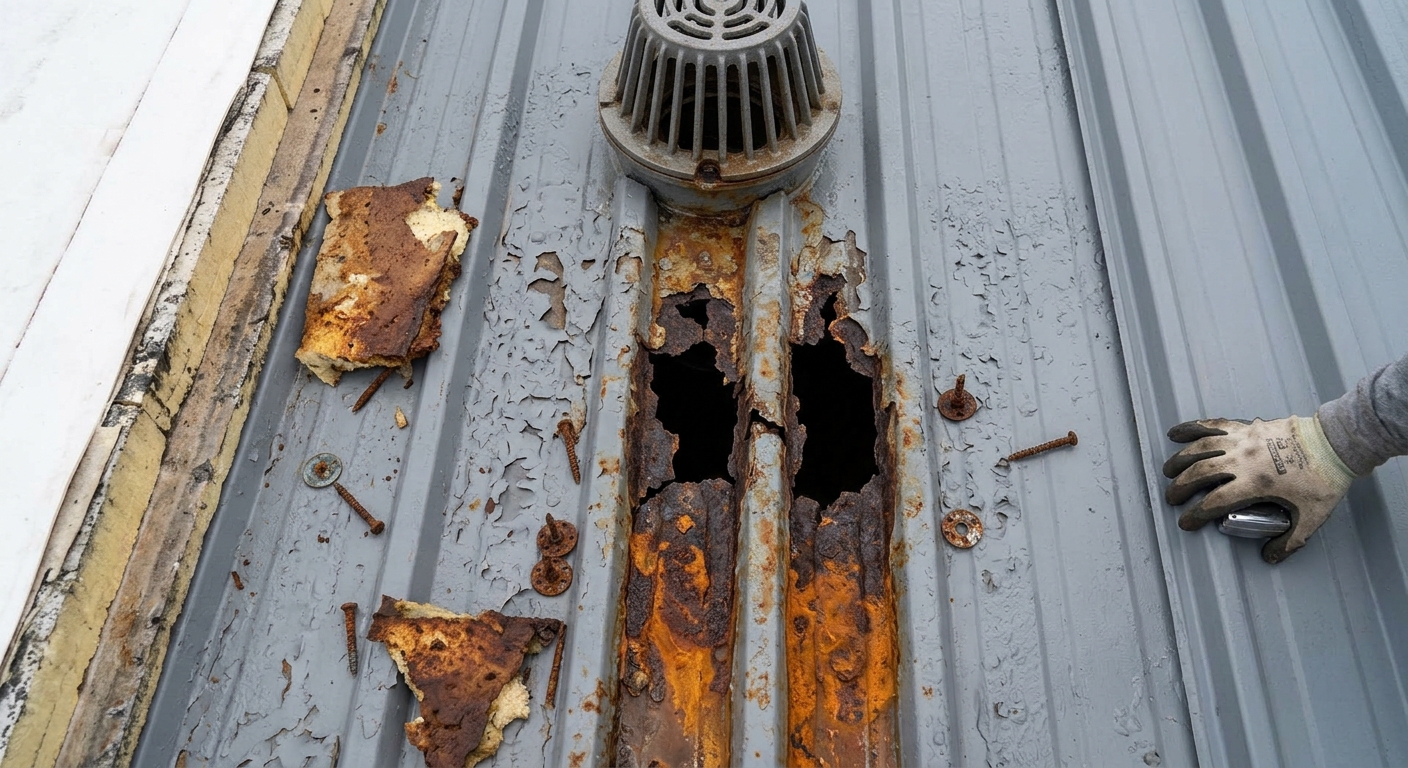
Under OSHA rule 29 CFR 1926.501(a)(2), the employer must determine that a walking/working surface has the strength and structural integrity to support employees before anyone works on it. A steel deck that has rusted through everything except its paint can look intact from above. The Florida Roofing and Sheet Metal Contractors Association’s Metal Deck 101 article (October 2024) names that condition, along with storm damage, as the two usual reasons a reroof stops until replacement deck arrives.
The code treats deck repair as part of the work. The Florida Building Code defines roof replacement as removing the existing covering, repairing any damaged substrate and installing a new covering, as reproduced in FRSA’s February 2026 review of 9th Edition changes. That 9th Edition takes effect December 31, 2026, so a roof bid this fall may be permitted under either edition depending on the permit application date. The deck question belongs in the scope, the bid form and the schedule from the first walk-through with a commercial re-roofing contractor.
How do steel, wood and concrete roof decks fail under a Florida roof?
Every deck type fails from water held against it: a long-running leak trapped in insulation, condensation from a humid or chemically active interior, or salt air reaching the deck near the coast.
Steel deck corrodes fastest where saturated insulation sits on it. The finish matters: FRSA’s deck article relays the Steel Deck Institute’s position that prime paint is impermanent and provisional and protects steel only briefly in ordinary exterior conditions. Galvanized deck carries a zinc coating that corrodes sacrificially to protect the steel; the Steel Deck Institute’s October 2025 guidance on galvanized decking describes G90 as the preferred coating for coastal, industrial and high-humidity exposures and G60 as a moderate-protection option for drier interiors. Corrosion also attacks the screws and plates that hold insulation to the deck. Exposed panels face the same chemistry, as covered in our guide to commercial metal roof corrosion in Florida.
Wood plank and wood structural panel decks rot where leaks keep them wet, and plywood delaminates. The NRCA tool lists delaminated plywood, cupped dimensional lumber, rotted deck components or framing, panel joints that are not supported at framing members, and missing grade and thickness stamps as the conditions to check.
Concrete decks fail more slowly and less visibly; the NRCA tool points to cracking, spalling and rust staining on the underside, and to depressions large enough to need a structural engineer’s evaluation. Lightweight insulating concrete, poured gypsum and cementitious wood fiber panels raise a question the roof consultant has to answer before the new system is attached: whether material that has been wet will still hold the specified fasteners.
| Deck type | How it fails | What the crew sees at tear-off | How condition is confirmed |
|---|---|---|---|
| Steel, prime painted | Rust under wet insulation; the prime coat is provisional (SDI via FRSA, Oct. 2024) | Rust scale, perforated flutes, rusted fasteners and plates | Visual check, gauge by micrometer, underside inspection where accessible (NRCA, Apr. 2025) |
| Steel, galvanized G60 or G90 | Zinc is consumed first, then the steel corrodes (SDI, Oct. 2025) | White rust, then red rust at laps and fasteners | Same as above, plus finish identification so replacement matches |
| Wood plank or wood structural panel | Rot and delamination where leaks persist | Soft spots, dark staining, separated plies | Probe, grade-stamp check, framing and joint support check (NRCA, Apr. 2025) |
| Structural concrete | Cracking, spalling, reinforcement corrosion | Rust stains, spalls, depressions | Underside survey; lab analysis where needed (NRCA, Apr. 2025) |
| Lightweight insulating concrete, gypsum, cementitious wood fiber | Saturation and loss of integrity | Crumbling or soft substrate, wet cores | Cores and consultant-specified testing before attachment |
Repair, overlay or replace: what are the options for a damaged roof deck?
A damaged deck has five common answers, each wrong under some condition. Penn State’s February 2025 bid tabulation shows how owners price the range, with separate per-square-foot unit prices for painting rusted deck at three severity levels, plating small openings with 22-gauge galvanized sheet, and replacing deck to match gauge, profile and finish.
| Option | Where it fits | Where it falls short |
|---|---|---|
| Clean and coat | Light surface rust; full steel section intact | Does not restore lost steel; corrosion under the coating resumes if moisture returns |
| Plate small openings | Isolated holes of roughly a square foot | A plate over a broad area of thin steel hides the problem without adding capacity |
| Nest new panels into existing flutes | Localized section loss on a profile that can be matched or nested | Obsolete profiles may not nest; panel ends and laps must land on supports |
| Full-sheet replacement, support to support | Larger corroded areas; several adjacent panels | Opens holes over occupied space; OSHA Subpart R fall protection applies; area counts toward the 30% diaphragm trigger |
| New deck over the existing deck | Widespread deterioration where removal would disrupt operations below | Changes load and attachment; the structural engineer must confirm framing and connections |
Partial replacement depends on matching the existing profile. FRSA’s deck article explains that roofers usually nest new panels into existing ones: F deck nests into B deck, A deck nests into both, and some older profiles have no current match, so deck type, gauge, finish and rib dimensions should be recorded before material is ordered. Roof deck typically runs from 22 to 16 gauge, with 22 the most common, and self-tapping screws are the usual replacement fastener because welding sparks and powder-driven pins add risk over an existing structure.
After Hurricane Irma, Advanced Roofing’s Big Easy Casino re-roof in Hallandale Beach included replacing steel decking, adding more than 30,000 screws to the existing steel deck per the Florida Building Code, and priming and painting the remaining deck to control rust. On the DePuy Synthes manufacturing facility in Palm Beach Gardens, Advanced Roofing removed two coal tar pitch roof systems from a 1960s cementitious wood fiber deck and secured a new 22-gauge steel deck over and through it to the bar joists above occupied cleanrooms, achieving FM Global approval.
What moves the cost and schedule of roof deck repair during a reroof?
Roof deck repair during a reroof is priced by the square foot, but quantity, profile availability and conditions under the deck move the total more, and none is known precisely until the old roof is off. Published unit prices vary with region, profile and access, so no dollar figures appear here.
| Driver | Why it moves cost or schedule | Source |
|---|---|---|
| Quantity found vs. quantity carried | Bids carry an allowance; overruns are paid at the unit price | Penn State bid tabulation, Feb. 2025 |
| Profile match | Obsolete profiles may not nest; nonstandard material can stall the roof | FRSA, Oct. 2024 |
| Gauge and finish | 22 to 16 gauge; galvanized G60 or G90 vs. prime paint | FRSA, Oct. 2024; SDI, Oct. 2025 |
| Fastening pattern | The pattern is part of the structural design; replacement must follow it | FRSA, Oct. 2024 |
| Area of structural deck removed | Over 30% of a diaphragm where wind speed exceeds 115 mph triggers an engineering evaluation | FBC Existing Building 8th Ed., Sec. 707.3.2 |
| Occupancy below | Off-hours work, interior protection, netting, clearances | NRCA, Apr. 2025 |
| Conduit under the deck | Saw cuts slow down near conduit close to the deck | Florida Building Commission fact sheet, 2020 |
Two contract terms keep the deck number honest. A per-square-foot unit price for each repair method, stated in the bid, converts a surprise into arithmetic, and a base-bid allowance with an add/deduct provision lets the owner pay for what is found instead of a worst-case guess. Advanced Roofing’s guide to commercial roofing cost in Florida recommends requiring deck unit prices in every bid for the same reason.
What changes when the building stays open below the deck?
On an occupied building, a deck opening is a hole over people, inventory or equipment, and the work plan has to treat it that way. OSHA’s November 8, 2002 interpretation letter on a reroof that uncovered deteriorated metal decking concluded that removing and replacing deck during repair falls under the steel erection standard, Subpart R, and that a controlled decking zone cannot substitute for conventional fall protection during removal of deteriorated deck. Crews cutting old panels need guardrails, nets or personal fall arrest.
Below the deck, the NRCA tool lists interior personnel netting, scheduling deck work when spaces are unoccupied, and removing or restricting occupants and equipment beneath the work. On WestRock’s Paper Mill Building 5, Advanced Roofing built a temporary sub-deck inside the plant from 20-foot aluminum beams, 3/4-inch plywood and plastic sheeting to protect production equipment and workers while precast concrete deck came out, then installed new 18-gauge stainless steel deck.
Weather sets the next limit. A Florida afternoon storm can arrive while deck is open, so the area removed in a day should match what the crew can replace, fasten and dry-in before leaving. Electrical conduit is another hazard: the Florida Building Commission’s 7th Edition roofing fact sheet notes that metal conduit under corrugated metal deck must sit at least 1.5 inches below the deck’s lowest surface, a rule written because conduit near the deck is easily damaged during reroofing. Our guides to occupied building roof replacement and commercial rooftop fall protection cover tenant notice and edge protection in more detail.
Which Florida Building Code provisions apply when roof deck comes out?
As of October 28, 2026, the 8th Edition (2023) Florida Building Code, Existing Building governs reroof permits, and the 9th Edition takes effect December 31, 2026. Three provisions matter most once deck replacement enters the scope.
- Roof diaphragm evaluation. Section 707.3.2 of the 8th Edition Existing Building code requires the roof diaphragm, its connections to framing and the roof-to-wall connections to be evaluated for current wind loads when structural deck is removed from more than 30 percent of the diaphragm of a building or building section where the ultimate design wind speed exceeds 115 mph. Where they cannot resist at least 75 percent of those loads, they must be replaced or strengthened. Buildings permitted under the Florida Building Code are exempt, and the High-Velocity Hurricane Zone follows Section 1620 of the Building volume.
- Wood deck mitigation. The Florida Building Commission’s fact sheet explains that, beginning with the 7th Edition, the Section 706.7 mitigation provisions for deck attachment and a secondary water barrier apply to all buildings with sawn lumber, wood plank or wood structural panel decks permitted before the Florida Building Code, including apartment and office buildings.
- High-Velocity Hurricane Zone. In Miami-Dade and Broward counties, reroofing follows Sections 1512 through 1525 of the Building volume; owners there can start with our Fort Lauderdale commercial roofing office.
Whether a specific building is past the 30 percent threshold, which edition its permit falls under and whether its diaphragm passes are determinations for the engineer of record and the building official. Re-check the adopted 9th Edition text at the Florida Building Commission before relying on any section number for a 2027 permit.
Commercial roof deck replacement checklist: who owns each step before and during tear-off?
- Facility or property manager: pull as-built drawings and leak history and open ceilings for underside access; an infrared roof inspection and cores show where wet insulation sits on the deck.
- Roof consultant: record deck type, profile, gauge and finish, and specify a repair method per condition.
- Owner or asset manager: require a unit price for each deck repair method and a base-bid allowance with add/deduct terms.
- Structural engineer of record: confirm whether planned removal approaches 30 percent of a diaphragm and which fastening pattern the replacement deck must follow.
- Roofing contractor: stock matching deck before tear-off, inspect exposed deck daily, photograph each area before removal and submit quantities for approval.
- Safety lead: write the fall protection plan for deck openings and coordinate netting or clearances.
- Operations or tenant manager: schedule clearances below deck work and notify occupants.
Frequently Asked Questions
What happens if the roof deck is rotted or rusted during a reroof?
Work on that area stops until the deck is assessed and repaired. The crew marks and protects the opening, the contractor documents the condition with photographs and measurements, and the owner or consultant approves a repair method and quantity, usually priced at a unit rate set in the contract. The new roof system goes on only after the deck is repaired, fastened and able to hold the specified attachment.
Who pays for commercial roof deck replacement found during a reroof?
The contract decides. Many commercial bids carry a deck allowance in the base price with a per-square-foot unit price for quantities above or below it, so the owner pays for the deck actually replaced. Without those terms, hidden deck damage usually becomes a change order negotiated mid-project. Owners should have their attorney or roof consultant review the concealed-conditions language before signing.
Can a new roof be installed over a rusted steel roof deck?
Light surface rust on a deck with its full steel section is commonly cleaned and coated before the new roof goes on. Deck with perforations, section loss, or rusted-out laps and fasteners has to be plated, partially replaced or fully replaced first, because the deck anchors the roof system against wind uplift. The structural engineer or roof consultant sets the line between those conditions.
How do you tell if a steel roof deck needs repair or full replacement?
Measure and map it. NRCA’s assessment tool calls for checking visible rust, identifying the deck type, measuring gauge with a micrometer, noting panels that fail to span at least three supports, and locating laps and ends that do not land on supports. Isolated holes point to plates or nested panels; widespread section loss, failed laps or deflection point to replacement and an engineer’s review.
Does replacing part of a roof deck trigger Florida Building Code upgrades?
It can. Under Section 707.3.2 of the 8th Edition Florida Building Code, Existing Building, removing structural deck from more than 30 percent of a roof diaphragm where the ultimate design wind speed exceeds 115 mph requires evaluating the diaphragm and its connections, with strengthening where they resist less than 75 percent of current wind loads. The building official confirms how it applies to a specific building.
How much time does roof deck replacement add to a commercial reroof?
It depends on how much deck is found and whether matching material is already on site. FRSA notes that a reroof stops until replacement deck arrives, so contractors who identify the profile, gauge and finish before tear-off and stock matching panels can replace small areas the same day. Large replacements add engineering review, fall protection setup and work windows coordinated with operations below.
Price the deck before the roof comes off
Commercial roof deck replacement is a known risk on any aging low-slope Florida roof, and it turns expensive mainly when the contract and the safety plan treat it as a surprise. Identify the deck from below and from cores, specify a repair method for each condition, carry unit prices and an allowance, and stock matching deck before tear-off. Track removed area against the 30 percent threshold, protect the space below every opening, and hand the structural and code determinations to the engineer of record and the building official who own them.
Written by The Technical Team at Advanced Roofing. Founded in 1983, Advanced Roofing is 100% employee-owned and was ranked #13 nationally on Roofing Contractor magazine’s Top 100 list, announced in August 2026 (read the ranking announcement).
Planning a reroof on a building with a suspect deck? Call (800) 638-6869 or request a free commercial roofing quote and ask for a deck assessment as part of the bid.