At a glance: An infrared roof inspection maps where wet insulation holds heat after sunset, and core samples confirm it. This guide explains how commercial roof moisture surveys work in Florida’s climate, why the dry season and the 9th Edition Florida Building Code (effective December 31, 2026) make the results more consequential, how infrared compares with impedance, nuclear, and coring methods, what changes on an occupied building, and a role-by-role checklist for judging a survey report before it decides repair, recover, or replacement.
An infrared roof inspection is a heat map that tells the inspector where to cut cores; the cores deliver the verdict. Run to ASTM C1153 on a dry roof during a usable scanning window and then verified, an infrared roof inspection Florida owners commission shows how much of the insulation is wet, where it sits, and whether the roof can be repaired, recovered, or has to come off. The stake is a second roof: a recover installed over wet insulation seals the water under the new membrane, and a tear-off ordered without a survey can send dry, paid-for insulation to the landfill. This article does not argue that infrared replaces cores or that every roof is a good candidate for it, and it names the assemblies that image poorly.
Why does wet insulation decide a Florida reroof under the building code?
Wet insulation decides a Florida reroof because the code prohibits recovering over a water-soaked roof. Section 706.3 of the Florida Building Code, Existing Building, lists the conditions under which a new roof covering cannot go over an existing one and every layer must come off down to the deck. The first condition is an existing roof that is water soaked or deteriorated to the point that it is no longer an adequate base for new roofing. In the 9th Edition (2026), which takes effect December 31, 2026, that condition is reworded to cover water-soaked roof system components as well as the roof covering, according to the approved modification published by FRSA’s technical director.
The Florida Building Commission’s Analysis of Changes for the 9th Edition Existing Building volume describes Condition 1 as revised for clarity and notes a revised Exception 3, which allows the upper roof system alone to be removed when the substrate left in place is adequate for the new roof. Both changes turn on the same field question: which parts of the existing assembly are wet. Insulation is a roof system component, so wet insulation closes the recover path and dry insulation under a removed upper roof can keep part of the old assembly in service.
As of October 2026, the adopted 9th Edition text should be confirmed on floridabuilding.org before any permit decision, and permit application date generally determines which edition governs a project. The calendar adds a second reason to survey now. The National Weather Service in Miami defines the South Florida wet season as May 15 through October 15, the months that deliver 60 to 70 percent of the region’s yearly rain. The drier months that follow are the easier season for thermal scanning.
How does a commercial roof moisture survey find wet insulation?
A commercial roof moisture survey finds wet insulation by reading differences in stored heat. Water holds far more heat than dry polyiso, perlite, or fiberglass board, so a wet area of the roof absorbs more of the day’s solar load and releases it more slowly. After sunset, dry areas cool quickly while wet areas stay warm, and a thermal camera records that pattern on the membrane surface. ASTM C1153, the standard practice for locating wet insulation in roofing systems with infrared imaging, covers nighttime imaging of roofs with insulation above the deck in contact with the waterproofing, both ground-based and aerial. It also sets weather conditions and requires verification with invasive testing.
The Florida constraint is the length of that scanning window. A technical paper by two Level III certified thermographers based in Stuart, Florida, published by the Infraspection Institute, reports that Florida summer highs and lows can differ by less than 10 degrees F, with air cooling starting several hours after sunset, while winter swings reach about 30 degrees F and cooling begins before sunset. The same paper describes a survey of a roof over 200,000 square feet in early July in South Florida where overcast skies opened the window at 3:30 p.m. and closed it by 5:30 p.m., forcing extra days on site.
Pattern reading is where a survey earns its fee. Wet board insulation tends to show at least one straight edge that follows the board joints, because water spreads through a board and stops at its edge. The table below, summarized from the same paper, lists common patterns.
| Thermal pattern | Likely cause | How it is confirmed |
|---|---|---|
| Warm rectangle or partial board shape with straight edges | Wet board insulation (polyiso, perlite, fiberglass) | Core inside the anomaly and at its edge; compare with a dry reference core |
| Warm lines parallel to membrane laps | Water trapped between plies of a built-up or modified bitumen roof | Inspect laps and blisters; cut a test core through the plies |
| Round, irregular blooms that merge | Water in lightweight insulating concrete (LWIC) or spray foam | Laboratory gravimetric test (samples weighed, oven-dried, reweighed) |
| Warm shape matching a patch or thick asphalt | Extra material mass from repairs or flood coat | Walk the area for raised material; core only if the shape breaks pattern |
| Long, faint lines in a grid | Joists, girders, or interior walls conducting heat | Check deck underside or drawings for structure under the lines |
| Cold field with warm halos near walls and equipment | Sky and object reflection on a low-emissivity surface | Rescan from a steeper angle or with a short/midwave camera |
Infrared, impedance, nuclear, or cores: which moisture survey fits your roof?
No single method answers every roof. Electrical impedance scanning, standardized in ASTM D7954, rolls a meter across the membrane to compare relative moisture in insulated low-slope roofing; the standard states that the practice alone does not determine the cause of the moisture. Nuclear gauges take point readings on a grid. The National Bureau of Standards’ state-of-the-art review of nondestructive roof moisture detection (Technical Note 1146, 1981) found that every method can respond to factors other than moisture, such as construction non-uniformities and building equipment, and concluded that cores at selected points are needed to confirm what the instruments show.
| Method | What it measures | Best fit | Where it falls short |
|---|---|---|---|
| Walk-on infrared (ASTM C1153) | Surface temperature pattern after sunset | Insulated low-slope roofs with dry, unballasted surfaces | Needs a dry roof and a usable night; weak on reflective membranes, ballast, new LWIC |
| Drone or aerial infrared | Same pattern, from above | Large roofs, campuses, first-pass screening | Less ground detail; findings still need on-roof marking and cores; FAA rules apply |
| Electrical impedance (ASTM D7954) | Relative moisture under the scanner | Nonconductive single-ply and built-up roofs when IR windows are short | Pass-by-pass coverage is slower; conductive surfaces and ballast limit use |
| Nuclear gauge | Hydrogen content at grid points | Thick or multi-layer assemblies | Point readings only; extra bitumen and other hydrogen-rich material can read as water |
| Cores and gravimetric tests | Measured moisture in samples | Verification of every method above | Destructive; each core needs a same-day patch; a sample speaks only for its spot |
A survey also has limits no instrument removes. It shows where water is, and ASTM C1153 states that the practice does not determine the cause of moisture or its point of entry, so leak tracing remains a separate job for the repair crew. Infrared cannot read the membrane under rooftop solar modules, equipment, or stacked walkway pads. Where an array covers part of the roof, the survey plan should name that area as unsurveyed, and roof and solar drone surveys from Advanced Green Technologies, the family’s solar contractor, can document the array side of the same roof.
What drives the cost, schedule, and reliability of an infrared roof survey?
The cost and reliability of an infrared roof survey are driven by roof area, surface type, weather, access, and the amount of verification included. Advanced Roofing does not publish survey pricing, and per-square-foot figures quoted online rarely state the roof size, report level, or number of cores behind them.
- Roof area and number of separate roof sections, which set how many nights of scanning are needed.
- Surface type: smooth white single-ply and other low-emissivity surfaces take more time and equipment than granulated cap sheets or aged membranes.
- Weather: the scan needs a dry surface and a usable window, so rain the day before moves the date.
- Night access and security: hatches, lifts, escorts, lighting, and tenant notice.
- Verification scope: the number of cores, same-night patching, and laboratory testing for LWIC samples.
- Deliverable: anomalies marked on the roof, a scaled plan or orthomosaic overlay, wet area by roof section, photos, and a core log.
Reliability follows the same list. A survey run in a short wet-season window on a reflective membrane, with no cores, is a thin basis for a six- or seven-figure reroof decision, however clean the images look.
What changes when the survey happens on an occupied Florida building?
On an occupied building the survey runs at night, and the plan has to cover both the roof and the people below it. Rooftop units, exhaust fans, kitchen hoods, and lit signage radiate heat that can read as false warm areas, so the property manager should list the equipment that runs overnight and the thermographer should note it on the roof plan. ASTM C1153 warns about nighttime roof access and calls it good safety practice to keep at least two people on the roof during ground-based inspections.
Drone thermal surveys move part of the work off the roof. Under the FAA’s Part 107 rules for certificated remote pilots, drones may fly at night, but airspace authorization is still required for night operations in controlled airspace below 400 feet. Advanced Roofing’s commercial roof drone surveys with thermal imaging produce GPS-tagged imagery and orthomosaic maps. A drone pass is a screening tool, and the anomalies it finds still need on-roof confirmation and cores.
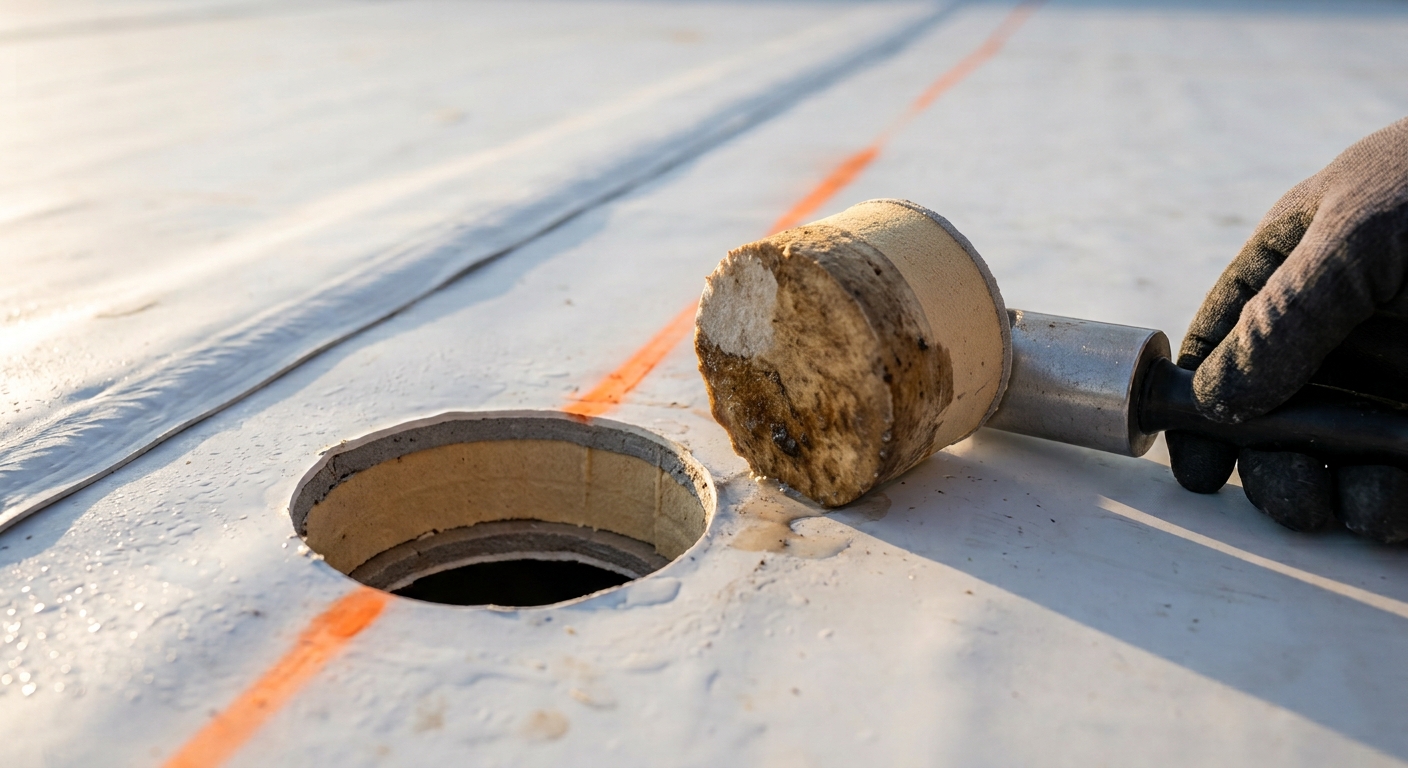
Cores open the roof, so each one must be patched the same night with materials compatible with the existing system. Check the warranty for notice requirements before coring. In Miami-Dade and Broward, the High-Velocity Hurricane Zone sections of the Florida Building Code govern roofing work, and the roofing contractor and building official decide what a core repair requires there.
How do the code change and the dry season affect when to schedule?
Three dates frame the survey decision for most Florida owners in late 2026. The South Florida wet season ends October 15, which opens the months with cooler nights and larger day-to-night swings for thermal work. The 9th Edition of the Florida Building Code takes effect December 31, 2026; whether a reroof should be permitted before or after that date is a question for the roof consultant and the building official, and survey results feed that answer. The third date is the age of the last survey.
A report produced before the 2026 hurricane season says nothing about water that has entered through storm damage since. Owners with a pre-season visual baseline, such as a 360 Roof Walk record, can compare surface conditions, but only a new moisture survey shows what now sits under the membrane.
What to require from an infrared roof inspection Florida report before you act on it
- Property manager: provide drawings, roof section areas, leak history, overnight equipment, and the after-hours security contact before the survey date.
- Roof consultant or contractor: state the method (walk-on, drone, or both), the standard followed (ASTM C1153 for infrared, ASTM D7954 for impedance), and the camera type.
- Thermographer: mark every anomaly on the roof surface and on a scaled plan, with square footage by roof section.
- Roofing contractor: cut cores inside anomalies and in dry reference areas, log each layer, and patch every core the same night.
- Roofing contractor: send LWIC samples for laboratory moisture testing instead of judging them by hand.
- Roof consultant: state wet area as a share of each roof section and show what a repair, recover, or replacement scope would remove.
- Asset manager or board: confirm with the building official which code edition applies to the planned permit date, and confirm warranty notice terms with the manufacturer.
- Owner: file the report and core log with the roof records, through a program such as Advanced Roofing’s roof management portal, so the next survey starts from a baseline.
Results then point to a scope. Small, isolated wet areas usually point to targeted commercial roof repair with wet material cut out and replaced. A dry, well-adhered single roof may qualify for a roof coating or restoration path, which our guide to commercial roof restoration vs replacement walks through. Widespread wet insulation points to commercial re-roofing, and the repair vs replacement decision for Florida commercial roofs covers the remaining tests.
Frequently Asked Questions
What is an infrared roof inspection?
An infrared roof inspection is a nighttime thermal survey of a low-slope roof that maps areas where wet insulation holds the day’s heat longer than dry insulation. A thermographer records the warm patterns, marks them on the roof and on a plan, and the findings are confirmed with core samples. ASTM C1153 is the standard practice that sets the equipment, weather, and verification requirements for this kind of survey.
When is the best time for an infrared roof inspection in Florida?
The best time is a clear, dry, low-wind evening after a sunny day, usually during the dry season that follows the wet season’s October 15 end in South Florida. Summer surveys are possible, but Florida’s small summer day-to-night temperature swing and afternoon storms shorten the scanning window. Avoid scanning within a day of rain, because surface water masks the pattern below it.
Can an infrared roof survey be done by drone?
Yes. Drones carrying thermal cameras can screen large roofs and campuses quickly and produce GPS-tagged maps. Under FAA Part 107, certificated remote pilots may fly at night, with airspace authorization required in controlled airspace. A drone survey is a first pass; anomalies still need on-roof marking and verification cores before they support a repair or reroof scope.
Does an infrared survey find roof leaks?
An infrared survey finds where water has collected in the roof assembly, which is often near the leak but not always at it. ASTM C1153 states that the practice does not determine the cause of moisture or its point of entry. Water on a metal deck can travel downslope before showing inside, so leak tracing remains a separate task for the repair crew.
Can I recover my roof if the moisture survey finds wet insulation?
Generally no for the wet areas. Section 706.3 of the Florida Building Code, Existing Building, prohibits recovering where the existing roof is water soaked, and the 9th Edition wording effective December 31, 2026 names roof system components as well. Small wet areas can sometimes be removed and replaced first; your roof consultant and building official make that determination for your building.
Which roofs are poor candidates for infrared moisture surveys?
Roofs with heavy stone ballast, uninsulated roofs, metal panel roofs, and newly poured lightweight insulating concrete image poorly, and highly reflective white or aluminum-coated surfaces need extra care. These roofs are better served by impedance scanning, nuclear readings, or a coring grid. A good survey proposal names the method that fits the assembly before scheduling.
What an infrared roof survey should settle before a reroof contract
An infrared roof survey earns its place in a Florida reroof decision when it is run in a usable window, read by someone who knows the assembly, and verified with cores. Done that way, it settles the question the Florida Building Code asks first: whether the existing roof is a sound, dry base. That answer decides between repair, recover, and removal. The survey is most useful now, before a scope goes to bid. Owners who use the Florida commercial roof maintenance schedule can add a moisture survey to the inspection cycle in the years before a planned replacement.
Written by The Technical Team at Advanced Roofing. Founded in 1983, Advanced Roofing is 100% employee-owned and was ranked the #13 largest roofing contractor in the U.S. on Roofing Contractor magazine’s 2026 Top 100 list.
To schedule a moisture survey or roof assessment on an occupied Florida building, request a free quote or call (800) 638-6869.