
At a glance: An occupied building roof replacement keeps tenants, patients, students or residents inside while the roof is removed and rebuilt in sections. This guide traces the six physical paths by which roof construction disruption reaches occupants (odor, noise, water, falling debris, crane picks and hot work), compares phased daytime, off-hours and partial-closure scheduling with their limits, lists what drives cost and schedule, covers the OSHA, fire-code and Florida Building Code items that apply, and ends with a checklist each decision-maker can own.
An occupied building roof replacement succeeds or fails on the part of the plan most bids never price, which is how odor, noise, debris, crane picks and open roof sections are kept away from the people working below. The roof system is usually the easier decision for a Florida property or facility manager, because the harder one is keeping the building open, safe and dry for the weeks a roof is torn off in sections. Getting that plan wrong shows up as fumes pulled into rooftop air intakes, a lobby ceiling soaked by a storm over an unfinished section, or a crane pick over an entrance nobody closed. This article explains where those disruptions come from and how to schedule around them, and it leaves roof system, price and code determinations to the engineer of record, the building official and the fire marshal.
Why does occupied building roof replacement need its own plan in late 2026?
An occupied building roof replacement is a reroof carried out while tenants, employees, patients, students or residents keep using the building below. The roof is removed and rebuilt in sections, each section is closed the same day, and crane picks, odor-producing work, noise and staging are scheduled around the occupants’ routes, air supply and hours.
Advanced Roofing’s commercial re-roofing service for occupied buildings describes the company’s focus as re-roofing occupied commercial buildings with little to no interruption to operations, working around business hours and offering night and weekend installation when necessary. Timing adds pressure this year. The National Weather Service Miami office defines the South Florida wet season as May 15 through October 15 and attributes 60 to 70 percent of average yearly rainfall to it, so mid-October opens the drier months, when fewer opened sections meet a storm.
The code calendar moves in the same quarter. Miami-Dade County’s notice on the Florida Building Code 9th Edition states that the new edition takes effect December 31, 2026, that permit applications submitted on or after that date must comply with it, and that applications sent through the county’s online portal after 4 p.m. on December 30, 2026 also fall under it. Advanced Roofing’s guide to commercial roof replacement timing in South Florida covers code and service life in depth. This article covers the people inside.
What actually disrupts tenants during a commercial reroof?
Roof construction disruption reaches occupants through six physical paths, and each path has a different control. A noise complaint and an odor complaint need different fixes.
| Disruption | How it reaches occupants | Typical control |
|---|---|---|
| Odor and fumes | Adhesive solvent vapor and heated-asphalt fume drawn into rooftop outside-air intakes and distributed by the air handler | Sequence work away from intakes; shut down or filter affected units with the mechanical contractor; lower-odor products where the specification allows |
| Noise and vibration | Tear-off, cutting and fastening carried through the roof deck into the space below | Loud work outside sensitive hours; daily notice for the zones affected |
| Water intrusion | Rain entering an opened section travels sideways through insulation and appears inside away from the opening | Open only what can be closed the same day; temporary protection staged before storm cells |
| Falling debris | Material displaced at the roof edge or dropped during hoisting | Canopies over doorways, barricaded drop zones, no storage within 6 ft of an unguarded edge (OSHA 1926.502) |
| Crane and hoisting | Loads lifted over parking, entrances and walkways | Picks outside occupied hours; routes and fall zones closed; ground monitors (OSHA 1926.1425) |
| Hot work | Torches, kettles and heat welders near combustible materials | Hot-work permits, fire watch after torches are out, fire alarm coordination with the facility |
Odor is the complaint that most often surprises owners, because it arrives through the building’s own ventilation. A packaged rooftop unit draws outside air through an intake hood a few feet above the membrane, so vapor from adhesives or fume from heated asphalt released nearby is pulled straight into the supply air. The NIOSH guide on reducing roofers’ exposure to asphalt fumes (Publication No. 2003-107) lists headache, eye, nose and throat irritation, nausea, fatigue and drowsiness as effects reported by exposed roofers. That guidance concerns workers, yet fumes entering an air handler are noticed indoors quickly, and in a clinic or school an odor complaint can stop work for the day.
Noise and water follow the structure. Impact and fastening noise travels through a steel deck into the space below far more readily than through a concrete deck, so a steel-deck building needs tighter quiet-hour windows. Water is the most expensive path. Rain that enters an opened section moves sideways through the insulation, so the stain inside can appear well away from the opening.
Phased daytime work, off-hours work or a partial closure: which approach fits the building?
There are three ways to schedule an occupied reroof, and most projects combine them by roof area. The choice depends on what the occupants do and how sensitive their space is to noise and odor.
| Approach | Where it fits | What it protects | Where it falls short |
|---|---|---|---|
| Phased daytime work with same-day dry-in | Offices, retail, warehouses, schools outside class hours | Productive daylight hours and inspection access | Noise and odor occur while occupants are present; needs daily notices by zone |
| Off-hours, night or weekend work | Retail and medical offices with fixed hours; loud tear-off over sensitive tenants | Daytime operations below | Slower production and premium labor; lighting, fall protection and supervision must work in the dark; condo residents are home at night |
| Temporary relocation or closure of spaces below | Operating rooms, laboratories, data rooms, areas under hot work or crane picks | The most sensitive operations | The owner loses use of the space; dates must be fixed early with the facility team |
Phased daytime work is the default on most commercial roofs because it gives the crew the most dry, daylight hours to open and close sections. Off-hours work earns its premium on the loudest days over the most sensitive tenants and rarely across a whole project. Partial closure fits the few spaces where odor or vibration cannot be tolerated at all. An owner who tells bidders which approach applies to which roof area gets proposals that price the same schedule.
The contractor should fit the building as well. A statewide contractor built for occupied buildings may not be the lowest bid on a small single-story roof whose tenant can simply close for a weekend.
What drives the schedule and cost of keeping a building open during a reroof?
Keeping occupants in place changes the cost of a reroof through productive hours and protection, and the roof system itself stays the same. Advanced Roofing does not publish pricing. The drivers below are the line items to require in every proposal, so bids can be compared on the same occupancy plan.
| Driver | Effect on schedule | Effect on cost | Who sets it |
|---|---|---|---|
| Allowed work hours | Fewer productive hours per day lengthen the project | Premium time for night or weekend shifts | Owner and property manager |
| Daily open-area limit | Production capped by what can be closed the same day | More set-ups per roof section | Contractor, adjusted for weather |
| Rooftop unit coordination | Shutdowns and intake protection scheduled per zone | Mechanical labor; possible temporary cooling | Mechanical contractor and facility manager |
| Overhead protection and barricades | Installed before tear-off near doors and walkways | Canopy, barricade and monitor labor | Contractor safety plan (OSHA 1926.501(c)) |
| Crane access windows | Picks limited to closed hours | Crane time and traffic control | Property manager and contractor; local right-of-way rules |
| Fire watch and hot-work permits | Torch work ends early enough for the watch to finish | Labor for the watch period | Fire code official and contractor |
Ask for a schedule that lists, by roof area, the allowed hours, the daily open-area limit and the shutdown window for each rooftop unit. A bid that looks faster than its competitors often assumes full daytime access, no intake protection and no weather days.
What changes on an occupied Florida building during the reroof?
Federal rules set the minimum protection at the roof edge. OSHA 29 CFR 1926.501(c) requires, where workers are exposed to falling objects, toeboards, screens or guardrails, a canopy structure, or a barricaded area, with objects kept far enough from the edge that they would not go over if displaced. OSHA 29 CFR 1926.502 bars storing roofing materials within 6 feet of a roof edge unless guardrails are erected. Those rules protect workers, and on an occupied building the same canopy and barricade layout is what keeps tenants and visitors out of the drop zone at doors and walkways.
Crane picks over an occupied site follow OSHA 29 CFR 1926.1425, which requires hoisting routes that minimize workers’ exposure to hoisted loads, to the extent consistent with public safety. In practice that means picks outside occupied hours and entrances under the swing closed. On Advanced Roofing’s Rapallo North Condominium reroof, an occupied high-rise in West Palm Beach, the company reports that safety monitors were on the ground whenever the crane was in use and that overhead protection was built for people leaving the building for the parking lot. An in-house commercial roofing crane division removes one outside vendor from that sequence.
Hot work needs a fire plan that the building’s own staff understand. NRCA’s technical column on fire code requirements for roofing work reports that NFPA 241 requires a fire watch of at least two hours after torches are extinguished on torch-applied systems, longer than the one-hour watch in NFPA 1. Florida’s statewide fire code is built on NFPA 1 and NFPA 101, as the State Fire Marshal’s Florida Fire Prevention Code page shows. In practice, torch work stops early enough for the watch to finish before the crew leaves. Whether a torch-applied system is permitted on a specific roof is the local fire official’s decision.
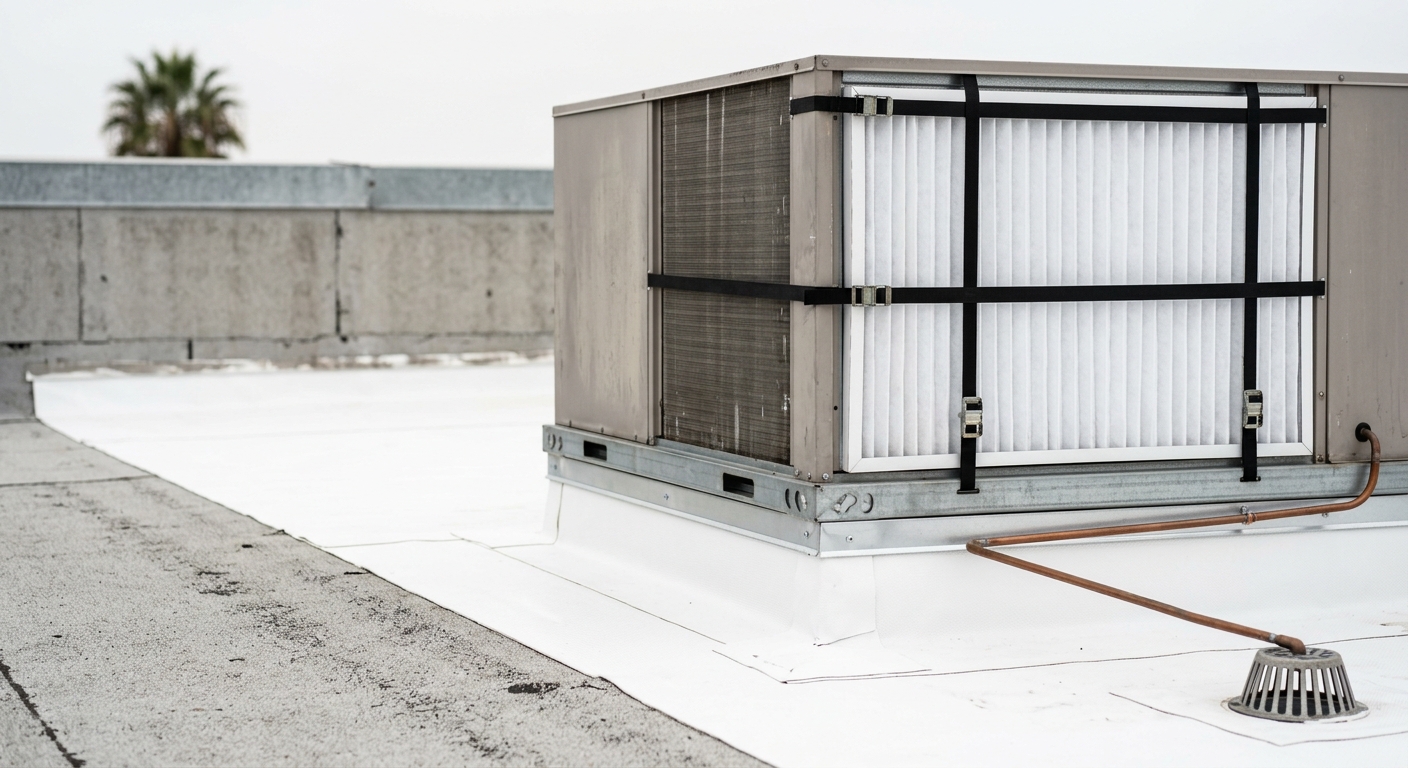
Rooftop equipment is where the roofing and mechanical schedules meet. Units may need to be shut down while adhesive work passes their intakes, curbs raised to meet the new insulation height, or units lifted and reset. Advanced Roofing’s commercial air conditioning division and the sister company’s rooftop unit change-outs at Advanced Air Systems can carry that sequence without a handoff between separate firms, which matters most in hospitals and schools where cooling cannot simply be switched off on a Florida afternoon.
Location adds a code layer on top of the occupant plan. Buildings in Miami-Dade and Broward sit in the High-Velocity Hurricane Zone, where roofing follows Florida Building Code Sections 1512 through 1525 and the approved assembly is a determination for the engineer of record and the building official. Broward projects run through the Fort Lauderdale commercial roofing office.
Which code and fire-code dates affect a reroof planned now?
As of October 14, 2026, three dated items bear on an occupied reroof planned for the coming dry season. Each should be re-checked on the day the permit application is filed.
- Florida Building Code, 9th Edition. Miami-Dade’s notice gives December 31, 2026 as the effective date, and applications filed on or after that date, or through the county portal after 4 p.m. on December 30, 2026, must meet it. Broward and Palm Beach cutoffs should be confirmed with the local building official.
- Florida Fire Prevention Code. The 8th Edition (2023), built on the 2021 editions of NFPA 1 and NFPA 101, is the edition the State Fire Marshal publishes at this writing, and the Division of State Fire Marshal has sought proposals for a 9th Edition based on the 2024 editions. Confirm with the fire official which edition will be enforced on the start date.
- Hurricane season. The Atlantic season runs through November 30, so a reroof starting in late October still needs a written plan for securing open sections if a named storm approaches. Advanced Roofing’s commercial roof hurricane season guide sets out that plan.
Occupied building roof replacement checklist: who owns each step?
Assign each item to a named person before bids go out, so every disruption path has an owner.
- Property or facility manager: map every occupied space under the roof with its hours and its sensitivity to noise, odor and vibration, and share it with bidders.
- Facility manager and mechanical contractor: list every rooftop unit and outside-air intake, and agree a shutdown or intake-protection plan for each zone.
- Roof consultant or engineer of record: confirm the scope with cores and a moisture survey; a commercial drone roof survey gives an overhead record of curbs, drains and intakes.
- Owner or asset manager: decide which roof areas are daytime, off-hours or partial-closure work, and whether the permit will be filed before or after December 31, 2026.
- Procurement: require each bid to state allowed hours, daily open-area limits, weather-day assumptions, crane windows and fire-watch staffing, and compare bids using the steps in how to select a commercial roofing contractor.
- Property manager: issue tenant notices for each zone and each crane day, name one contact for complaints, and confirm closed entrances and walkways the day before they close.
- Contractor safety lead: document overhead protection, barricades, warning lines and hot-work permits in a site-specific plan the property manager signs.
Frequently Asked Questions
Can a business stay open during a commercial roof replacement?
Most can. The roof is replaced in sections that are closed the same day, loud and odor-producing work is scheduled around occupied hours and rooftop air intakes, and crane picks move to early mornings or weekends where the site allows. Operating rooms, laboratories and data rooms may need a short relocation planned with the facility team.
How do you control roofing odors in an occupied building?
Odor reaches tenants mainly through rooftop units that draw outside air near the work. The controls are sequencing adhesive and hot work away from intakes, shutting down or filtering affected units for the period of the work with the mechanical contractor, and using lower-odor products where the specification and manufacturer approvals allow. The roofing and mechanical schedules should be written together before mobilization.
Can a commercial roof be replaced at night or on weekends?
Yes, for selected areas. Off-hours work suits loud tear-off over sensitive tenants or retail with fixed hours, but production is slower, labor costs more, and lighting, fall protection and supervision have to work in the dark. Advanced Roofing’s re-roofing service page states that the company offers night and weekend installations when necessary. Most projects reserve off-hours work for specific days and roof areas.
What protects people walking below during a roof replacement?
OSHA 29 CFR 1926.501(c) requires falling-object protection such as toeboards, screens or guardrails, a canopy structure, or a barricaded area, and OSHA 1926.502 bars storing roofing materials within 6 feet of a roof edge without guardrails. On occupied sites, the same canopies over doorways, closed walkways and ground monitors during crane picks keep tenants and visitors out of the drop zone.
How long does a fire watch last after torch-applied roofing?
NRCA reports that NFPA 241 requires a fire watch of at least two hours after torches are extinguished, while NFPA 1 sets a watch of at least one hour after hot work. Florida’s fire code is built on NFPA 1, and the local fire official decides permits and requirements for a specific building, so confirm the requirement before scheduling torch work over an occupied space.
Do tenants need written notice before a commercial reroof starts?
Leases and association rules set notice obligations, so the owner’s attorney or property manager should confirm what is required. As a practice, tenants should receive the start date, the zones affected each week, crane days, closed entrances and a single contact for complaints before mobilization, with updates whenever weather moves the schedule.
Plan the disruption before pricing the roof
Tenants judge an occupied building roof replacement by what reaches them: odor through the air handlers, noise through the deck, water through an unfinished section and a crane over the front door. Each of those arrives by a physical path that can be planned for before the first section is opened, and each plan has an owner. Owners who map the occupied spaces, schedule rooftop units with the roof, fix the crane and fire-watch windows, and require every bidder to price the same occupancy plan get a reroof the building can live through and a schedule they can defend to tenants, boards and asset managers. With the dry season open and a new code edition arriving December 31, 2026, this quarter is when that plan gets written.
Written by The Technical Team at Advanced Roofing. Founded in 1983, Advanced Roofing is 100% employee-owned and was ranked the #13 largest roofing contractor in the U.S. on Roofing Contractor magazine’s 2026 Top 100 list, announced in August 2026.
To plan a reroof around the people in your building, request a free commercial roofing quote or call (800) 638-6869.