At a glance: Salt air corrodes a coastal metal roof from the edges, fasteners and laps inward, and the stage it has reached decides whether restoration is still an option. This guide explains how chlorides, humidity and dissimilar metals drive corrosion, how to stage it from chalking to perforation, what published panel warranties exclude near salt water, which Florida Building Code fastener rules apply, and what changes on an occupied building. It closes with a role-by-role checklist and the December 31, 2026 code date.
Commercial metal roof corrosion Florida owners find near the coast is a question of how much metal is left, and the answer decides whether the roof can be restored. A coastal metal roof with chalking, white rust and early red rust at fasteners and laps can usually be cleaned, treated, refastened and coated; a roof with section loss, perforated panels or failed fasteners across its field needs panels or the whole roof replaced. Coating the second roof spends the restoration budget on a system that still has to come off, sometimes after a storm has tested its weakened attachment. This article gives owners the corrosion stages, the coastal warranty and fastener facts, and the checks that separate a restoration candidate from a replacement. It does not set a distance from the ocean at which any roof must be replaced, and it does not decide the code path, wind rating or warranty status of a specific building.
Why does distance from salt water decide so much on a coastal metal roof?
Distance from salt water sets how fast a metal roof corrodes, because airborne chloride salt is deposited most heavily near breaking surf and thins out inland. FEMA’s NFIP Technical Bulletin 8 (June 2019) states that corrosion rates for metal are dramatically higher in coastal environments, that salt spray from breaking waves and onshore winds significantly accelerates corrosion of fasteners and connectors, and that higher temperature and humidity raise corrosion rates further. The bulletin also notes that measured corrosion data are not available for most coastal communities, so professionals judge a site by the condition of older buildings at various distances from the shoreline.
The international classification for this exposure is ISO 9223:2012, which sorts atmospheres into corrosivity categories from C1, very low, to CX, extreme, using the first-year corrosion of standard metal specimens. The standard names airborne salinity, sulfur dioxide and time of wetness as the key factors. A site’s category, measured or estimated, is a better design input than a distance alone.
Panel manufacturers write the same exposure into their warranties. McElroy Metal’s published Galvalume limited warranty (revision 2/24) does not apply to sheets within 1,500 feet of a coastline with breaking surf, 800 feet of a large bay or 400 feet of a marsh. Petersen’s PAC-CLAD 25-year acrylic-coated Galvalume warranty (dated January 1, 2025) excludes installations less than 2,800 feet from a seacoast, 1,200 feet from a large bay or 600 feet from a canal or brackish water. The two documents use different distances, so the warranty for the specific panel on the roof is the one to read. FEMA’s fact sheet on wall systems and openings (FEMA P-2181) recommends that framing connectors and fasteners within 3,000 feet of the coastline be hot-dipped galvanized or stainless steel.
What causes commercial metal roof corrosion Florida owners find near the coast?
Commercial metal roof corrosion in Florida starts when airborne salt settles on the roof and stays wet in humid air, turning every film of moisture into an electrolyte. It begins where protection is thinnest or water lingers, at cut panel edges, exposed fastener heads, side and end laps, and surfaces rain does not rinse. Dissimilar metals and copper runoff accelerate it.
A coated steel panel defends itself in layers: the paint finish, the metallic coating of zinc or aluminum-zinc alloy, and the steel. The finish chalks and fades under ultraviolet exposure first. The metallic coating then corrodes sacrificially, which shows as white or dark oxide, and red rust appears when that coating is consumed and the steel itself is corroding. A through-fastened roof carries thousands of exposed screws, each sealed by a washer that ages in the sun, and every one is a place for the sequence to start.
The Metal Construction Association’s technical bulletin on dissimilar metal corrosion in roofing installations (2022) lists the accelerants that matter most on a Florida roof: trapped moisture, contaminated water and galvanic contact between dissimilar metals, with chlorides from seawater acting as strong electrolytes. It warns that copper runoff from flashings, piping or rooftop HVAC equipment corrodes zinc, aluminum and aluminum-zinc coated steel, that air-conditioning condensate can be a stronger electrolyte than rainwater and should be piped to a drain, and that wood blocking and protective pads trap moisture against the panel. For marine applications, the bulletin treats 316L stainless steel as generally the minimum for stainless panels and fasteners.
| Stage | What you see | What it means | Typical response |
|---|---|---|---|
| Finish chalking and fading | Powdery surface, faded color | Paint is weathering; metallic coating intact | Rinse, clean and monitor; coating optional |
| White or dark oxide | Deposits at laps, cut edges and fastener heads | Zinc or aluminum-zinc coating is corroding | Clean, treat, prime and coat the affected areas |
| Surface red rust | Rust staining at fasteners, edges and laps | Metallic coating consumed locally; steel corroding | Mechanical preparation, rust-inhibitive primer, refastening, coating |
| Pitting and section loss | Scale, pits, thinned metal, loose fasteners | Panel or fastener capacity reduced | Engineer review; replace affected panels and fasteners |
| Perforation | Holes, daylight from below, active leaks | Panel no longer sheds water or carries load as designed | Replace panels; restoration is not appropriate for those areas |
Coating restoration, panel replacement or a new roof: where does each option fall short?
Coastal metal roof restoration is a specified system that includes pressure washing to remove salt and chalk, mechanical removal of loose rust, a rust-inhibitive primer, replacement of failed fasteners, sealing of laps and penetrations, and base and top coats applied to the manufacturer’s stated thickness. Surface preparation is usually written to Society for Protective Coatings standards. The American Galvanizers Association’s summary of SSPC surface preparation standards describes SP 2 hand-tool and SP 3 power-tool cleaning, which remove loose rust and paint, and SP 11, which takes power-tool cleaning to bare metal. Advanced Roofing’s commercial roof coating systems include acrylic, silicone and elastomeric products,.
Restoration works only on metal that is still structurally sound. A coating does not restore thickness to a pitted panel, rebuild the bite of a screw in an enlarged hole, or stop corrosion moving inside a lap the coating cannot reach. Section replacement handles localized pitting or perforation, and Advanced Roofing’s in-house sheet metal fabrication can form matching trim and details, though replacement panels must still match the profile and product approval of the system. When section loss, failed attachment or perforation runs across the field, full replacement is the honest answer, and it is the point where the material can be chosen for the exposure. The low-slope tests in the commercial roof restoration vs replacement guide follow the same logic for membrane roofs.
| Option | Fits when | What stays in place | Where it falls short |
|---|---|---|---|
| Spot repair and refastening | Isolated rust and loose fasteners on a sound roof | Panels and attachment | Does not slow corrosion elsewhere; repeated rounds signal the end of service life |
| Coating restoration | White rust and surface red rust, no section loss, adhesion tests pass | Panels, clips and structure | Does not restore lost metal; the coating warranty covers the coating, not the panels; recoats are required |
| Section panel replacement | Localized pitting or perforation in an otherwise sound field | Unaffected panels | Must match profile and product approval; old panels keep aging; dissimilar metals must be avoided |
| Retrofit or full replacement | Widespread section loss, failed fasteners or perforation | Structure | Highest first cost; permitting and wind design apply; most disruption to occupants |
For an owner with a sound roof and isolated rust, targeted commercial roof repair may be the right first step. A large contractor built for occupied commercial buildings may not be the lowest bid on a small coating job.
What drives the cost, schedule and service life of coastal metal roof work?
Advanced Roofing does not publish pricing, and published per-square-foot ranges for metal restoration rarely state the corrosion stage they assume. The drivers below move a coastal metal roof budget in a predictable direction.
| Driver | Effect on scope | Where to check |
|---|---|---|
| Share of panels with section loss or perforation | Each affected panel moves from coating to replacement | Hands-on survey; engineer review |
| Fastener count, type and condition | Through-fastened roofs carry many exposed fasteners; replacing them is labor-heavy | Sample removal; FBC Section 1507.4.4 via FRSA |
| Distance to salt water | Can void panel substrate warranties; drives coating and fastener selection | Panel manufacturer warranty document |
| Dissimilar metals and copper runoff | Isolation or rerouting is required before coating | MCA bulletin (2022) |
| Surface preparation level | SP 2 or SP 3 cleaning costs less labor than SP 11 to bare metal | Coating manufacturer specification |
| High-Velocity Hurricane Zone location | Replacement panels need product approval; permit review adds time | Building official |
| Occupancy | Limits work hours, cure windows and staging areas | Site logistics plan |
Service life after restoration is the term in the coating manufacturer’s warranty for the specified system and thickness, read together with its coastal exclusions. General life ranges quoted online vary widely, and the commercial roof warranty guide explains how to read what a warranty actually covers.
What changes when the metal roof is over an occupied Florida building?
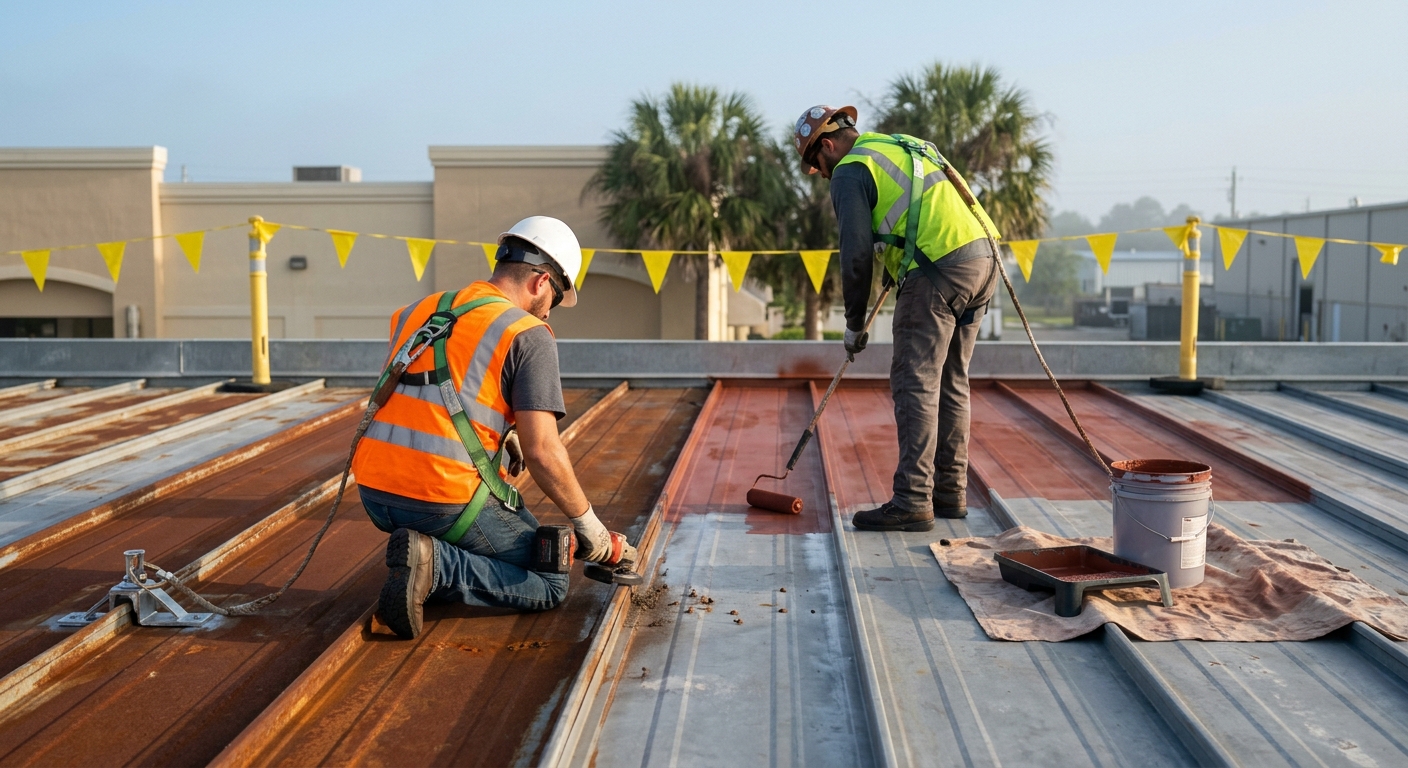
On an occupied building, salt removal and surface preparation are the wettest and loudest parts of a metal restoration. Pressure washing carries salt, chalk and rust particles into gutters and onto walkways, parked cars and storefronts below, so runoff is controlled and the property manager gets notice before each section. Power-tool cleaning and fastener replacement are loud on a metal deck over offices or classrooms.
Coating brings odor and overspray near rooftop air intakes, so rooftop units in the work zone are shut down or their outdoor-air intakes protected on a schedule the tenants know in advance. Afternoon storms limit how much primer and coating can be applied and cured in a day. Panel replacement opens the roof, so panels come off only where the crew can close the roof the same day, and crane picks for panels move outside business hours. Advanced Roofing runs its own crane division, and the occupied building roof replacement guide covers how tenant notice, staging and safety are planned.
Location adds two checks. In Miami-Dade and Broward, the High-Velocity Hurricane Zone provisions of the Florida Building Code apply, so replacement panels and assemblies need the applicable product approval and the building official confirms whether the scope needs a permit; owners in Broward can start with Advanced Roofing’s Fort Lauderdale commercial roofing team. On any roof, condensate lines and copper refrigerant piping should be checked for runoff onto the metal before coating, because the MCA bulletin identifies both as corrosion sources.
Which code dates and fastener rules apply to coastal metal roof work in 2026?
As of October 20, 2026, four dated items belong in the decision file.
- Florida Building Code, 9th Edition, effective December 31, 2026. The Florida Building Commission publishes the code; the permit application date generally decides which edition governs. Miami-Dade County’s permitting notice on the 9th Edition states that online applications submitted after 4 p.m. on December 30, 2026 must comply with the new edition.
- Metal panel fasteners, Section 1507.4.4. In FRSA’s reproduction of the Florida Building Code fastener sections (2017 edition text), panels are secured with the approved manufacturer’s fasteners; absent a recommendation, galvanized fasteners serve steel roofs, stainless steel is acceptable for all metal roofs, and aluminum fasteners serve aluminum roofs on aluminum supports.
- Screw corrosion resistance, Section 1506.6. The same source lists three routes: equivalence to ASTM A641 Class 1, testing under TAS 114 Appendix E, or a coating with not more than 5 percent red rust after 1,000 hours of ASTM B117 salt spray. HVHZ fasteners under Section 1517.5 are tested to TAS 114 Appendix E.
- Recommendations versus requirements. FEMA’s 3,000-foot connector guidance is a recommendation, and warranty distances are contract terms. Neither is a code requirement, and the engineer and building official decide what a specific scope needs.
Decision checklist: who verifies what before a coastal metal roof contract is signed?
- Facility or property manager: pull the original panel and coating warranties, the product approval and the installation date, and record the distance to the nearest surf, bay, canal or marsh.
- Roof consultant or engineer: walk and hand-probe the roof, stage each area by the table above, pull sample fasteners to inspect shank corrosion under the washer, and confirm whether the attachment still meets the wind design.
- Coating manufacturer representative: run adhesion test patches and issue a written specification naming the preparation level, primer, fastener and lap treatment, thickness and coastal exclusions.
- Mechanical contractor: reroute condensate and copper runoff and confirm isolation at curbs and supports.
- Bidders: price the same staged survey and carry unit prices for fastener and panel replacement.
- Building official: confirm permit needs, the code edition the permit date triggers and, in the HVHZ, the required product approval.
- Operations: keep the roof on a commercial roof maintenance schedule with post-storm checks, and file reports in a roof management program so warranty records stay complete.
Frequently Asked Questions
How far from the ocean does salt air corrode a metal roof?
No single distance applies, because wind direction, surf and humidity change the exposure. FEMA’s Technical Bulletin 8 reports that corrosion is most severe near breaking surf with onshore winds. Published panel warranties draw lines between 400 and 2,800 feet depending on the manufacturer and water body, and FEMA recommends galvanized or stainless connectors within 3,000 feet of the coastline.
Can a rusted commercial metal roof be restored instead of replaced?
Yes, when the rust is on the surface and the metal underneath is sound. Restoration fits roofs with white rust and surface red rust, intact panels and fasteners that can be replaced. Section loss, perforation or failed attachment across the field points to panel or full replacement, because a coating cannot restore lost metal.
Does a metal roof warranty cover corrosion near salt water?
Often it does not. McElroy Metal’s Galvalume warranty excludes sheets within 1,500 feet of breaking surf, and PAC-CLAD’s acrylic-coated Galvalume warranty excludes installations within 2,800 feet of a seacoast. Terms differ by product, so the owner reads the warranty issued for the panel on the roof and confirms its status with the manufacturer.
What fasteners should be used on a metal roof near the coast in Florida?
The panel manufacturer’s approved fasteners come first under Florida Building Code Section 1507.4.4. Stainless steel is acceptable for all metal roofs under that section, and the Metal Construction Association treats 316L stainless as generally the minimum for marine exposure. The fastener must also meet the system’s wind uplift approval, which the engineer confirms.
Is aluminum or Galvalume better for a coastal commercial roof?
Aluminum avoids the coastal exclusions found in many Galvalume warranties, but it is not immune to corrosion. The MCA bulletin warns that copper corrodes aluminum severely and that graphite pencil marks attack it. The right choice depends on the site’s corrosivity, the wind design and the product approval, so the designer and manufacturer make the call.
How often should a coastal metal roof be inspected?
Twice a year and after every major storm is the common baseline for Florida commercial roofs. Coastal metal roofs deserve close attention at fasteners, laps, cut edges and areas sheltered from rain, since at least one published warranty excludes panels sheltered from natural rain washing. Recording each inspection supports both the maintenance plan and any warranty claim.
Let the corrosion stage set the scope
A coastal metal roof is restored or replaced on the evidence of how much metal is left. Chalking, white rust and surface red rust on panels that are still sound make a roof a restoration candidate, and treating it on time defers a replacement the building does not need yet. Section loss, perforation and failed fasteners across the field make it a replacement, and coating it moves the cost to a later and riskier year. The staged survey, the panel warranty with its coastal exclusions, the fastener rules and the December 31, 2026 code date belong in one file. Holding every bid to that file lets the owner defend the choice to a board, an asset manager or a lender.
Written by The Technical Team at Advanced Roofing. Founded in 1983, Advanced Roofing is 100% employee-owned and was ranked the #13 largest roofing contractor in the U.S. on Roofing Contractor magazine’s 2026 Top 100 list.
To schedule a corrosion assessment of a coastal metal roof or plan commercial re-roofing, request a free commercial roofing quote or call (800) 638-6869.