At a glance: OSHA assigns most rooftop fall protection duties to employers, but building owners carry their own: written certification of rope descent anchorages under 29 CFR 1910.27(b)(1), possible controlling-employer status when they direct the work, and full duties for their own maintenance staff. This guide sets out how those duties divide, compares guardrails, travel restraint, fall arrest, and designated areas, flags the Florida code and OSHA ladder dates that matter in 2026, and ends with a role-by-role checklist an owner can act on.
Commercial rooftop fall protection on an existing Florida building is shared work, and the owner holds a larger share than most service contracts suggest, because the owner alone controls the hatch, edges, skylights, and anchors every contractor’s crew depends on. OSHA writes its fall protection rules for employers, yet one provision requires the building owner to certify rope descent anchorages in writing, and an owner who directs rooftop work can be cited as a controlling employer under OSHA’s multi-employer policy. A gap usually shows up as a technician stepping backward off an unguarded edge beside a rooftop unit, followed by an investigation and a claim against the building. This article explains how the duties divide and which rooftop safety systems close the usual gaps; whether a specific building or contract complies is a determination for the owner’s safety professional, building official, and attorney.
Why Is Commercial Rooftop Fall Protection on the Owner’s Agenda in 2026?
Falls remain the hazard federal inspectors cite most often. Fall Protection, General Requirements (29 CFR 1926.501) ranked first on OSHA’s list of most frequently cited standards for fiscal year 2025, ahead of hazard communication and construction ladders. The Bureau of Labor Statistics Census of Fatal Occupational Injuries for 2024 counted 844 deaths from falls, slips, and trips that year, about one in six of the 5,070 workplace fatalities it recorded. Those figures cover every industry, not roofs alone, and rooftop service work on commercial buildings is part of that exposure.
Three developments sharpen the question for owners. The general industry standard at 29 CFR 1910.28 sets specific rules for low-slope roofs, skylights, and fixed ladders during maintenance and service work. On April 6, 2026, OSHA published a proposed rule in the Federal Register to remove the November 18, 2036 deadline for retrofitting older fixed ladders. The Florida Building Code’s 9th Edition takes effect December 31, 2026.
Florida low-slope roofs carry rooftop units, exhaust fans, and often solar arrays, each bringing technicians up on a recurring schedule. Many of those visits are booked by phone and never supervised on the roof.
Who Is Responsible for Fall Protection on a Commercial Roof?
Responsibility for fall protection on a commercial roof divides by role. Each employer protects its own workers, and the building owner controls the conditions those workers find when they arrive. OSHA places the duty to provide fall protection on the employer, and reroofing work falls under the construction standard at 29 CFR 1926.501. An owner becomes an OSHA employer on the roof whenever its own maintenance staff go up, and the general industry standard then applies to that staff.
One provision addresses building owners by name. Under 29 CFR 1910.27(b)(1), before any rope descent system is used, the owner must inform the employer in writing that each anchorage has been identified, tested, certified, and maintained to support at least 5,000 pounds in any direction for each worker attached, and the employer may not let anyone use an anchorage until it holds that statement. OSHA’s November 2017 enforcement memorandum adds that owners with uncertified anchorages should say so in writing. The rule covers rope descent work such as window cleaning; it does not require an owner to certify every tie-off point on the roof.
The second route runs through OSHA’s Multi-Employer Citation Policy (CPL 02-00-124). An employer with general supervisory authority over a worksite, including the power to correct hazards or require others to correct them, is a controlling employer, and that authority can come from a contract or from control exercised in practice. It must exercise reasonable care to prevent and detect violations, though with less inspection depth than the contractor doing the work. Whether a particular owner qualifies is a question for the owner’s attorney.
| Role | Who it usually is on a Florida commercial roof | What OSHA expects | Source |
|---|---|---|---|
| Exposing employer | HVAC, roofing, solar, telecom, or window-cleaning contractor | Protect its own workers; ask the controlling party to correct hazards it cannot fix | CPL 02-00-124 |
| Creating employer | Any trade that removes a rail, leaves a hatch open, or cuts a new roof opening | Do not create the hazard, even when only other employers’ workers are exposed | CPL 02-00-124 |
| Controlling employer | Owner, property manager, or general contractor with authority to correct hazards | Reasonable care to prevent and detect violations | CPL 02-00-124 |
| Building owner (rope descent) | Owner of a building where window cleaners or facade crews use rope descent systems | Written statement that each anchorage is identified, tested, certified, and maintained for 5,000 lb per worker | 29 CFR 1910.27(b)(1) |
| Owner as employer | Owner’s in-house maintenance or engineering staff | Full general industry fall protection and training duties | 29 CFR 1910.28, 1910.30 |
Premises liability under Florida law is separate from OSHA enforcement. Some vendors call the owner’s duty absolute; how a court treats it depends on the facts and the contract.
Rooftop Safety Systems Compared: Which Protection Fits Which Task?
On a low-slope roof, OSHA’s general industry rule sets protection by distance from the edge. Within 6 feet, workers need a guardrail, safety net, travel restraint, or personal fall arrest system. From 6 to 15 feet, a designated area marked by a warning line is allowed only for infrequent, temporary tasks. At 15 feet or more, infrequent, temporary work can proceed under an enforced stay-back rule.
Those provisions sit in 29 CFR 1910.28(b)(13), and the criteria for each system sit in 29 CFR 1910.29, including guardrail top rails at 42 inches, plus or minus 3 inches, able to resist 200 pounds, and warning lines hung 34 to 39 inches high and visible from 25 feet. A guardrail protects everyone without training or equipment. Travel restraint and fall arrest depend on a rated anchor, a harness, a trained user, and, for fall arrest, prompt rescue. A designated area depends on workers obeying the line.
| System | How it protects | Best fit on an occupied roof | Where it falls short |
|---|---|---|---|
| Guardrail, fixed or freestanding (42 in. top rail, 1910.29(b)) | Physical barrier; no user action needed | Hatches, edges near rooftop units, frequent-access routes | Cost grows with edge length; freestanding bases need protection pads and wind review in Florida |
| Parapet at least 39 in. high | Building element acts as the barrier | Roofs where the parapet already meets guardrail height | Many low-rise Florida parapets are shorter; height must be measured, not assumed |
| Travel restraint (anchor plus fixed-length lanyard) | Keeps the worker from reaching the edge | Occasional edge work where rails are impractical | Needs a rated anchor, harness, and training; most anchors penetrate the membrane |
| Personal fall arrest system | Stops a fall after it starts | Short tasks at the edge; facade access | Needs 5,000 lb anchorage or a qualified-person design, clearance below, and a rescue plan |
| Designated area (warning line) | Visual boundary only | Infrequent, temporary tasks at least 6 ft from the edge | Not permitted within 6 ft of the edge; gives no physical protection |
| Skylight screen or rail | Covers or surrounds the opening | Every skylight on a walked roof area | Covers must carry twice the intended load (1910.29(e)); a plastic dome is not a cover |
No system on that table makes a roof safe by itself. Harness systems fail when an anchor is unrated or a lanyard is too long for the clearance below, and warning lines get moved. Planning works down a hierarchy, removing the exposure, then guarding it, then protecting the individual, so rails at the points workers visit most are usually the first upgrade to price. Advanced Roofing supplies and installs rooftop safety systems from Kee Safety, including non-penetrating guardrail, hatch railing, skylight guardrail, and walkways.
What Drives the Cost and Schedule of a Rooftop Safety Retrofit?
Advanced Roofing does not publish pricing, and the cost figures that circulate online for rooftop guardrail and anchors are rarely tied to a building size, a roof system, or a scope. The budget for a specific roof is set by a short list of variables an owner can measure before asking for a proposal.
- Linear feet of edge near serviceable equipment, hatches, and technician routes.
- Skylights on walked areas, and whether each needs a rated cover or a rail.
- Fixed ladders over 24 feet, and whether each predates November 19, 2018.
- Anchorage type, penetrating or counterweighted, and whether a qualified person must design it.
- The roof system and whether the membrane manufacturer must approve each base or anchor.
- Remaining roof service life, since components on a roof near replacement will be removed and reset.
- Occupancy constraints such as work hours, hoist access, and tenant notice.
The last two variables decide timing. Installing rails, skylight protection, and anchors during a planned commercial re-roofing project avoids a second round of membrane penetrations and flashing, and Advanced Roofing’s guide to commercial roof warranty terms in Florida covers what can void coverage.
What Changes on an Occupied Florida Building?
On an occupied building, the roof is a workplace for people the owner does not employ and rarely sees. HVAC, solar, telecom, and window-cleaning crews arrive on separate schedules. An access log at the hatch, a sign-in rule through the property manager, and a one-page roof map of edges, skylights, anchors, and rails give every crew the same picture. The same map belongs in the file for scheduled roof maintenance visits, so the roofer and the HVAC contractor see the same hazards.
Florida conditions change the equipment choices. Freestanding guardrail and counterweighted anchors rest on the membrane without penetrations, which protects the roof system, but in a high-wind region their ballast, base spacing, and storm-season securing need review against the manufacturer’s installation data and, in Miami-Dade and Broward counties, the High-Velocity Hurricane Zone requirements the building official enforces. Salt air shortens the life of uncoated steel hardware, and afternoon storms leave membranes slick. A commercial roof maintenance schedule should add a check of rails, gates, and anchors after each storm season.
During a reroof, responsibility for the edge changes hands. The roofing contractor works under the construction standard while tenants’ service contractors may still need access. The pre-construction meeting should settle who reaches which areas in each phase and who restores rails removed for tear-off. Advanced Roofing’s guide to occupied building roof replacement covers the rest of that sequence.
What Do the Building Code and OSHA’s Ladder Rule Require, and When?
The building code sets requirements for the building itself, independent of who works on it. The 2021 International Building Code, the model code for the Florida Building Code, Building, 8th Edition, requires guards at least 42 inches high where equipment that needs service sits within 10 feet of a roof edge more than 30 inches above the level below, and where a roof hatch opening sits within 10 feet of such an edge (Sections 1015.6 and 1015.7). These are generally applied when equipment is replaced under a permit, so a rooftop unit change-out can trigger a guard the building never had. Confirm the adopted Florida text with the building official before scoping.
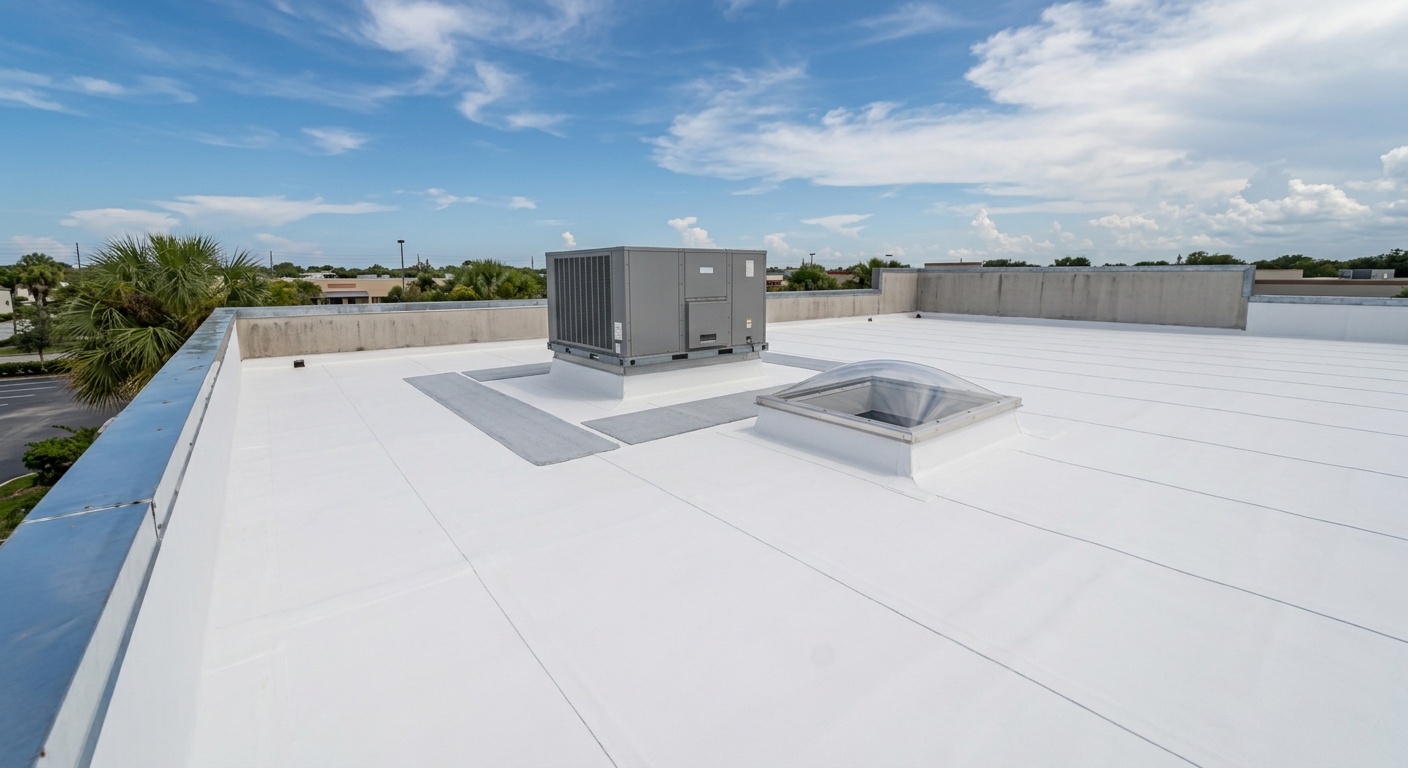
Two dates matter as of October 2026. The 9th Edition (2026) Florida Building Code, built on the 2024 International Building Code, takes effect December 31, 2026, and the Florida Building Commission’s analysis of changes to the Florida Building Code, Building lists what moved. Until OSHA finalizes its ladder proposal, the 2036 deadline remains in the regulation, and new or replaced ladders over 24 feet still need a ladder safety or personal fall arrest system. Skylights belong in the same review, since 29 CFR 1910.28(b)(3) treats a skylight as a hole, and replacing an aging unit through commercial skylight services is a natural point to add a screen.
Building Owner Fall Protection Checklist: Who Does What
Each item is assignable to a named role and can go to a board or asset manager.
- Property manager: compile a roof map of every access point, edge, skylight, ladder, anchor, and rail.
- Facility manager: list recurring rooftop tasks by trade, frequency, and location.
- Owner’s safety professional: assess each access route, hatch, skylight, and edge against 29 CFR 1910.28 and rank fixes by how often workers are exposed.
- Owner: state in writing whether rope descent anchorages exist and meet 29 CFR 1910.27(b)(1), and give that statement to window-cleaning contractors.
- Asset manager or CFO: budget rail, skylight, and anchorage work with the next reroof so components are installed and flashed once.
- Roofing contractor: confirm with the membrane manufacturer that each anchor, rail base, and walkway system is approved for the roof system before installation.
- Mechanical engineer: on equipment replacements, check for units within 10 feet of an edge and show guards in the permit set.
- Owner’s attorney: review service contracts for safety authority, access rules, and indemnity language.
Frequently Asked Questions
Is a building owner responsible for fall protection on a commercial roof?
OSHA places most fall protection duties on employers, including the contractors who send workers to the roof. The owner has direct duties when its own staff work on the roof, a written anchorage duty under 29 CFR 1910.27(b)(1) for rope descent systems, and possible controlling-employer obligations when it directs the work. The owner also controls the hatch, edges, and skylights crews encounter. How liability falls in a specific case is a question for the owner’s attorney.
Do roof anchors need to be certified?
Anchorages for rope descent systems must be identified, tested, certified, and maintained to hold at least 5,000 pounds in any direction per attached worker, and the owner must confirm that in writing before use under 29 CFR 1910.27(b)(1). Anchorages for personal fall arrest must meet 29 CFR 1910.140, either 5,000 pounds per worker or a qualified-person design with a safety factor of at least two. Have a qualified person evaluate unlabeled or legacy anchors before anyone ties off.
How close to the roof edge can workers go without fall protection?
Under 29 CFR 1910.28(b)(13), general industry work less than 6 feet from a low-slope roof edge always needs a guardrail, safety net, travel restraint, or personal fall arrest system. A designated area is allowed from 6 to 15 feet only for infrequent, temporary work. Beyond 15 feet, infrequent and temporary tasks need no system, provided the employer enforces a rule keeping workers out of the 15-foot zone unless protected.
Does a rooftop guardrail have to penetrate the roof membrane?
No. Freestanding guardrail systems use weighted bases that rest on the roof surface, and some roof hatch railings mount to the hatch itself, so neither needs to penetrate the membrane. On Florida roofs, base layout, ballast, and storm securing should follow the manufacturer’s installation data and be reviewed for wind exposure. Penetrating anchors and rails must be flashed into the roof system with the membrane manufacturer’s approval.
Are caged ladders still compliant for roof access?
For fixed ladders more than 24 feet above a lower level, a cage remains acceptable on ladders installed before November 19, 2018, while new and replaced ladders need a ladder safety system or personal fall arrest system. The regulation still sets a November 18, 2036 deadline for all such ladders, but OSHA proposed removing it on April 6, 2026. Re-check the Federal Register before budgeting a retrofit.
The Owner’s Share of Rooftop Fall Protection Is the Building Itself
Commercial rooftop fall protection divides along a clear line. Contractors protect their own workers with harnesses, warning lines, and training, and they answer to OSHA for it. The owner controls what those workers find when they climb through the hatch, including whether the edge beside the condenser has a rail, whether the skylight has a screen, and whether the anchor on the parapet carries a current certification or no record at all. Owners who map the roof, fix the access points first, and fold the remaining work into the next reroof address those hazards on a schedule they choose, rather than one set by an inspection or an incident.
Written by The Technical Team at Advanced Roofing. Founded in 1983, Advanced Roofing is 100% employee-owned and was ranked the #13 largest roofing contractor in the U.S. on Roofing Contractor magazine’s 2026 Top 100 list.
To scope guardrail, skylight protection, and roof access safety upgrades with your next roof project, request a quote from Advanced Roofing or call (800) 638-6869.