
At a glance: A Florida commercial roof’s service life depends on its system, ply count, deck slope and maintenance record. This guide sets out the planning lives Florida Housing Finance Corporation assigns to TPO, modified bitumen, built-up and coated roofs, explains why contractor and manufacturer figures run higher or lower, lists the conditions that shorten or extend a specific roof’s life, covers the condo reserve and Florida Building Code rules tied to roof age, and ends with a role-by-role checklist for estimating remaining life.
The commercial roof lifespan Florida owners can plan on is a range set by four facts about the roof: the system, the number of plies, the slope of the deck, and the maintenance record. Florida Housing Finance Corporation’s planning table assigns 20 years to TPO and other thermoplastic single-ply roofs and 10 to 20 years to modified bitumen, depending on plies and drainage, and every figure assumes maintenance done on schedule. An owner who budgets on the long end of a sales range and skips the inspections behind it pays twice, first for leaks and interior damage and again for a replacement that arrives years before the reserve schedule expected it. This article does not assign a service life to any building; that estimate belongs to the roof consultant, engineer or reserve professional who inspects it.
Why do Florida owners need a defensible roof lifespan number in 2026?
A roof lifespan figure now carries legal and financial weight in Florida. Under section 718.112, Florida Statutes, a condominium association’s budget must reserve for roof replacement based on the roof’s estimated remaining useful life and estimated replacement cost. Associations with buildings three or more habitable stories tall must also obtain a structural integrity reserve study at least every 10 years, and the roof is the first item the statute lists. The number a board accepts becomes the schedule its owners fund. Our guide to condo milestone inspection roof findings explains how the roof appears in those reports.
Lenders work from published tables. Fannie Mae describes the Estimated Useful Life tables in its Form 4099.F as standardized averages that do not replace the consultant’s professional judgment. Florida’s counterpart is the Florida Housing Finance Corporation’s Appendix F Estimated Useful Life tables (revised July 29, 2024), written for capital needs assessments. It splits low-slope roofs by deck slope as well as by system, which national contractor lists rarely do.
The calendar adds a third reason. The Florida Building Commission updates the code every three years, and the 9th Edition (2026) takes effect December 31, 2026, so a roof that wears out next year will be replaced under rules its installer never faced. See also our guide to roofing capital planning for multiple properties.
Why is commercial roof lifespan Florida-specific?
Florida shortens roof life through heat, ultraviolet exposure, standing water, salt air and wind. The U.S. Department of Energy reports that conventional roofs can reach 150°F or more on a sunny summer afternoon, while a reflective roof can stay more than 50°F cooler. Daily heating and afternoon rain expand and contract membranes, flashings and seams, and heat and ultraviolet light oxidize asphalt-based surfaces until they lose flexibility.
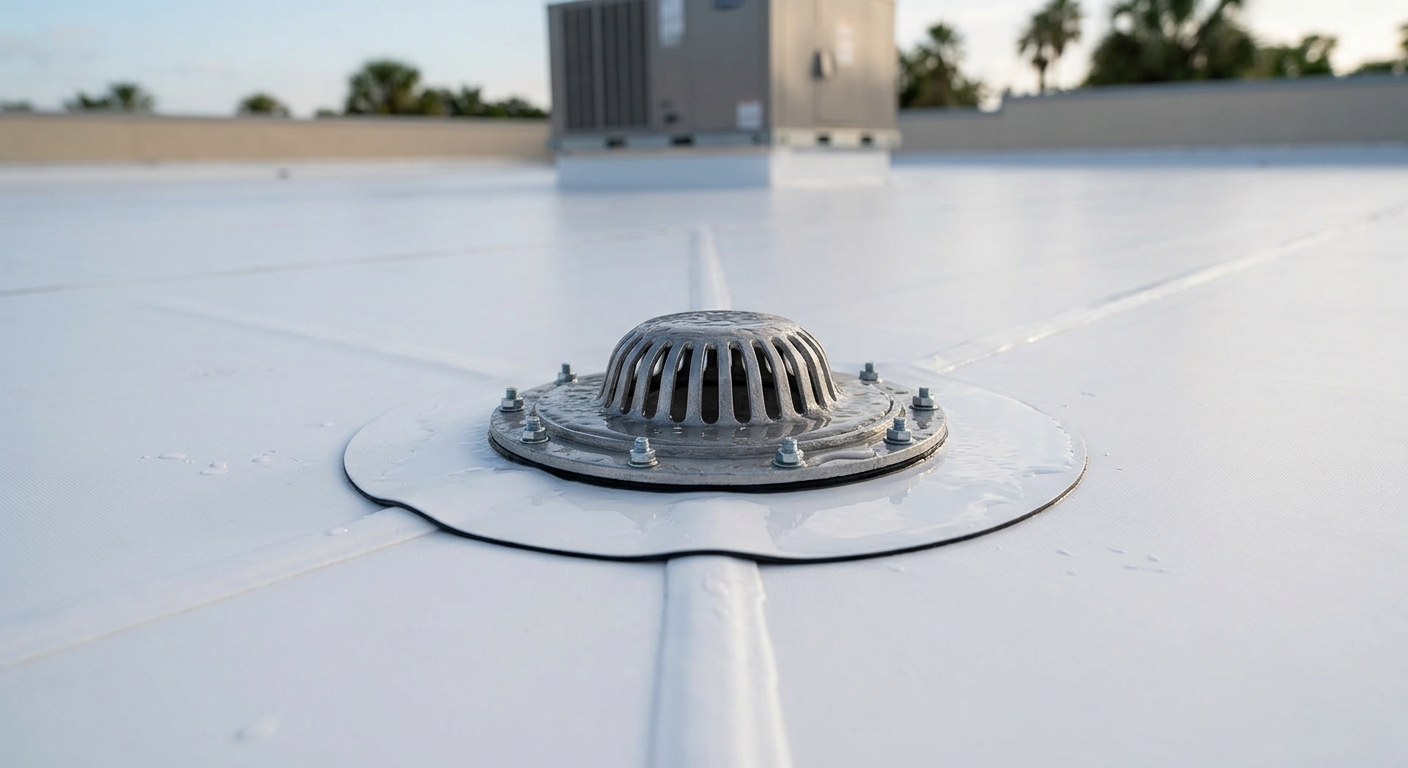
Drainage is the factor owners can measure most easily. Water that stays on a roof holds heat, dirt and moisture against seams and laps, and the state table reflects that directly. Florida Housing plans a two-ply mopped modified bitumen roof at 15 years on a dead-level deck and 20 years on a deck sloped a quarter inch per foot, and it applies the same five-year difference to four-ply built-up and EPDM roofs. Our guide to commercial roof ponding water in Florida covers why drains and scuppers stop working.
Coastal exposure and soiling work more slowly. The Florida Housing instructions name climatic conditions, wet locations and proximity to salt water among the factors that change useful life, and they require the consultant to justify any departure from the table. The Cool Roof Rating Council has rated reflective roofing on both initial and three-year aged values since 2002, because a white roof that has weathered and gone gray absorbs more heat than it did when new.
| Roof system (as listed) | Dead-level deck | Sloped deck (¼ in. per ft) | Note |
|---|---|---|---|
| 4-ply built-up, asphalt | 18 years | 25 years | Coal-tar built-up listed at 35 years |
| 2-ply modified bitumen, mopped | 15 years | 20 years | Five-year slope difference |
| Single-ply modified bitumen, torched | 10 years | 15 years | Shortest roof covering in the table |
| EPDM single-ply | 15 years | 20 years | Five-year slope difference |
| Thermoplastic single-ply (TPO, PVC) | 20 years | 20 years | One value; not split by slope |
| Rubberized or elastomeric white (cool) roof | 15 years | 15 years | One value |
| Low-slope roof drains and scuppers | 30 years | 30 years | Component, not covering |
| Aluminum parapet caps and copings | 25 years | 25 years | Component, not covering |
Source: Florida Housing Finance Corporation, Capital Needs Assessment Appendix F, Estimated Useful Life Tables, revision 7-29-2024, multifamily column, accessed October 28, 2026. Values assume regular preventive maintenance at prescribed frequencies.
How long do TPO, modified bitumen and built-up roofs last, and where does each fall short?
Florida Housing Finance Corporation’s planning table gives a commercial roof in Florida 20 years for TPO and other thermoplastic single-ply systems, 15 to 20 years for two-ply modified bitumen, 10 to 15 years for single-ply torched modified bitumen and 18 to 25 years for four-ply asphalt built-up roofing, with the higher figures on sloped decks and every figure assuming scheduled maintenance.
TPO roof life expectancy is where published figures spread widest. Advanced Roofing’s own TPO commercial roofing guide states that a professionally installed TPO system typically lasts 20 to 30 years, against the state’s 20-year planning value. The table is an average for budgeting, and the higher figure describes a well-installed, maintained roof that reaches its potential. GAF’s aged TPO field study sampled 20 EverGuard TPO roofs installed 8 to 16 years earlier and reported that most still met the current ASTM D6878-19 requirements for new membrane. That finding covers those roofs and that product only, and it does not establish a 30-year life for any TPO sheet.
Modified bitumen roof lifespan depends on how many plies were installed and how. Advanced Roofing’s modified bitumen roofing page states that a single-layer system has a 12- to 16-year lifespan and that multiple layers add to it, which tracks the state table. Granule loss is the visible clock. When granules wash away, ultraviolet light reaches the bitumen, which dries, cracks and alligators until the laps open.
Built-up roofing carries the longest planning lives in the table, 18 to 25 years for four-ply asphalt and 35 years for coal-tar pitch, and many Florida buildings still have one under a later recover. A second roof over a first can trap water and limit what the next contractor may do. Our TPO vs PVC vs modified bitumen comparison covers how to choose among systems for a new roof.
| System | Florida planning life | What extends it | Where it falls short |
|---|---|---|---|
| TPO | 20 years | Clean welds, thicker sheet, sound attachment, clean surface | Finite weathering layer over the scrim; cold welds and punctures; grease and chemical exposure |
| PVC | 20 years (listed with thermoplastics) | Chemical-resistant formulation; separation from asphalt | Plasticizer loss with age; incompatible with asphalt without a separation layer |
| 2-ply modified bitumen | 15 to 20 years | Sloped deck, reflective granulated cap, maintained laps | Granule loss and UV aging; ponding on dead-level decks; open flame if torch-applied |
| Single-ply modified bitumen | 10 to 15 years | Positive drainage; coating while still sound | No second ply behind a cut or open lap |
| 4-ply built-up | 18 to 25 years (coal tar 35) | Maintained surfacing; drainage | Heavy; blisters; often already recovered once, which limits the next recover |
| Coating restoration | 15 years (white elastomeric listing) | Dry, adhered substrate; recoat on schedule | Does not fix wet insulation, lost adhesion or a deteriorated deck; not a new-roof warranty |
Planning lives from Florida Housing Finance Corporation Appendix F (rev. 7-29-2024). Strengths and limits prepared by Advanced Roofing as of October 28, 2026.
No roof system is immune to hurricane damage, and none of these figures accounts for a storm that exceeds the assembly’s rated pressure; warranties carry wind-speed limits and exclusions. On a dry, adhered roof with years left, commercial roof coatings can be the right call.
What shortens or extends service life on a specific building?
Remaining useful life is the planning life minus the roof’s effective age, adjusted for what the roof shows on inspection. A 14-year-old TPO roof inspected twice a year, on a sloped deck over dry insulation, can have more life left than a 9-year-old roof over wet insulation. Florida Housing requires the consultant to justify any variance from the table, and these factors drive those variances.
| Factor | Effect on service life | Who confirms it |
|---|---|---|
| Deck slope and drainage | Dead-level decks planned 5 years shorter for built-up, 2-ply modified bitumen and EPDM (Florida Housing, 2024) | Roof consultant |
| Number of plies | Single-ply torched modified bitumen planned 5 years shorter than 2-ply mopped (Florida Housing, 2024) | Roofing contractor, by core sample |
| Inspection frequency | NRCA recommends inspections at least twice a year, spring and fall | Owner, maintenance contractor |
| Wet insulation | Shortens remaining life regardless of membrane age; can rule out a recover | Moisture survey verified by cores |
| Distance from salt water | Named by Florida Housing as a factor that changes useful life | Roof consultant |
| Surface reflectance | Three-year aged reflectance is rated separately from initial (Cool Roof Rating Council) | Cleaning record, product rating |
| Rooftop traffic and equipment | Punctures and flashing wear at curbs, walkways and service areas | Property manager, mechanical contractor |
| Planned rooftop solar | Roof must outlast the array or face a remove-and-reinstall | Roof consultant, solar designer |
Maintenance is the variable an owner controls. NRCA recommends that owners and facility managers schedule roof inspections at least twice a year, preferably in spring and fall. A preventive roof maintenance program that clears drains, reseals flashings and documents each visit builds the record a warranty requires and the evidence a reserve professional needs to support a longer estimate. A roof without that program should be planned shorter than the table. Owners of several buildings can keep the records in commercial roof asset management.
Two findings change the estimate more than any table. Wet insulation found by an infrared roof inspection verified with cores shortens the life of the whole assembly, and a roof that already carries two coverings cannot take a third under the Florida Building Code. Either finding turns a planning number into a replacement date.
What changes when an aging roof sits over an occupied Florida building?
A roof near the end of its life fails first inside the building, at ceiling tiles, inventory, patient rooms and tenant spaces. A planned replacement can be scheduled in the drier months, phased by roof section and sequenced around tenant hours. An emergency replacement in August is scheduled around the weather, with tear-off exposed to afternoon storms and tenants learning about the work after the water reaches them.
On an occupied building, tear-off is limited to what the crew can dry in the same day, crane picks are scheduled outside business hours where the site allows, and the property manager receives notice of every shutdown window before it starts. Our guide to occupied building roof replacement covers odor, noise and access, and Advanced Roofing’s commercial re-roofing team plans that sequence before permitting.
In Miami-Dade and Broward counties, the High-Velocity Hurricane Zone provisions of the Florida Building Code govern the replacement assembly and its product approvals, which adds review time. Estimating remaining life a year or two ahead leaves the owner a choice of season, contractor and system that an emergency replacement does not.
Which Florida code and condo rules depend on a roof’s age?
As of October 28, 2026, three Florida rules turn a roof’s age into a compliance question. Section 553.844, Florida Statutes, provides that when a roof was built, repaired or replaced under the 2007 Florida Building Code or a later edition, a repair, replacement or recover of 25 percent or more of the roof or roof section requires only the repaired portion to meet current code. A roof installed under an earlier code does not get that exception.
Section 706.3 of the Florida Building Code, Existing Building, prohibits a new covering over an existing roof in listed conditions, including water-soaked coverings and roofs with two or more existing coverings. FRSA has published the approved 9th Edition modifications to Section 706.3, and the adopted text should be confirmed with the Florida Building Commission before a recover is planned. The permit application date generally decides which edition governs.
For condominiums, the structural integrity reserve study under section 718.112 puts a remaining useful life on the roof in writing at least every 10 years. Whether a specific roof qualifies for the 25 percent exception, may be recovered, or carries the right reserve figure is a determination for the building official, engineer of record, reserve professional and association attorney.
How should owners and boards estimate the remaining life of their roof?
- Property or facility manager: pull the roofing permit, installation date, warranty certificate and repair invoices, and record the code edition the roof was permitted under.
- Roofing contractor or roof consultant: identify the system, ply count and number of coverings on every roof section, and record whether each deck drains.
- Roof consultant: run a moisture survey, verify it with cores, and map wet insulation by section.
- Maintenance contractor: confirm twice-yearly inspections and current warranty maintenance terms; our commercial roof warranty guide lists them.
- Reserve professional or engineer: start from the Florida Housing planning life, adjust for observed condition, and state the reason for every adjustment.
- Asset manager or board treasurer: run the commercial roof repair vs replacement test before funding a large repair on a roof near the end of its life.
- Energy lead: confirm the roof will outlast any planned rooftop solar array.
Frequently Asked Questions
How long does a TPO roof last in Florida?
Florida Housing Finance Corporation’s planning table assigns 20 years to TPO and other thermoplastic single-ply roofs, assuming scheduled maintenance. Advanced Roofing states that a professionally installed, maintained TPO system typically lasts 20 to 30 years. Sheet thickness, attachment, seam quality, drainage and the insulation underneath decide where a specific roof lands.
How long does a modified bitumen roof last in Florida?
Ply count and drainage decide it. The Florida Housing table plans single-ply torched modified bitumen at 10 to 15 years and two-ply mopped systems at 15 to 20 years, with the higher figure on sloped decks. Advanced Roofing’s modified bitumen page gives a single-layer system 12 to 16 years.
Does a roof warranty term tell me how long the roof will last?
No. A warranty term is the period during which the manufacturer accepts specified obligations, subject to maintenance, wind-speed limits and exclusions. A roof can outlast its warranty or fail inside it. Use the term as one input alongside the planning table and the roof’s measured condition.
Can a roof coating extend the life of a commercial roof?
A coating can extend service life over a roof that is dry, adhered and sound. It does not fix wet insulation, lost adhesion or a deteriorated deck, and a coating warranty is not a new-roof warranty. The Florida Housing table plans a white elastomeric roof at 15 years, so plan a recoat.
How often should a commercial roof be inspected in Florida?
NRCA recommends roof maintenance inspections at least twice a year, preferably in spring and fall. In Florida, the spring visit prepares the roof for hurricane season and the fall visit records what the season did. Add an inspection after any named storm, and keep a dated report for every visit.
What remaining useful life should a condo board use for its roof?
The figure in its structural integrity reserve study, which section 718.112, Florida Statutes, requires for buildings three or more habitable stories tall. A planning table is the starting point, the engineer or reserve professional adjusts it for condition, and the association’s attorney advises on the statute.
Plan on the table, then measure the roof
A Florida commercial roof lasts as long as its system, plies, drainage and maintenance allow, and the state’s planning table gives owners a defensible starting point of about 20 years for TPO, 10 to 20 years for modified bitumen and 18 to 25 years for built-up roofing. Those figures hold only when inspections happen on schedule. The estimate that belongs in a reserve study or capital plan starts from the table and is adjusted by cores, moisture data and the repair record of the specific roof. Owners who make that estimate a year or two early keep the choice of season, system and contractor, and with the 9th Edition taking effect December 31, 2026, the permit date belongs in the same plan.
Written by The Technical Team at Advanced Roofing. Founded in 1983, Advanced Roofing is 100% employee-owned and was ranked the #13 largest roofing contractor in the U.S. on Roofing Contractor magazine’s 2026 Top 100 list.
To estimate the remaining life of your roof or plan its replacement, request a free commercial roofing quote or call (800) 638-6869.