At a glance: The most useful commercial roof warranty for a Florida building is usually a manufacturer no-dollar-limit (NDL) warranty with a wind rating chosen on purpose, perimeter metal included, and a maintenance record that keeps it in force. This article explains how NDL coverage differs from contractor and material-only warranties, how warranted wind speed is measured, what rooftop trades do to coverage on an occupied building, which Florida code and statute dates apply, and what to confirm before signing.
The commercial roof warranty Florida owners should ask for is usually a manufacturer no-dollar-limit (NDL) warranty with a wind rating chosen on purpose, perimeter metal included, and a maintenance record the owner actually keeps. Term length, the number most bids lead with, matters less than who pays for labor, what wind speed ends coverage, and which acts by the owner or other trades void it. The stake is concrete: owners learn after a tropical storm or a rooftop HVAC change-out that the 20-year document in the file does not pay for the leak. This article does not argue that any warranty replaces a sound installation, code compliance, or property insurance, and it does not interpret any insurance policy.
Why does the fine print in a Florida roof warranty matter more in 2026?
Commercial roof warranties in Florida carry wind, maintenance, and alteration conditions that national cost guides rarely explain, and the wind clause is where most owners are surprised. The Carlisle SynTec warranty services page advertises warranties covering winds of up to 120 mph with terms of up to 30 years, while the Carlisle TPO guide specification lists a standard 55 mph wind speed warranty and tells specifiers to contact the manufacturer for anything higher. Which number a roof received is settled project by project.
Warranted wind speed is also measured differently from a storm’s headline number. A 2020 Carlisle SpecTopics bulletin on warranty wind speed explains that warranted wind speed is a 3-second peak gust recorded at the weather station nearest the building, measured 10 meters above the ground, and that it should not be copied from the design wind speed on ASCE 7 maps. The National Hurricane Center’s Saffir-Simpson scale rates hurricanes by maximum sustained wind, with Category 1 starting at 74 mph. Because gusts run higher than sustained winds, a tropical storm that never reaches hurricane strength can still exceed a 55 mph gust limit. The same Carlisle bulletin states that a roofing warranty is not building insurance: debris impact, broken glazing, and internal pressurization in a hurricane fall to the owner’s property insurer. Storm preparation steps are covered in the commercial roof hurricane season guide.
Florida law adds a deadline that runs separately from any warranty term. Under section 95.11(3)(b), Florida Statutes, an action founded on the construction of an improvement to real property generally must be brought within four years, and in any event within seven years of the certificate of occupancy or completion, and repairs performed under warranty do not extend that period. A 20-year warranty does not stretch the statutory clock; the owner’s attorney decides how it applies to a given roof.
What does an NDL roof warranty cover compared with other commercial roofing warranty coverage?
An NDL roof warranty is a manufacturer’s total-system warranty that pays to repair covered leaks, whether the cause is defective material or the installer’s workmanship, without a cap tied to the original roof price. Commercial roofing warranty coverage comes in four common forms, and the difference between them is who pays for labor and which components are included.
| Warranty type | Issued by | Pays for | Typical gaps |
|---|---|---|---|
| Contractor workmanship warranty | Installing roofing contractor | Repair of leaks caused by installation errors, for the term stated in the contract | Ends with the contractor’s solvency; excludes material defects; terms vary by contract |
| Manufacturer material-only warranty | Membrane manufacturer | Replacement material for a defective membrane | Labor, flashings, and edge metal often excluded; may be prorated |
| Manufacturer labor and material (limited) warranty | Manufacturer, through an approved installer | Material and labor for covered defects, often with a dollar cap | Cap can fall below actual repair cost late in the term |
| Manufacturer NDL (total system) warranty | Manufacturer, after its own inspection | Covered leaks from material or workmanship, no dollar limit | Wind-speed ceiling, exclusions for damage by others, owner maintenance conditions |
The type matters for a physical reason. Water rarely enters through the middle of a sound membrane. It enters at the details: a heat-welded seam that did not fully fuse, a base flashing that lost adhesion at an equipment curb, a split pipe boot, or edge metal that lifted and let wind get under the sheet. Those are installation and detailing failures, so a material-only warranty seldom pays for the leaks owners actually have. An NDL warranty brings the manufacturer onto the roof before coverage is issued; Carlisle states that every roof it warrants is inspected by a field service representative. That inspection is a second review of the details, and it is part of what the owner is buying.
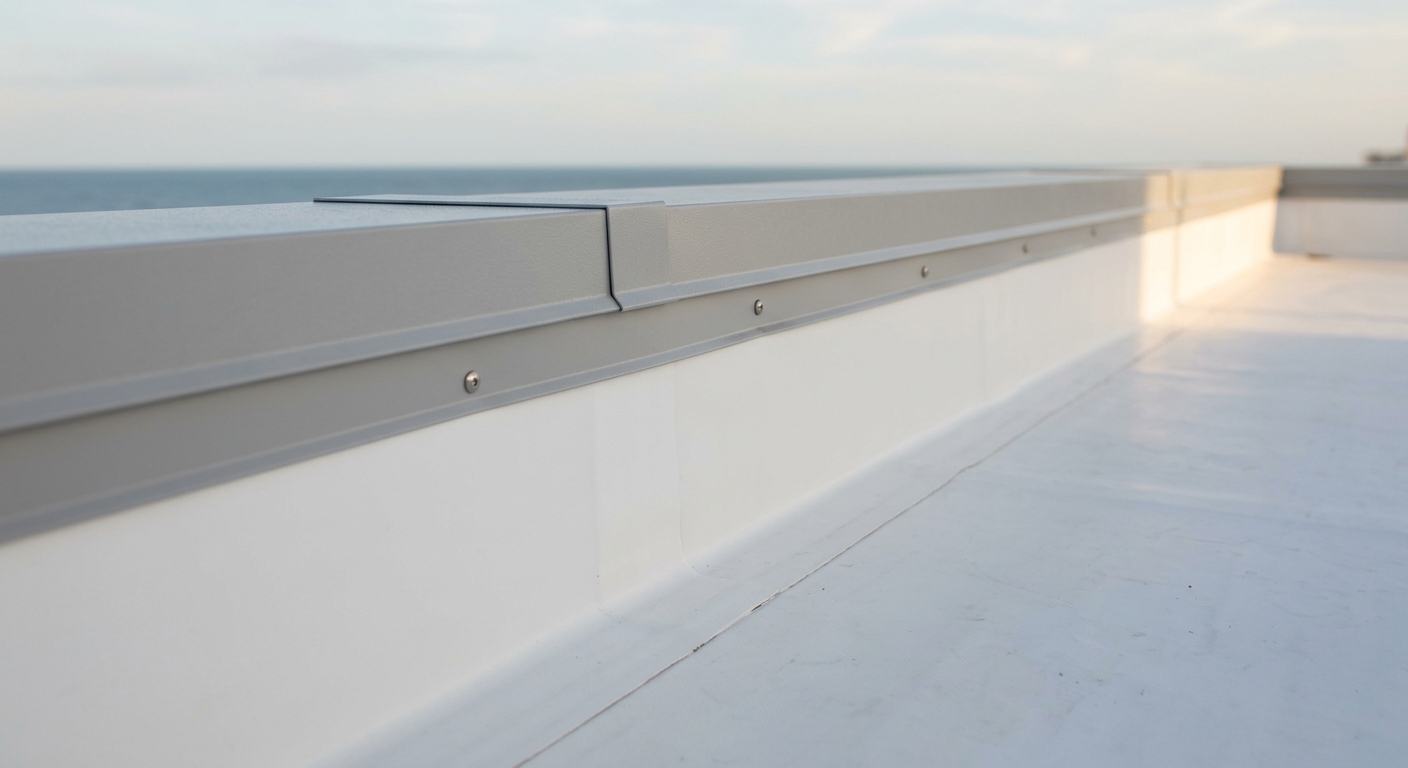
Edge metal deserves its own question. Many warranties cover the membrane and its flashings but leave perimeter metal out unless the metal is the manufacturer’s product. Carlisle, for example, warrants its SecurEdge CF snap-on fascia with the roof system in an edge-to-edge warranty of up to 30 years with 120 mph wind coverage, and lists Miami-Dade approval for the High-Velocity Hurricane Zone. Where coping or fascia is shop-fabricated by the roofing contractor, as it can be through Advanced Roofing’s sheet metal fabrication division, the bid should state in writing who warrants the perimeter.
Which warranty option fits the building, and where does each fall short?
The right choice depends on the hold period, roof exposure, equipment traffic, and whether the owner will fund maintenance for the full term.
| Option | Fits | What it adds | Where it falls short |
|---|---|---|---|
| Contractor warranty only | Repairs, short hold periods, small roof sections | Simple terms and a direct relationship with the installer | No manufacturer inspection; depends entirely on one contractor’s solvency and response |
| Standard NDL warranty | Most re-roofs on owned buildings | Material and workmanship coverage without a dollar cap | Standard wind coverage on some systems is 55 mph peak gust (Carlisle guide specification) |
| NDL with wind and edge-to-edge upgrades | Coastal, tall, or exposed roofs | Higher warranted wind speed; perimeter metal inside the warranty | Higher cost; Carlisle cautions against buying wind coverage matched to design maps instead of need |
| NDL with maintenance extension | Long-hold owners who fund annual inspections | Carlisle Continu-Care adds 5 years; GAF WellRoof adds up to 25% (35-year cap) | Extension terminates if annual documentation lapses; requires an approved contractor |
The longest term is not automatically the best value. Carlisle’s TPO guide specification limits its 25- and 30-year warranties to 80-mil membrane or thicker fleece-backed sheets, so a longer term usually means a heavier assembly and a higher installed price. The owner’s question is whether the building will be held, and maintained, long enough to use the extra years. A coating warranty is a different product again; the commercial roof restoration vs replacement guide explains why it is not a new-roof warranty.
Maintenance extensions reward owners who already maintain. The Carlisle Continu-Care warranty extension adds five years to a Carlisle Total System Warranty for owners who keep the roof regularly inspected and maintained. The GAF WellRoof Guarantee Extension adds up to 25 percent to a Diamond Pledge NDL guarantee, to a 35-year maximum, when a GAF PlatinumElite contractor inspects the roof every year and documents needed repairs. Both depend on paperwork filed on schedule. Advanced Roofing’s preventive maintenance program is designed around that record, and its Advanced Access roof management portal keeps those records in one place.
What drives the cost, term, and wind rating of a commercial roof warranty?
Manufacturers do not publish NDL warranty fees, and Advanced Roofing does not publish pricing, so this article gives no cost figure. What can be stated is which variables move the warranty line in a bid. Owners should ask every bidder to price the warranty as a separate line item so offers can be compared on equal terms.
| Driver | Effect on the warranty | Source |
|---|---|---|
| Term length | 25- and 30-year TPO warranties require 80-mil or thicker fleece-backed membrane | Carlisle TPO guide specification |
| Warranted wind speed | Standard 55 mph peak gust on some systems; coverage offered up to 120 mph | Carlisle guide specification; Carlisle warranty services page |
| Perimeter metal | Edge-to-edge coverage requires the manufacturer’s edge system | Carlisle SecurEdge CF product page |
| Optional coverages | Puncture and hail coverage limited to specified membranes | Carlisle TPO guide specification |
| Contractor status | Some extensions are offered only through a manufacturer’s top-tier contractors | GAF WellRoof property owner sheet (2024) |
| Maintenance commitment | Annual inspections extend the term by 5 years (Carlisle) or up to 25% (GAF) | Carlisle Continu-Care page; GAF WellRoof sheet |
In Florida one variable outweighs the rest. The warranted wind speed should be chosen with the roof consultant and set against what the owner’s property insurance already covers, because the two documents are built to respond to different losses.
What changes for a roof warranty on an occupied Florida building?
On an occupied building, most warranty risk arrives after the roofers leave. Carlisle’s bulletin notes that a roofing warranty assumes rooftop foot traffic is limited to maintenance and equipment inspection. Every HVAC change-out, solar installation, satellite dish, or sign bracket puts another trade on the membrane, and a new penetration flashed by a contractor the manufacturer has not approved can put coverage for that area at risk under the warranty’s alteration terms.
The controls are procedural. The property manager keeps a log of every rooftop access, requires walkway pads to equipment, and routes any new penetration through the roofing contractor of record before the work starts, so the change can be submitted to the manufacturer. When one company handles roofing, sheet metal, and mechanical work, curb and penetration flashing stays with one accountable party; Advanced Roofing offers air conditioning services alongside roofing for that reason.
Leak response is the other occupied-building issue. NDL warranties set notice requirements for leaks and limits on who may repair the roof during the term, and Carlisle provides a leak report form on its warranty page. The building’s leak protocol should name who notifies the contractor and manufacturer and who may place temporary protection. Damage to ceilings, inventory, and tenant operations below the roof is a property insurance question, as Carlisle’s bulletin makes clear. A documented commercial roof maintenance schedule supplies the record a warranty claim needs.
Which Florida code and legal deadlines affect a commercial roof warranty?
As of October 14, 2026, the 9th Edition (2026) Florida Building Code takes effect December 31, 2026, and the Miami-Dade County notice on the 9th Edition code change states that permit applications submitted on or after that date must comply with the new edition. A warranty does not establish code compliance. The roof assembly must carry the product approvals the code requires, including Miami-Dade Notices of Acceptance in the High-Velocity Hurricane Zone, and the building official decides whether it complies. Owners planning a 2027 commercial re-roofing project should confirm that the warranted assembly and the permitted assembly are the same assembly.
Disputes follow a statutory path. Before an owner sues over a construction defect, section 558.004, Florida Statutes, requires written notice at least 60 days before filing, or 120 days for an association representing more than 20 parcels, and gives the contractor a right to inspect and offer a repair. Separately, section 489.147, Florida Statutes, bars contractors who are not licensed public adjusters from interpreting policy provisions or adjusting claims for an insured. After a storm, warranty, defect, and insurance claims can overlap; the attorney, the insurer, or a licensed public adjuster sorts out which applies. Advanced Roofing’s podcast on understanding commercial roof warranties covers warranty disputes with a Florida construction attorney.
What should a commercial roof warranty Florida owners sign actually include?
- Asset manager or owner: ask every bidder for a sample warranty for the exact system bid, and require the warranty to be priced as its own line item.
- Roof consultant or engineer: set the warranted wind speed against the building’s exposure and the owner’s insurance, rather than copying the ASCE 7 design wind speed.
- Property manager: confirm in writing whether coping, fascia, gutters, and scuppers are inside the manufacturer’s warranty or carried only by the roofing contractor.
- Asset manager: confirm whether the warranty transfers on sale and what transfer requires; Carlisle, for example, publishes a warranty transfer form.
- Facility manager: calendar the annual inspection any maintenance extension requires and assign who files the documentation with the manufacturer.
- Property manager: adopt a rooftop access rule that routes HVAC, solar, and telecom work through the roofing contractor of record.
- Condo board or community association manager: send warranty and defect-notice questions to the association attorney, and keep warranty documents with the reserve study records.
- Owner: check the installer’s financial capacity; Advanced Roofing states that its contractor warranty is backed by its captive insurer, ARI Insurance, Inc., and lists $50 million single-project and $150 million aggregate bonding capacity.
Advanced Roofing’s page on the manufacturers Advanced Roofing is authorized to install lists 24 roofing manufacturers. A large contractor may not be the lowest bid on a small, simple roof.
Frequently Asked Questions
What is an NDL roof warranty?
An NDL (no-dollar-limit) roof warranty is a manufacturer’s total-system warranty that pays to repair covered leaks caused by defective materials or installation workmanship, without a cap tied to the original roof cost. The manufacturer issues it only after its own representative inspects the finished roof. Coverage still has limits: a wind-speed ceiling, exclusions for damage by others, and owner maintenance conditions written into the document.
Does a commercial roof warranty cover hurricane damage in Florida?
Usually only in part. Roof warranties cover leaks up to a stated wind speed, measured as a 3-second peak gust at the nearest weather station, and some systems carry a standard limit of 55 mph. Carlisle’s technical guidance states that a roofing warranty is not building insurance and that debris and envelope damage in a hurricane fall to the owner’s property insurer. Read the wind clause and confirm coverage with your insurer.
How long does a commercial roof warranty last?
Terms depend on the system and the contractor’s certification. Carlisle’s TPO guide specification offers warranties from 5 to 30 years, with the longest terms limited to heavier membranes, and GAF’s WellRoof extension can carry a Diamond Pledge NDL guarantee to a 35-year maximum with annual inspections. Contractor workmanship warranties are separate documents, and the construction contract states their term.
Can a commercial roof warranty be transferred when the building is sold?
Often, but not automatically. Transfer usually requires a written request to the manufacturer, and some programs add an inspection or a fee before coverage passes to the new owner. Carlisle, for example, publishes a warranty transfer form on its warranty services page. Buyers should request the warranty, the inspection history, and the transfer terms during due diligence.
What voids a commercial roof warranty?
Common causes include alterations by trades the manufacturer has not approved, new penetrations flashed without the roofing contractor of record, skipped owner maintenance, unreported leaks, and repairs with incompatible materials. Chemical exposure, ponding outside the design limits, and damage from foot traffic can also fall outside coverage. The exact list is in the exclusions section of the issued warranty, which owners should read before accepting the roof.
Is a contractor workmanship warranty enough on its own?
For a repair or a building held briefly, it can be. For a full re-roof, a contractor warranty alone depends entirely on that contractor’s solvency and responsiveness, and it usually excludes material defects. A manufacturer NDL warranty adds an independent inspection and a second responsible party. Many owners carry both: the contractor’s warranty for early workmanship issues and the manufacturer’s for the full term.
Read a Florida roof warranty for its limits before comparing its length
The commercial roof warranty Florida owners should want is the one whose limits match the building: an NDL warranty from the manufacturer, a wind rating chosen with the roof consultant and set against the property insurance, perimeter metal included, and a maintenance record that keeps coverage and any extension in force. Term length is the last number to compare. Statutory deadlines under Florida law run on their own clock, code compliance belongs to the building official, and storm losses beyond the roof belong to the insurer. An owner who reads the exclusions before signing knows which of those parties to call when water comes through the ceiling.
Written by The Technical Team at Advanced Roofing. Founded in 1983, Advanced Roofing is 100% employee-owned and was ranked the #13 largest roofing contractor in the U.S. on Roofing Contractor magazine’s 2026 Top 100 list.
To compare warranty options on an upcoming re-roof, request a free quote or call Advanced Roofing at (800) 638-6869.