
At a glance: TPO, PVC, and modified bitumen all perform on Florida flat roofs, and each fails in a predictable way when it is chosen for the wrong building. This guide compares the three by how they fail, where each falls short, what drives cost and schedule, and what changes when tenants stay inside during the work. It covers HVHZ product approval, the recover rules in Florida Building Code Section 706.3 before and after the December 31, 2026 code change, torch-safety requirements, and a role-by-role decision checklist.
On a Florida flat roof, the TPO vs PVC vs modified bitumen decision turns on four facts about the building: the grease, chemicals, and foot traffic the roof will see, the roof already on the deck, whether tenants stay inside during the work, and which approved assembly meets the building’s design wind pressure. An owner who picks the membrane first and answers those questions later can end up with PVC laid directly against old asphalt, a torch crew above an occupied wing, or a new white roof over wet insulation, and each mistake shortens the roof’s life or disrupts the building below. This article compares the three systems against those four facts, with the December 31, 2026 Florida Building Code change in view. It does not argue that one membrane suits every Florida building, and it does not replace the roof consultant or engineer of record who designs the assembly.
Why does the TPO vs PVC vs modified bitumen choice look different in Florida in 2026?
Florida regulates the roof as an assembly, so the membrane name on a proposal says little by itself. The Florida Product Approval search filters roofing approvals by design pressure and by whether each is approved inside or outside the High-Velocity Hurricane Zone. In Miami-Dade and Broward, the HVHZ sections of the code apply, and Miami-Dade County’s Product Control search lists single-ply and modified bitumen roof systems by Notice of Acceptance, material, and maximum design pressure. An approval covers the deck, insulation, and attachment it lists, so the question for any bid is which listed assembly the contractor intends to build.
The code also changes at the end of the year. The 8th Edition (2023) Florida Building Code remains in effect as of September 30, 2026, the 9th Edition takes effect December 31, 2026, and the permit application date generally decides which edition governs. FRSA’s February 2026 summary of the approved changes to Existing Building Section 706.3 lists the conditions that force a tear-off instead of a recover, including water-soaked or deteriorated coverings, two or more existing coverings, and blisters that are not cut open and secured. It also shows a new exception that lets the upper of two roofs come off while an adequate lower substrate stays.
Heat is the other Florida constant. The U.S. Department of Energy’s Energy Saver guidance on cool roofs states that conventional roofs can reach 150°F or more on a sunny summer afternoon and that a reflective roof can stay more than 50°F cooler. DOE lists a reflective mineral surface or coating as the cool option for a modified bitumen cap sheet, so a reflective roof is available in all three systems.
How do TPO, PVC, and modified bitumen roofs fail on a Florida building?
TPO and PVC are thermoplastic single-ply membranes, and modified bitumen is a multi-ply asphalt system, so they age and fail in different places. ASTM publishes a product standard for each (D6878 for TPO, D4434 for PVC, and D6164, D6163, and D6222 for SBS and APP modified bitumen sheets), all listed in ASTM’s roofing standards catalog. The scope of ASTM D6164 states that in-place criteria such as uplift resistance, impact resistance, and material compatibility fall outside the material specification, which is why the assembly and the installer carry so much of the result.
| System | Material and product standard | How seams and laps are made | Typical Florida surface | Where it usually fails first |
|---|---|---|---|---|
| TPO | Thermoplastic polyolefin sheet with reinforcing scrim; ASTM D6878 | Hot-air welded; the two sheets fuse into one | White, reflective | Poorly welded seams and flashings; punctures; weathering surface wearing toward the scrim |
| PVC (including KEE-enhanced sheets) | Plasticized polyvinyl chloride sheet; ASTM D4434 | Hot-air welded | White, reflective | Flashings and punctures; plasticizer loss with age, faster where the sheet touches incompatible asphalt |
| Modified bitumen (SBS or APP) | Polymer-modified asphalt sheets in two or more plies; ASTM D6164, D6163, D6222 | Lapped and bonded by torch, hot asphalt, cold adhesive, or self-adhesion | Granulated cap sheet; reflective granules or coating available | Laps and flashings; granule loss that exposes bitumen to UV; blisters |
A TPO seam is made by melting two sheets together with hot air, so a good weld is as strong as the sheet and a cold weld is a leak that waits for wind. The weathering surface above the reinforcing scrim protects the scrim from Florida sun, and NRCA’s Professional Roofing reported in 2017 that ASTM D6878-13 added a thickness-over-scrim requirement of at least 30 percent of nominal thickness, which is why sheet thickness belongs in any TPO comparison.
PVC is made flexible with plasticizers, and its aging depends on keeping them in the sheet. NRCA’s Professional Roofing noted in a 2017 review of membrane chemical compatibility that several single-ply manufacturers state their membranes are not compatible with bituminous materials, and that manufacturers and NRCA commonly recommend a slip sheet or cover board between them. On a recover over old modified bitumen, that separation layer is part of the specification. At kitchen exhausts the comparison reverses. Advanced Roofing’s commercial roof types guide lists chemical and fuel resistance among PVC’s properties and recommends it for restaurants.
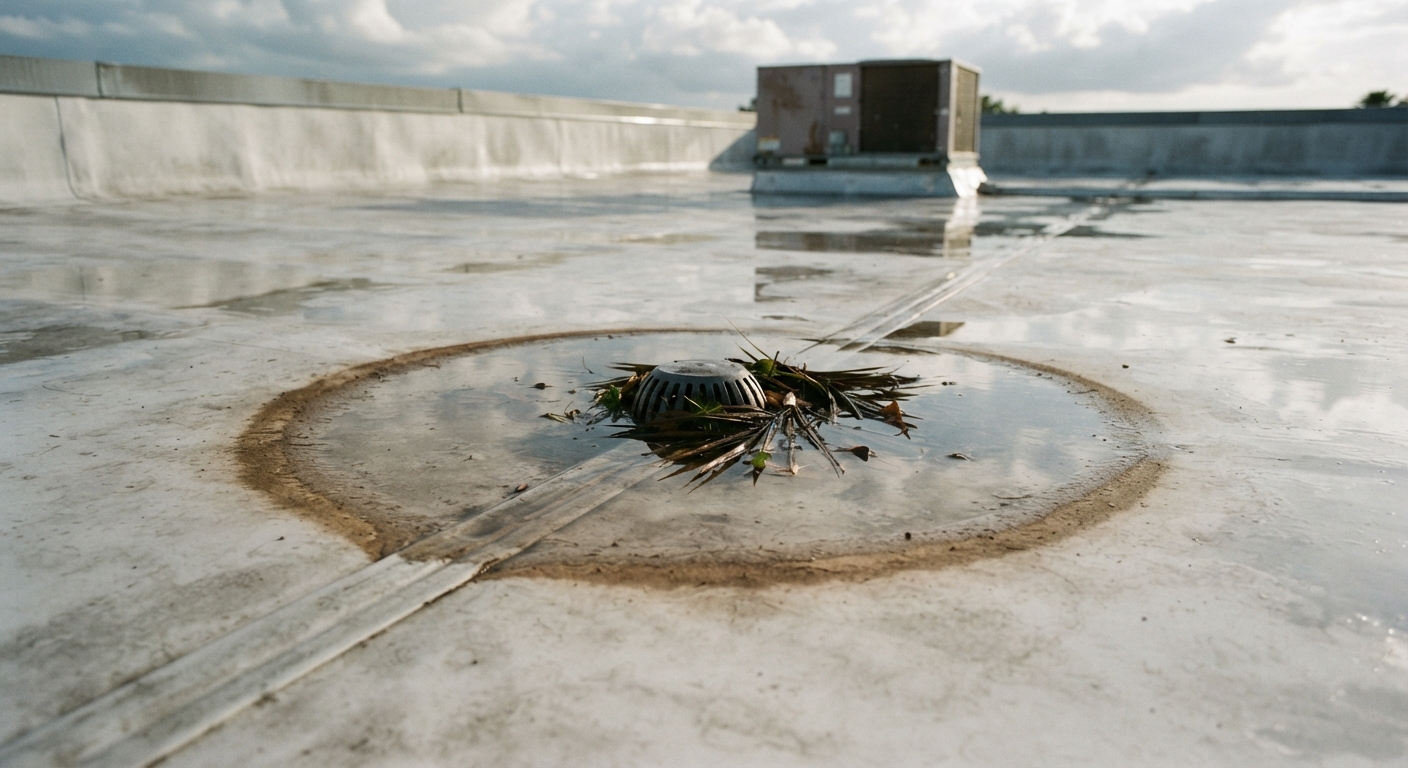
Modified bitumen gets its redundancy from layers. A base ply and a cap sheet are bonded into one membrane, so a single cut in the cap sheet does not by itself open the roof. Its Florida weakness is ultraviolet exposure. Where granules wash away, the exposed bitumen dries, cracks, and alligators. Ponding water speeds aging on all three systems by holding heat, dirt, and moisture against the surface and keeping seams and laps wet, so tapered insulation and clear drains belong in the membrane decision.
Where does each flat roof membrane fall short?
TPO fits large, open roofs that call for a welded white single-ply. PVC fits roofs exposed to cooking grease or chemicals and roofs with dense detailing. Modified bitumen fits roofs that need multi-ply redundancy, heavy maintenance traffic, or compatibility with an existing asphalt roof. Each has a failure mode the owner should plan around before choosing.
| Membrane | Strongest fit on a Florida building | What it does well | Where it falls short | Verify before you specify |
|---|---|---|---|---|
| TPO | Warehouses, distribution centers, and retail boxes with open roof areas | Welded seams; reflective surface; several thicknesses and fleece-backed versions | Grease and chemical exposure; finite weathering surface over the scrim; cold welds; punctures from traffic and debris | Sheet thickness, attachment method, listed assembly and design pressure, warranty maintenance terms |
| PVC / KEE | Restaurants, food processing, and roofs with many exhausts and penetrations | Resistance to fats and oils per manufacturer data; welded seams; flexible for detailing | Incompatible with asphalt without a separation layer; plasticizer loss over time | Chemical-resistance data for the exact sheet, separation layer on recovers, listed assembly |
| Modified bitumen (SBS/APP) | Roofs with heavy maintenance traffic, recovers over compatible asphalt, buildings that want multi-ply redundancy | Multiple plies; granulated cap sheet; torch, hot-mopped, cold-applied, or self-adhered options | Open flame when torch-applied; heavier; granule loss and UV aging; darker surface unless a reflective cap or coating is specified | Application method, reflective cap sheet rating, fire-watch plan, HVHZ listing |
Published service-life figures for these membranes disagree with each other, and none of the ASTM product standards assigns a service life. The comparison an owner can verify rests on the warranty term and conditions for the exact assembly, the sheet thickness, the required maintenance, and the condition of the deck and insulation beneath. No roof membrane is immune to hurricane damage either. Each approved assembly is rated to a tested pressure, storms can exceed it, and warranties carry wind-speed limits and exclusions.
Workmanship is the variable a data sheet cannot show. Carlisle SynTec Systems gave Advanced Roofing its 2020 Excellence in Single-Ply Award, and the company’s announcement reports that Advanced Roofing installed and warranted more than 9.8 million square feet of Carlisle single-ply roofing that year. A statewide contractor built for occupied buildings will not always be the lowest bid on a small, simple roof, which may not need the most complex option here.
What drives cost, schedule, and performance for each membrane?
Advanced Roofing does not publish pricing, and a membrane price comparison that ignores the assembly misleads. The 2026 commercial roofing cost guide builds a Florida budget from the assembly up, and these drivers decide how far apart the three bids land.
| Driver | Why it moves budget, schedule, or performance | Who confirms it |
|---|---|---|
| Wet insulation found in cores | Decides recover eligibility and tear-off quantity under FBC Existing Building Section 706.3 | Roofing contractor, roof consultant |
| Existing roof type and number of coverings | Asphalt under PVC needs a separation layer; two existing coverings force a tear-off under the 8th Edition | Roofing contractor, manufacturer |
| Attachment method and design pressure | Fastened, adhered, and multi-ply assemblies carry different listed pressures and fastening densities, higher at corners and perimeters | Engineer of record, building official |
| Sheet thickness and backing | Thicker sheets add weathering surface and cost; fleece-backed sheets change the adhesive system | Roof consultant, manufacturer data sheet |
| Penetrations and rooftop equipment | Every curb and pipe needs flashing; dense detailing favors the system the crew flashes most reliably | Roofing contractor, mechanical engineer |
| Modified bitumen application method | Torch, hot asphalt, cold adhesive, and self-adhered sheets differ in crew size, fire controls, odor, and weather sensitivity | Roofing contractor, fire official |
| Warranty type and maintenance terms | Longer warranties can require specific assemblies, inspections, and repairs by authorized contractors | Manufacturer, owner |
Reflectance changes the operating side of the ledger. The Cool Roof Rating Council’s rated product directories report tested solar reflectance and thermal emittance for single-ply sheets and cap sheets. DOE notes that dark growth shows more on light roofs in warm, moist climates, so reflectance lasts only while the surface stays clean. Semiannual roof maintenance keeps it clean and builds the record most warranties expect.
What changes when the building stays open during the re-roof?
Torch-applied modified bitumen puts an open flame above occupied space, and NRCA’s Professional Roofing summarized in a July 2024 review of fire-code requirements that NFPA 1 lets the authority having jurisdiction require a permit for roof torching and requires torch-applied systems to comply with NFPA 241, which sets requirements for equipment, personnel qualifications, flame-contact protection, and fire watch. The review notes NFPA 241’s fire watch is stricter than NFPA 1’s one-hour minimum. The local fire official decides which edition and terms apply to a given permit.
Owners who want modified bitumen redundancy over a hospital wing, a school, or a condominium can specify cold-applied or self-adhered sheets instead of torching, at the cost of cure time, temperature sensitivity, and adhesive odor. TPO and PVC seams are welded with hot air and no open flame, though solvent-based adhesives used with adhered single-ply also produce odor, so fresh-air intakes on nearby rooftop units need coordination with the mechanical contractor. Mechanically fastened assemblies on steel decks are loud in the space below.
Advanced Roofing’s commercial re-roofing on occupied buildings follows the same sequence whichever membrane is chosen:
- A pre-construction meeting sets staging, access routes, shutdown windows, and tenant notices.
- Tear-off is limited to what can be dried in the same day, with temporary protection staged ahead of afternoon storms.
- Material and rooftop equipment lifts by the in-house crane division are scheduled outside business hours where the site allows.
- Daily cleanup and photo progress reports give the property manager one record.
- Close-out delivers the permit final, approval numbers, warranty registration, and maintenance schedule.
- If a storm threatens while a section is open, the late-season commercial roof hurricane plan covers securing it.
Which code dates and approvals control a 2026 membrane decision?
As of September 30, 2026, three regulatory items control the choice. The 8th Edition Florida Building Code governs permits applied for before December 31, 2026, and the 9th Edition governs applications on or after that date. The revised Section 706.3, as FRSA has published it, adds an exception for removing the upper of two roof coverings, and the adopted text should be read from the Florida Building Commission before a recover is designed around it. In Miami-Dade and Broward, the HVHZ roofing provisions in Sections 1512 through 1525 of the Florida Building Code, Building, govern the assembly. Advanced Roofing’s Miami commercial re-roofing page lists TPO, PVC, and modified bitumen among the systems it installs there as HVHZ assemblies with Miami-Dade NOA approval. Whether a specific roof may be recovered, which edition governs, and which assembly meets the design pressure are determinations for the engineer of record and the building official.
How do you choose between TPO, PVC, and modified bitumen for your building?
Assign each item to a named person before bids go out.
- Property manager: list every rooftop exposure (grease, chemical vents, foot traffic) and every tenant constraint (hours, noise-sensitive spaces, fresh-air intakes).
- Roofing contractor: core the existing roof, run a moisture survey, and report existing coverings and wet insulation; a commercial drone survey adds an overhead record.
- Roof consultant or engineer of record: name the listed assembly for each option, with its product approval or NOA number and design pressures, including corners and perimeters.
- Manufacturer’s representative: confirm substrate compatibility, including any separation layer for PVC over asphalt, and the warranty’s maintenance terms.
- Fire official: confirm permit and fire-watch requirements before torch-applied modified bitumen is bid on an occupied building.
- Energy lead: check rated reflectance and say now whether rooftop solar is planned, because an array adds penetrations and load the roof and its warranty must accommodate.
- Owner or asset manager: compare bids on the same assembly, thickness, and warranty term, and ask each bidder what its system cannot do; if an insurer’s notice started the project, see the insurance roof-replacement playbook.
At Broward County’s Stirling Road Branch Library, Advanced Roofing and Advanced Green Technologies replaced a failed 21,600-square-foot modified bitumen roof in 2021 with a 115-mil KEE PVC fleece-backed membrane, planned together with a 158 kW solar array.
Frequently Asked Questions
Is PVC better than TPO for a restaurant roof in Florida?
PVC is generally the stronger single-ply choice where kitchen exhaust deposits cooking grease on the roof, because PVC and KEE-enhanced sheets are formulated to resist fats and oils. Confirm resistance with the manufacturer’s chemical data for the exact sheet, add grease containment at each exhaust fan, and keep that area on the maintenance schedule.
Can TPO or PVC be installed over an existing modified bitumen roof?
A single-ply recover over modified bitumen is possible only when the existing roof is dry, adhered, and the only covering, and when Section 706.3 of the Florida Building Code, Existing Building, and the HVHZ sections allow it. Cores and a moisture survey come first. PVC also needs a separation layer from the asphalt, and the recover assembly must be listed in a current product approval.
Is torch-applied modified bitumen allowed on an occupied building?
Torch-applied modified bitumen can be permitted on an occupied building, and the local fire official sets the conditions. NFPA 1 allows the authority having jurisdiction to require a permit for roof torching and directs torch-applied work to NFPA 241, which covers equipment, crew qualifications, and fire watch. Cold-applied and self-adhered modified bitumen avoid the open flame and are the alternatives to evaluate over hospitals, schools, and condominiums.
How long does a TPO, PVC, or modified bitumen roof last in Florida?
Service life depends on the assembly, sheet thickness, drainage, workmanship, and maintenance more than on the membrane name, and published estimates disagree widely. The ASTM product standards set minimum sheet properties and do not assign a service life. For a figure you can hold a bidder to, use the warranty term for the exact assembly and budget the maintenance that keeps it in force.
Does a white roof membrane lower cooling costs in Florida?
A reflective roof reduces heat flow into air-conditioned space, and the U.S. Department of Energy reports that a reflective roof can stay more than 50°F cooler than a conventional roof on a sunny summer afternoon. Actual savings depend on insulation, HVAC equipment, operating hours, and cleaning. White TPO and PVC sheets and reflective modified bitumen cap sheets can all be checked in the Cool Roof Rating Council directory.
Choose the assembly first, then the membrane
TPO, PVC, and modified bitumen each earn their place on Florida roofs, and each fails in a predictable way when it is chosen for the wrong building. The grease and chemicals on the roof point toward or away from PVC, the roof already on the deck decides whether a recover is allowed and what separation it needs, the tenants below decide whether a torch belongs on the job, and the listed assembly decides whether any of it meets the design pressure. With the 9th Edition taking effect December 31, 2026, the permit date belongs on that list too. Settling those questions before bidding puts proposals on equal terms and avoids paying for a second roof early.
Written by The Technical Team at Advanced Roofing. Founded in 1983, Advanced Roofing is 100% employee-owned and was ranked the #13 largest roofing contractor in the U.S. on Roofing Contractor magazine’s 2026 Top 100 list.
To compare TPO, PVC, and modified bitumen on your building’s actual assembly, request a commercial roofing quote online or call (800) 638-6869.