
At a glance: Florida condominium boards now hold two statutory documents that talk about the roof: the milestone inspection, which rates it as part of a structural review, and the structural integrity reserve study (SIRS), which sets how much money must be reserved to replace it. This article explains what each records, why neither tests the roof for trapped water, how the roof reserve line is built, what changes when a roof is replaced over occupied units, and which dates control the decision through 2028. It closes with a checklist assigned by role.
A condo milestone inspection roof entry and the roof line in a structural integrity reserve study (SIRS) answer different questions, because the milestone inspection asks whether the building is structurally safe and the SIRS asks how much money must be in reserve when the roof wears out. Neither is a roof moisture survey, and a board that reads a Fair roof rating as a replacement date can reserve for the wrong year, then close the gap with a special assessment when core samples turn a planned recover into a tear-off. The statute allows no initial SIRS to be completed after December 31, 2026, so boards still finishing one have a single budget cycle to get the roof numbers right. This article explains what each document records about the roof and where each falls short; it does not interpret any association’s declaration or replace its engineer, reserve professional, or attorney.
Why is December 31, 2026 a deadline for condo roof decisions?
Florida’s condominium safety laws followed the June 24, 2021 partial collapse of Champlain Towers South in Surfside, which the Division of Florida Condominiums, Timeshares and Mobile Homes notes took 98 lives. Section 553.899, Florida Statutes, requires a milestone inspection of every condominium or cooperative building three habitable stories or taller by December 31 of the year it turns 30, then every 10 years; the local enforcement agency may move the first inspection to year 25 where conditions such as proximity to salt water warrant it. Section 718.112(2)(g), Florida Statutes, requires a SIRS at least every 10 years for the same buildings and lists the roof first among its components.
The dates now converge. As of September 30, 2026, section 718.112(2)(g)7. set December 31, 2025 as the completion date for associations existing on or before July 1, 2022, lets an association with a milestone inspection due on or before December 31, 2026 complete both together, and bars any initial SIRS from being completed after December 31, 2026. For budgets adopted on or after December 31, 2024, owners cannot vote to waive or reduce reserves for SIRS components, the roof included, and directors who willfully and knowingly fail to complete the study breach their fiduciary duty. The 9th Edition of the Florida Building Code takes effect the same day, so a 2027 roof permit may fall under a different code edition than the SIRS preparer assumed; the building official decides which edition governs.
What does a condo milestone inspection roof review actually record?
A milestone inspection is a structural inspection, and its roof findings are structural findings. Section 553.899 defines it as an architect’s or engineer’s review of load-bearing elements and primary structural systems, says its purpose is not code compliance, and excludes signs of leakage from substantial structural deterioration unless the inspector judges otherwise. Phase one is visual; phase two testing follows only when phase one finds substantial structural deterioration.
The Florida Building Commission’s standardized Milestone Inspection Report Form EB 18-2024 shows the level of roof detail. Its Floor and Roof System section records roof pitch, framing, deck material, cladding type, a Good, Fair, or Poor covering rating, supports under tanks and air conditioning equipment, drains, parapets, and expansion joints, each a visual judgment made on inspection day.
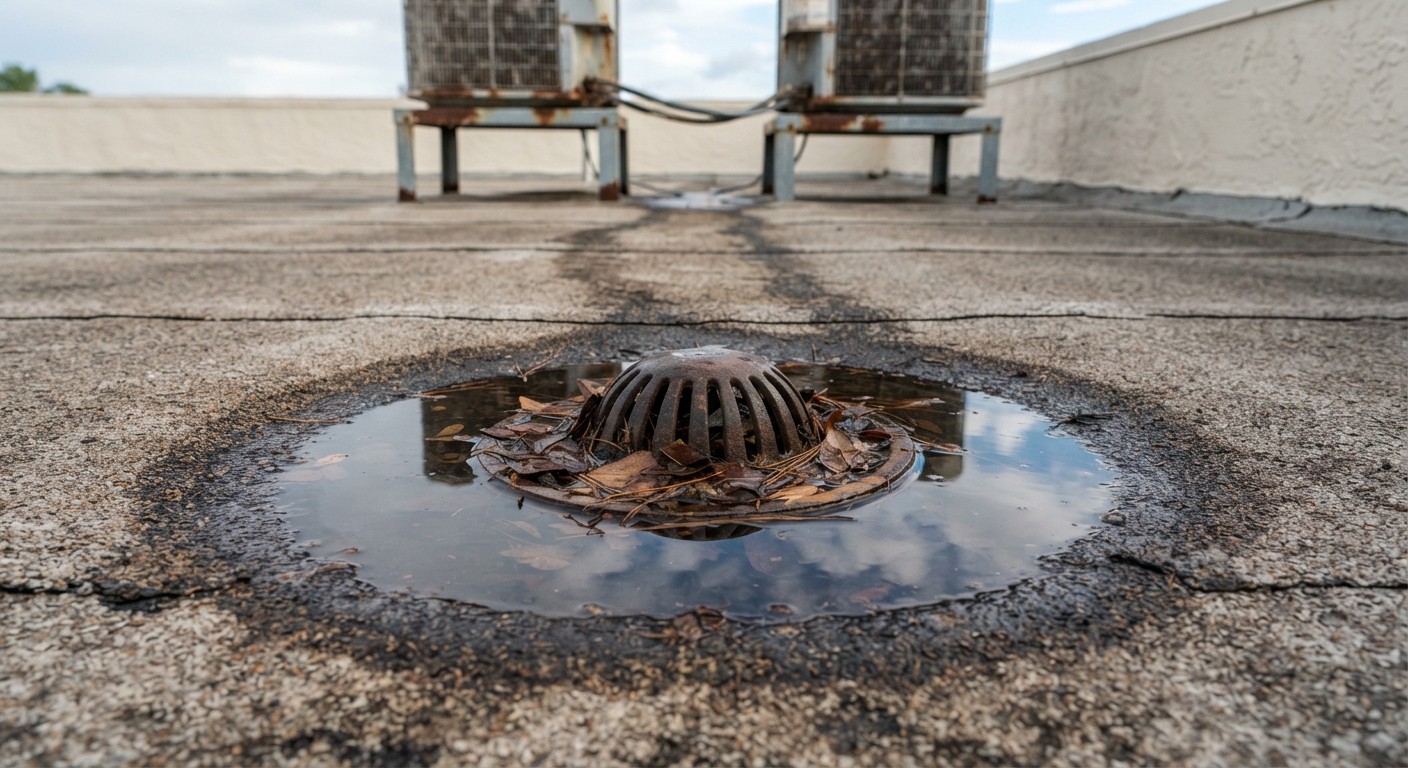
The roof matters to the structure because water moves down. A breach at a seam or a condenser-stand penetration lets water into the insulation, where it spreads under a membrane that still looks intact. On many Florida condominium towers the layer below is lightweight insulating concrete over steel deck, or a structural concrete slab. Wet insulation holds water against that deck, corrodes steel deck and fasteners, and, where water reaches reinforcing steel in a slab or parapet, feeds the rust expansion that spalls concrete.
FEMA’s P-2181 fact sheet on low-slope roof systems (March 2022) identifies edge flashings and copings as a common starting point for wind failure on membrane roofs, so the parapet line on the milestone form deserves attention even when the covering is rated Fair.
| Roof question | Milestone inspection (phase one) | SIRS | Roof condition assessment with cores |
|---|---|---|---|
| Is the roof structure sound? | Primary focus of the inspection | Visual review only | Reports deck condition found at each core |
| Is the insulation wet? | Not tested unless phase two is triggered | Not tested | Infrared or impedance survey confirmed by core samples |
| Condition of the roof covering | Good, Fair, or Poor rating | Estimated remaining useful life | Membrane, seam, flashing, and edge findings with photographs |
| Replacement cost | Not required | Estimated replacement cost required | A defined scope a contractor can price |
| Rooftop equipment supports | Condition of supports noted | Included where the item meets the statutory threshold | Curb, stand, and flashing detail |
| Who performs it | Florida-licensed architect or engineer | Engineer, architect, or CAI- or APRA-credentialed reserve professional | Roof consultant or licensed roofing contractor |
Milestone inspection vs SIRS vs roof assessment: which answers the board’s roof question?
Each document is built for one job, and the roof decision needs pieces of all three. Under section 718.112(2)(g)8., a milestone inspection from the past five years that meets the SIRS requirements can stand in for the SIRS visual inspection. The SIRS preparer still has to produce the remaining-useful-life estimate and replacement cost the milestone form never asked for.
| Option | What it gives the board | Where it falls short |
|---|---|---|
| Phase one milestone inspection | Sealed structural finding, a roof covering rating, and a list of items needing further inspection | Visual only; no moisture testing; not a code-compliance or roof-life determination |
| Phase two milestone inspection | Testing and a repair program for areas of structural distress | Triggered only by substantial structural deterioration; scope is set by structural need, not roof budgeting |
| Structural integrity reserve study | Remaining useful life, replacement cost, and a baseline funding plan for the roof | Based on a visual inspection; only as accurate as the roof data the preparer receives |
| Roof condition assessment with cores and moisture survey | Measured wet area, deck findings, and recover eligibility | Not a statutory document; counts only when delivered to the engineer or reserve professional |
| Free contractor inspection | A quick opinion and a proposal | The bidder has an interest in the outcome; statute requires written disclosure of related bids |
The practical answer is to commission the statutory documents from the professionals the statutes name and give them better roof data. A moisture survey confirmed by core samples tells the reserve professional whether the next roof can be a recover or must be a tear-off, and the 2026 Florida commercial roofing cost guide shows how that one finding moves a budget. A commercial drone survey adds a current overhead record, and Advanced Roofing’s roof management program keeps inspection reports, repair history, and warranty records for the next preparer.
Contractor independence is written into the statute. A contractor who bids to perform a SIRS must disclose in writing any intent to bid on the work it recommends, and section 553.899(12) sets parallel rules for milestone inspections. A roofing contractor, Advanced Roofing included, does not sign milestone inspections or SIRS reports. Its role is measured roof data before the study and the roof itself after the board decides.
What drives the roof line in a structural integrity reserve study?
The roof reserve line is an estimated replacement cost spread across the roof’s estimated remaining useful life and adjusted each year. The Division’s example uses a roof that will cost $100,000 to replace in 10 years. The association does not need the full $100,000 on hand today, only enough each year to have the money available when the work is due without the reserve balance falling below zero. Section 718.112(2)(g)4. requires every SIRS to include at least a baseline funding plan built on that rule, and the Division states that from 2026 the replacement cost of items of $25,000 or more must account for inflation.
| Driver | Effect on the roof reserve line | Who confirms it |
|---|---|---|
| Remaining useful life estimate | A shorter life raises the annual contribution | SIRS preparer, informed by the roof assessment |
| Recover eligibility | A tear-off carries new insulation and disposal that a recover does not | Roof consultant and building official |
| Share of wet insulation | Moves the scope from recover toward tear-off | Moisture survey confirmed by core samples |
| High-Velocity Hurricane Zone location | HVHZ assemblies and Miami-Dade product approvals apply | Building official |
| Rooftop equipment | Lifting and resetting condensers adds crane time and trade coordination | Contractor, mechanical engineer, association attorney |
| Code edition at permit | 9th Edition rules apply to permits governed by it after December 31, 2026 | Building official |
| Funding method | Special assessments, lines of credit, and loans require a majority of total voting interests | Board and association attorney |
This article quotes no roof cost for any building. The statute requires an updated SIRS before the board adopts any budget whose reserve funding does not align with the study, so a roof estimate that changes after cores are pulled belongs in an updated study before the next budget. Repairs can be right for a roof with years left, while repeated repairs past its service life cost more over time than replacement. A restoration coating can extend the life of a dry, adhered roof, yet it does not fix wet insulation or a deteriorated deck, and a coating warranty is not a new-roof warranty.
What changes when a condo roof is replaced over occupied units?
A condominium roof is replaced over people who are home. Top-floor owners live directly under the tear-off, and rooftop condensers often serve individual units. Each section torn off is dried in the same day, crane picks over entrances are scheduled with the property manager, and owners get notice before their equipment is disconnected. Whether a condenser belongs to the association or a unit owner is a declaration question for the association’s attorney, and the answer decides who pays to lift and reset it.
Advanced Roofing’s condominium re-roofing work follows that pattern. At the 23-story Aquazul Condominium in Fort Lauderdale, where foot traffic around equipment had worn out a 15-year-old roof, Advanced Roofing used its in-house crane division to replace 10,223 square feet without disrupting residents, earning 3rd place in the Low Slope category of FRSA’s 2018 S.T.A.R. Awards. The nine-area Rapallo North Condominium re-roof in West Palm Beach earned 1st place in the Low Slope category of FRSA’s 2019 S.T.A.R. Awards. At the Towers of Oceanview East condominium in Hallandale, sister company Advanced Air Systems raised more than 200 air conditioning units onto new hurricane stands while Advanced Roofing replaced the roof.
In Miami-Dade and Broward, the High-Velocity Hurricane Zone sections of the Florida Building Code and Miami-Dade product approvals govern the roof assembly. Hurricane season runs June 1 through November 30, so a replacement approved at a winter budget meeting is easier to stage when most of the tear-off falls outside it. No roof assembly is immune to a storm that exceeds its design pressures, and warranties carry wind-speed limits and exclusions the board should read before signing.
Which Florida statutes and code dates control the roof decision in 2026 and 2027?
As of September 30, 2026, these dated rules govern the roof decision. Re-check each against the current statute and the association attorney’s advice before the board acts.
- SIRS completion. No initial SIRS may be completed after December 31, 2026, even when paired with a milestone inspection (section 718.112(2)(g)7.).
- SIRS delay. A required SIRS may be delayed for up to the two budget years immediately following a milestone inspection to fund its repairs (section 718.112(2)(g)9.).
- Reserve pause. For budgets adopted on or before December 31, 2028, a majority of the total voting interests may pause or reduce reserves for up to two consecutive budgets to fund recent milestone repairs; a new SIRS is required before contributions resume (section 718.112(2)(f)2.e.).
- Phase two repairs. Repairs for substantial structural deterioration must be commenced within 365 days after the phase two report is received (section 553.899(11)).
- Owner distribution. The milestone summary and the SIRS, or notice of its availability, go to owners within 45 days of receipt.
- Florida Building Code, 9th Edition. Effective December 31, 2026. FRSA has published an approved modification to Existing Building Section 706.3 that would let an adequate existing substrate remain when an upper roof system is removed; recovering stays prohibited over water-soaked or deteriorated coverings or two or more coverings. Confirm the adopted text with the building official.
Condo roof checklist: who owns each step before the next budget?
- Board secretary: confirm the certificate of occupancy date, the milestone due date, and the SIRS completion date, and file each director’s affidavit acknowledging receipt of the SIRS.
- Community association manager: send the roof record (installation date, permits, warranty, repair invoices, leak history by unit) to the engineer and reserve professional before their site visits.
- Engineer or architect: state which roof-related items need further inspection and whether any roof condition indicates structural deterioration.
- Reserve professional: document the basis for the roof’s remaining useful life and replacement cost, including whether it assumes a recover or a tear-off.
- Roof consultant or roofing contractor: run a moisture survey confirmed by cores, photograph perimeter and equipment supports, and disclose any intent to bid in writing.
- Association attorney: confirm rooftop equipment ownership, the vote each funding method requires, and disclosure compliance.
- Treasurer: confirm the SIRS reflects the chosen funding method before the budget is adopted; if the insurer is also questioning roof age, see the insurance roof replacement playbook.
- Procurement: compare bids using how to select a roofing contractor; a statewide contractor built for occupied high-rises may not be the lowest bid on a small, simple roof.
- Operations: fund semiannual roof maintenance inspections so the warranty stays in force; CAMs can add the property manager continuing education courses.
Frequently Asked Questions
Does a condo milestone inspection include the roof?
Yes, as part of a structural review. The state’s standardized report form asks the architect or engineer to record the roof framing, deck, covering type and a Good, Fair, or Poor covering rating. Phase one is visual and is not a moisture survey, so it does not show whether the insulation is wet or how long the roof will last.
Is the roof required in a structural integrity reserve study?
Yes. Section 718.112(2)(g), Florida Statutes, lists the roof first among the components a SIRS must cover for condominium buildings three habitable stories or taller. The study must state the roof’s remaining useful life and replacement cost and include a funding plan that reaches that cost in time.
Can a milestone inspection replace the SIRS inspection?
Partly. A milestone inspection completed within the past five years that meets the SIRS requirements may replace the visual inspection portion of the SIRS. The preparer still has to estimate the roof’s remaining useful life and replacement cost and build the funding plan.
Can a condo board waive roof reserves in Florida?
Not in an association that must obtain a SIRS. For budgets adopted on or after December 31, 2024, owners cannot vote to waive or reduce reserves for SIRS components, including the roof. A temporary pause to fund milestone repairs is available under conditions the association attorney should confirm.
Can a roofing contractor perform a SIRS?
No. A SIRS must be performed or verified by a Florida-licensed engineer or architect, or a reserve professional credentialed by the Community Associations Institute or the Association of Professional Reserve Analysts. A roofing contractor can supply roof data and must disclose in writing any intent to bid on recommended work.
What happens if the SIRS roof estimate turns out to be wrong?
The association updates the study. Florida law requires an updated SIRS before the board adopts a budget whose reserve funding does not align with the study’s plan. A moisture survey with core samples before the study reduces the chance of a large correction later.
Give the roof its own evidence before the reserve schedule is set
The milestone inspection rates the roof as part of the structure and the SIRS prices it, yet neither measures the water that decides whether the next roof is a recover or a tear-off. With initial SIRS completion closing on December 31, 2026 and roof reserves no longer open to a waiver vote, the roof number in the study becomes the number owners fund. A moisture survey confirmed by cores, delivered to the engineer and reserve professional before they finish, gives that number a measured basis. The board keeps the decision, and the licensed professionals the statutes name keep the determinations.
Written by The Technical Team at Advanced Roofing. Founded in 1983, Advanced Roofing is 100% employee-owned and re-roofs occupied buildings across Florida.
To give your engineer and reserve professional measured roof data before the next budget meeting, schedule a condo roof inspection online or call (800) 638-6869.