
At a glance: The Florida Building Code expects a low-slope roof to drain within 48 hours of rain, and water that stays longer is ponding. This guide covers the code definition and the December 31, 2026 edition change, the mechanisms behind most ponding, a comparison of fixes with where each falls short, how primary and overflow scuppers work, what drives cost and schedule on an occupied building, and a checklist of who does what.
Commercial roof ponding water Florida property managers find after an afternoon storm has a code definition, because the Florida Building Code expects a low-slope roof to drain within 48 hours of precipitation, and water that stays longer marks a slope, outlet, or deck problem that will not correct itself. The fix depends on which of those three is failing, and a wrong diagnosis costs twice, because a coating over a deflecting bay or new tapered insulation feeding an undersized scupper can leave more weight on the roof than before while the membrane under the pond keeps aging. This guide explains why Florida commercial flat roofs pond, how drains and commercial roof scuppers work as primary and overflow systems, which repairs hold, and where each one falls short. It does not calculate rain loads or decide code compliance for a specific building, because those determinations belong to the engineer of record and the building official.
What does the Florida Building Code count as ponding water?
Ponding water on a commercial roof is water that remains on the surface 48 hours after rain, and the Florida Building Code builds that test into its definition of positive roof drainage. The 8th Edition (2023) defines positive roof drainage as the condition in which all loading deflections of the roof deck have been considered and sufficient slope has been provided to drain the roof within 48 hours of precipitation, according to FRSA’s July 2023 summary of 8th Edition definition changes. The same article explains that the 8th Edition replaced the word additional with sufficient, which removed an argument that every reroof must add slope.
The Asphalt Roofing Manufacturers Association’s ponding water bulletin (October 2024) uses the same 48-hour threshold and recommends a minimum slope of one-quarter inch per foot, a position it says NRCA and IIBEC share. Chapter 15 of the Florida Building Code, Building, 8th Edition sets minimum design slopes for low-slope roof coverings, and Chapter 11 of the Florida Building Code, Plumbing governs how drains and scuppers are sized. An FRSA legal column published in 2017 adds a regional caveat: the NRCA 48-hour definition reflects Midwest drying conditions with lower humidity and more wind, so a marginal roof can hold water longer through a Florida wet season than the same slope would elsewhere.
The timing matters this year. The 9th Edition (2026) of the Florida Building Code takes effect December 31, 2026, according to the Florida Building Commission, and the permit application date generally determines which edition governs a drainage repair or reroof.
Why do commercial flat roofs develop ponding water?
Short answer: Commercial flat roofs pond when water reaches a low point faster than a drain or scupper can remove it, or when a low point has no outlet at all. In Florida, the usual causes are clogged outlets, too little slope, deck deflection, and rooftop equipment that blocks flow. The fix starts with clearing outlets, then corrects slope, outlet capacity, or the deck.
Advanced Roofing’s guide to common commercial roof problems lists ponding among seven frequent leak sources. Most roofs have more than one of the mechanisms below.
Table 1. What causes ponding water on a commercial flat roof
| Cause | What happens physically | Typical sign | Who confirms it |
|---|---|---|---|
| Clogged or obstructed outlets | Debris, palm fronds, loose gravel, or a displaced strainer cuts flow at a drain or scupper and water backs up behind it | Pond centered on a drain, or along a parapet at a scupper | Roofing contractor on a maintenance visit |
| Insufficient slope | The structure or insulation provides less fall than the roof covering needs, so water spreads into shallow sheets | Wide, shallow ponds and dirt rings across the field | Roof consultant or contractor with a slope survey |
| Deck deflection | Water weight bends the deck, the bend holds more water, and the cycle repeats | Ponds at mid-span between supports that deepen each season | Structural engineer |
| Flow obstructions | Equipment curbs without crickets, raised seams, or a drain set higher than the roof around it | Ponds on the upslope side of rooftop units and skylights | Roofing and mechanical contractors |
| Wet or crushed insulation | Saturated or compressed boards settle and form depressions | Soft spots underfoot; ponds that grow after foot traffic | Cores and a moisture survey |
Deflection is the mechanism that turns ponding into a structural question. Section 1611 of the Florida Building Code, Building, Chapter 16, as reproduced in FRSA’s 2017 column on ponding water and manufacturer warranties, computes rain load at 5.2 pounds per square foot for each inch of water depth and requires susceptible bays to be evaluated for ponding instability under ASCE 7. A bay that deflects under water collects more water, which deflects it further. ARMA’s bulletin lists the slower membrane damage: biological growth, and alligator cracking as dried sediment shrinks and pulls at the surface.
Florida roofs add three local sources. Rooftop air-conditioning condensate that discharges onto the membrane instead of into a drain keeps a pond wet through the dry season, a condition ARMA calls out directly. Palm debris and wind-blown trash clog strainers after afternoon storms, which is why a Florida commercial roof maintenance schedule adds drain checks after every named storm. FRSA’s 2017 column also notes that replacing part of a roof can change its geometry enough to create new ponding.
Which fixes work for flat roof drainage problems?
The fix for flat roof drainage problems has to match the cause, and every option has a condition where it fails. FRSA’s 2017 column groups the prevalent remedies into three families: adding outlets such as drains, scuppers, or gutters; reshaping the roof surface with tapered insulation, crickets, or fill; and correcting the deck itself. Coatings appear in that column only as a lesser method, and the ARMA bulletin recommends crickets upslope of equipment and saddles between drains as part of a tapered system.
Table 2. Ponding water fixes compared
| Fix | Best for | What it involves | Where it falls short |
|---|---|---|---|
| Clear and maintain outlets | Ponds centered on a clogged drain or scupper | Remove debris, reset strainers, tighten drain clamping rings, add outlets to the maintenance schedule | Does nothing for slope, deflection, or undersized outlets |
| Add or enlarge drains or scuppers | Large areas served by too few or undersized outlets; low points with no outlet | New drain bodies and interior piping, or through-wall scuppers with collector heads and leaders; overflow added where missing | Interior drain work disturbs ceilings and tenants; capacity must be checked against the code storm by a design professional |
| Tapered insulation, crickets, and saddles | Too little slope; water trapped upslope of curbs or between drains | A taper plan tied to drain locations, crickets on the high side of equipment, saddles between drains | Raises the roof surface against curbs, thresholds, and base flashing heights; adds weight; concentrates water if outlets are undersized |
| Deck repair or reinforcement | Deflection or a deteriorated deck | Engineer-designed reinforcement or deck replacement in affected bays | Requires a structural engineer and usually removing the roof over that area |
| Localized fill or a ponding-rated coating | Small, shallow birdbaths on an otherwise sound roof | Manufacturer-approved fill, or a coating rated for standing water | Does not remove water; does not fix wet insulation or deflection; may not satisfy warranty or code drainage requirements |
Order matters. Clearing outlets comes first because it is cheap, fast, and diagnostic: a pond that disappears once the strainer is cleared was a maintenance problem that a preventive roof maintenance program addresses, and a pond that remains after the drain runs freely is a slope, capacity, or structural problem. That second case calls for a commercial roof repair scope or, on an aging roof, a re-roofing assessment, since a reroof is the least disruptive moment to install tapered insulation and new outlets.
FRSA’s 2018 article on tapered insulation warns that a regraded roof can hold a large volume of water if its primary drain clogs, so taper and overflow capacity are designed together. A coating suits only shallow areas on a dry, sound roof; the restoration versus replacement guide explains why no coating can be applied over wet insulation.
What drives the cost and schedule of a ponding water fix?
A ponding correction has no meaningful per-square-foot price before the cause is known, because the variables below change the work more than roof size does. Budget from a site-specific proposal built on a slope survey and cores.
Table 3. Cost and schedule drivers for a ponding water fix
| Driver | Why it moves cost or schedule | Who determines it |
|---|---|---|
| Root cause | Clearing a drain is a service call; deck repair is a structural project | Roofing contractor, then a structural engineer if deflection is suspected |
| Outlet count and type | Interior drains need new piping inside the building; through-wall scuppers need sheet metal and exterior leaders | Design professional sizing to the Florida Building Code, Plumbing, Chapter 11 |
| Taper design and thickness | Thicker taper raises curbs, flashing heights, and edge details | Contractor’s taper plan reviewed against the Florida Building Code, Chapter 15 |
| Insulation condition | Wet boards found by cores must come out before any recover or regrading | Cores and moisture survey |
| HVHZ location | Miami-Dade and Broward follow separate roofing sections and require approved products | Building official |
| Occupied-building constraints | After-hours work, ceiling protection, and phased sections extend the schedule | Owner, property manager, and contractor |
How do commercial roof scuppers and overflow drains protect an occupied Florida building?
Commercial roof scuppers are openings in a parapet or roof edge that let water leave the roof sideways, and on Florida buildings they serve either as primary drainage or as the emergency overflow behind interior drains. The storm drainage provisions FRSA reproduced in 2017 require secondary drains or scuppers wherever a parapet would trap water if the primary drains clog, size that secondary system without counting any flow through the primary system, set a minimum scupper opening of 4 inches, and require secondary discharge above grade where building staff will notice it. Rain loads are based on the 100-year hourly rainfall rate; NOAA’s Precipitation Frequency Data Server publishes rainfall estimates by location, and the design professional selects the rate for the building.
Scuppers fail in a way drains do not. An IIBEC Interface article by roof consultant Philip Dregger (October 2013) investigated a roof collapse where base flashings from a prior reroof covered the overflow scuppers and the primary scupper was undersized by a factor of four or more. Citing FM Global and ASCE data, the article explains that a 6-by-6-inch scupper discharges far less water than a 6-inch round drain at the same water depth, because water leaves sideways without the weight of the pond pushing it down. The storm that preceded the collapse delivered less than the 100-year hourly total, yet exceeded the design per-minute rate for roughly 20 minutes. The case is from a western state under 2009 model codes, and its lesson about covered and undersized overflows applies to any parapet roof.
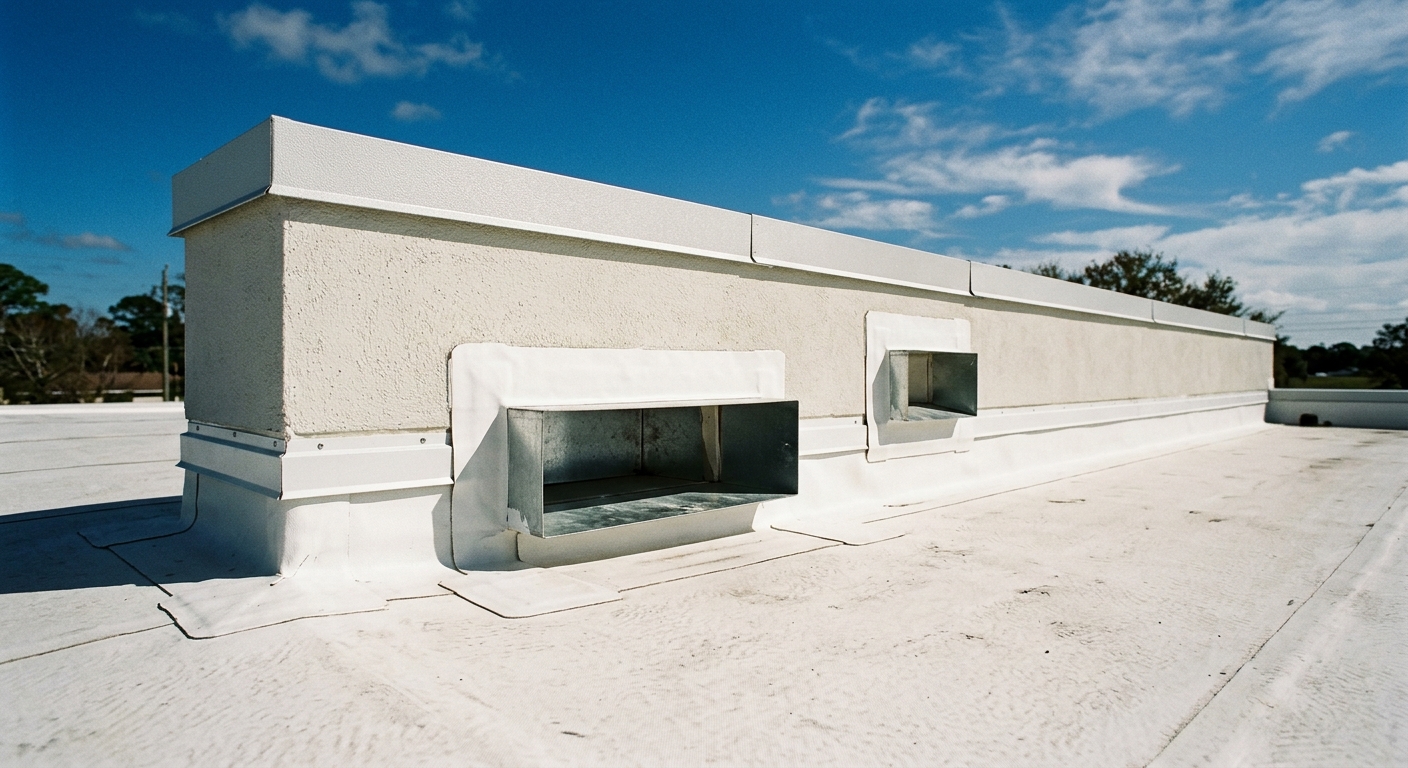
On an occupied building, drainage work is sequenced around the people below it. Adding an interior drain means cutting the deck, running piping through a ceiling, and tying into the storm line, so the work is scheduled after hours in retail and office space and coordinated with facility staff in medical buildings. Through-wall scuppers move most of the work outside. Advanced Roofing performs sheet metal fabrication in-house, which keeps scupper metal and membrane flashing under one contractor, and rooftop condensate lines can be rerouted to drains through its air conditioning division in the same scope. Building staff who clear strainers between visits need fall protection that meets OSHA’s walking-working surfaces standard, 29 CFR 1910.28.
Which code and warranty rules apply before you fix ponding?
Three sets of rules shape a ponding repair: the building code, the roof manufacturer’s warranty, and the permit edition. On reroofing, FRSA’s 2018 tapered insulation article explains that the existing-building code exempts a reroof from the one-quarter-inch-per-foot minimum slope when the roof provides positive drainage, so a one-eighth-inch taper can comply if the roof actually drains within 48 hours. HVHZ roofs in Miami-Dade and Broward follow separate sections. The article quotes the 2017 edition, so confirm the 8th Edition text before a design relies on it.
Warranties are the second constraint. FRSA’s 2017 column reports that typical commercial manufacturer warranties require positive drainage or exclude membrane failure caused by its absence, and that some manufacturers limit the surface area ponding may cover. The same column states that passing building department and manufacturer inspections does not relieve a contractor of code compliance. Read the warranty for the installed system before choosing a fix, and send coverage questions to the manufacturer.
As of October 14, 2026, permits applied for before December 31, 2026 generally fall under the 8th Edition. Whether a drainage correction needs a permit, and under which edition, is the building official’s decision.
Commercial roof ponding water Florida checklist: who does what?
The sequence runs from the cheapest diagnosis to the most involved fix.
- Property or facility manager: photograph ponds 48 hours after a heavy rain, with the date, a location on a roof plan, and approximate depth, and keep the record in the roof file.
- Property or facility manager: pull the manufacturer warranty and identify its drainage or ponding language before calling for repairs.
- Roofing contractor: clear and inspect every drain, strainer, and scupper, then report which ponds remain once outlets run freely.
- Roofing contractor or roof consultant: survey slope at the remaining ponds, take cores where insulation may be wet, and add a commercial drone survey on large roofs.
- Structural engineer: evaluate any bay where ponds deepen season to season or where the deck visibly sags.
- Design professional: confirm primary and overflow capacity against the Florida Building Code, Plumbing, before outlets are added or resized.
- Mechanical contractor: route rooftop condensate lines to drains and confirm crickets around new or replaced curbs.
- Owner or asset manager: approve a fix only after the cause is identified, and fold permanent correction into the next reroof when the roof is near the end of its service life.
Frequently Asked Questions
How long can water sit on a commercial flat roof in Florida?
Water should clear within 48 hours of rain. The Florida Building Code’s definition of positive roof drainage uses that 48-hour window, and ARMA and most membrane manufacturers use the same threshold. Water still standing after two days of drying weather is ponding. Shallow water that clears within a day after an afternoon storm is normal on a low-slope roof, though repeated near-misses at the same spot are worth inspecting.
Does ponding water void a commercial roof warranty?
It can. Many commercial manufacturer warranties require positive drainage or exclude membrane damage caused by its absence, and some limit the area ponding may cover. Whether a specific condition affects a claim depends on the warranty language for your installed system. Read that document, record ponds with dated photographs, and direct coverage questions to the manufacturer.
What is the difference between a roof drain and a scupper?
A roof drain sits in the field of the roof and carries water down through piping inside the building. A scupper is an opening in a parapet or roof edge that discharges water sideways to a collector head and leader outside. At the same water depth, a round drain moves considerably more water than a scupper of similar size, so scuppers are sized for their own flow characteristics.
Are overflow scuppers required on a flat roof in Florida?
Where parapets or other perimeter construction would trap water if the primary drains clog, Florida’s building and plumbing codes require a secondary drainage system, which can be overflow scuppers or overflow drains. That secondary system is sized without counting flow through the primary drains. Whether your building needs added overflow capacity is a determination for the design professional and the building official.
Can a roof coating fix ponding water?
A coating does not remove water from a roof. Some coatings are rated by their manufacturers for standing water and can protect shallow low spots on an otherwise sound roof. A coating cannot correct wet insulation, a deflecting deck, or undersized outlets, and it may not satisfy warranty or code drainage requirements. Use one only after the cause of ponding is known.
Is ponding water dangerous to the building structure?
It can be. The Florida Building Code’s rain-load equation assigns 5.2 pounds per square foot to each inch of water depth, and a bay that deflects under that weight collects more water. Most ponding is a membrane-aging problem, but ponds that deepen season to season, a sagging deck, or covered overflow scuppers call for a structural engineer’s evaluation.
Fix the cause of ponding before you fix the roof surface
Ponding water on a Florida commercial flat roof is a drainage condition with a code definition, and the 48-hour test tells an owner when a pond has crossed from normal to defective. The correct fix follows the cause: clear outlets first, correct slope with tapered insulation and crickets, add or enlarge drains and scuppers where capacity is short, and bring in a structural engineer where the deck deflects. Overflow scuppers deserve the same attention as primary drains, because the IIBEC collapse case shows what follows when they are covered or undersized. Dated photographs and a warranty read before the repair give the owner a decision that holds up with the board and the manufacturer.
Written by The Technical Team at Advanced Roofing. Founded in 1983, Advanced Roofing is 100% employee-owned and was ranked the #13 largest roofing contractor in the U.S. on Roofing Contractor magazine’s 2026 Top 100 list.
To have the drains, scuppers, and slope on your roof evaluated, request a free commercial roofing quote or call Advanced Roofing at (800) 638-6869.