
At a glance: The R-value target for a Florida commercial reroof comes from the energy code, the climate zone, the occupancy, and the permit date, and it should be fixed before bids go out. This guide sets out the 8th Edition minimums (R-20ci and R-25ci, with an R-25ci Group R column), the polyiso thicknesses that reach them, how tapered layouts are counted, what the 9th Edition changes on December 31, 2026, the disputed question of whether a reroof triggers the code, and a checklist that assigns each decision to the right professional.
On a Florida reroof, the commercial roof insulation R-value Florida’s energy code assigns to the building’s climate zone, occupancy, and permit date should be settled before anyone picks an insulation product, because that number sets the thickness of the new assembly, and the thickness sets flashing heights, curb work, fastener lengths, and much of the bid. An owner who leaves the target to the tear-off risks a change order when wet boards are cored out or an inspection hold over a thin tapered layout at the drains. This guide explains the 8th Edition minimums, what the 9th Edition changes on December 31, 2026, and where the reroof trigger is genuinely disputed. It does not determine compliance for any specific building, which is the job of the design professional and the building official.
Why the Florida energy code roofing question changes on December 31, 2026
The Florida Building Code, Energy Conservation, 8th Edition (2023) governs commercial roof insulation in Florida today, and the 9th Edition (2026) takes effect on December 31, 2026. The 8th Edition is built on the 2021 International Energy Conservation Code with Florida amendments, according to PIMA’s Florida roof insulation fact sheet, and in February 2024 the Florida Building Commission certified to the U.S. Department of Energy that its commercial provisions meet ASHRAE Standard 90.1-2019. The 9th Edition adds 2024 IECC modifications to that base, per the Commission’s Analysis of Changes for the 9th Edition commercial energy provisions.
Permit applications filed before the effective date are generally reviewed under the 8th Edition and later applications under the 9th; the building department confirms which applies. Two 9th Edition changes reach low-slope roof insulation. New Section C402.1.3.2 bars area-weighted averaging for R-value compliance, except that tapered above-deck insulation may comply by multiplying the rated R-value per inch by the average thickness. The Existing Building volume revises Section 706.3 so that, where two roof coverings exist, the upper system can be removed and an adequate lower substrate can stay, according to the Commission’s Analysis of Changes for the 9th Edition Existing Building volume and FRSA’s summary of the approved 9th Edition reroofing modifications.
Neither change lowers a minimum R-value. As of November 3, 2026, the Commission’s 9th Edition commercial analysis lists no change to the roof insulation rows for Climate Zones 1 and 2. Confirm that against the adopted table before relying on it for a 2027 permit, and have the designer of any commercial re-roofing project state which edition the drawings follow.
What commercial roof insulation R-value Florida’s energy code requires in 2026
Under the 8th Edition (2023) Florida Building Code, Energy Conservation, a commercial low-slope roof with insulation entirely above the deck needs at least R-20 continuous insulation in Climate Zone 1 and R-25 in Climate Zone 2 for most occupancies. Group R buildings, such as condominiums and hotels, need R-25 in both zones. An assembly U-factor path is also permitted.
| Climate zone | Counties (Florida table) | All other occupancies | Group R (condo, hotel, dorm) | U-factor alternative (all other / Group R) |
|---|---|---|---|---|
| Zone 1 | Broward, Collier, Hendry, Lee, Miami-Dade, Monroe, Palm Beach | R-20ci | R-25ci | U-0.048 / U-0.039 |
| Zone 2 | All other Florida counties | R-25ci | R-25ci | U-0.039 / U-0.039 |
The county list matters more than it appears. The model 2021 IECC places four Florida counties in Climate Zone 1, and the Florida code includes three more south Florida counties, according to a Florida Solar Energy Center comparison prepared for the Commission. A Fort Myers or Naples building that a national template assigns to Zone 2 can carry a lower minimum under the Florida table, so the zone on the drawings should come from that table.
R-value measures resistance to conductive heat flow, and on a Florida roof the dominant flow runs downward most of the year, from a sun-heated membrane through the deck into the conditioned space. Chapter 4 of the 2023 Florida Building Code, Energy Conservation counts only the insulation layers, sums continuous layers, and ties product ratings to the Federal Trade Commission R-value rule. Polyiso manufacturers publish long-term thermal resistance (LTTR) values under ASTM C1289, and those ratings dropped in 2014. In FRSA’s analysis of reroofing R-value requirements, a 1.5-inch board once rated R-10.0 is now rated R-9.0, so matching an old drawing takes about 1.7 inches.
Tapered layouts are thinnest at the drains, and the 8th Edition’s tapered provision ties compliance to areas within 1 inch of the minimum tapered thickness, which designers do not all read the same way. Wet insulation is the other failure. Water conducts heat far better than the foam or perlite it displaces, so a wet area insulates poorly, adds dead load, and corrodes steel deck fasteners. Cores and a moisture survey find it before the contract does.
Polyiso roof insulation and the other compliance paths, compared
Each route to a compliant roof carries a cost or constraint the others avoid. The table compares the paths that come up most on Florida low-slope reroofs.
| Path | How it shows compliance | Where it falls short |
|---|---|---|
| Flat polyiso, prescriptive R-value method | Layers summed to meet R-20ci or R-25ci in Table C402.1.3 | Thickness is fixed by the table; about 3.5 to 4.5 inches of board before the membrane |
| Tapered polyiso over flat base layers | Slope to drain plus the edition’s tapered-insulation rule | Thin at drains; the 8th and 9th Edition methods differ, so the layout must match the permit’s edition |
| HD polyiso cover board counted in the total | A 0.5-inch HD polyiso cover board adds R-2.5 (PIMA) | Must be listed in the approved roof assembly; not every system accepts it as the cover board |
| Assembly U-factor method | Whole assembly at or below U-0.048 or U-0.039 (Table C402.1.4) | Needs assembly calculations from the designer and adds design time |
| Performance path or ASHRAE 90.1-2019 | Energy model in DBPR-approved software (EnergyGauge Summit, IESVE, COMcheck) | Requires a design professional and a model; rarely practical for a simple reroof |
| Keep dry existing insulation (recover, or 9th Edition 706.3 Exception 3) | No new-construction value claimed; existing efficiency not reduced | Not allowed over wet or deteriorated components; HVHZ follows separate sections; leaves the old R-value in place |
Polyiso roof insulation is the default board on Florida commercial roofs because, as PIMA describes it, polyiso delivers more R-value per inch than most other roof insulation options, which keeps the assembly thinner where parapet and curb heights are tight. PIMA Technical Bulletin 118 notes boards are typically made from 0.5 to 4.5 inches thick and recommends multiple layers with staggered joints. Its rated values assume a dry, properly attached board.
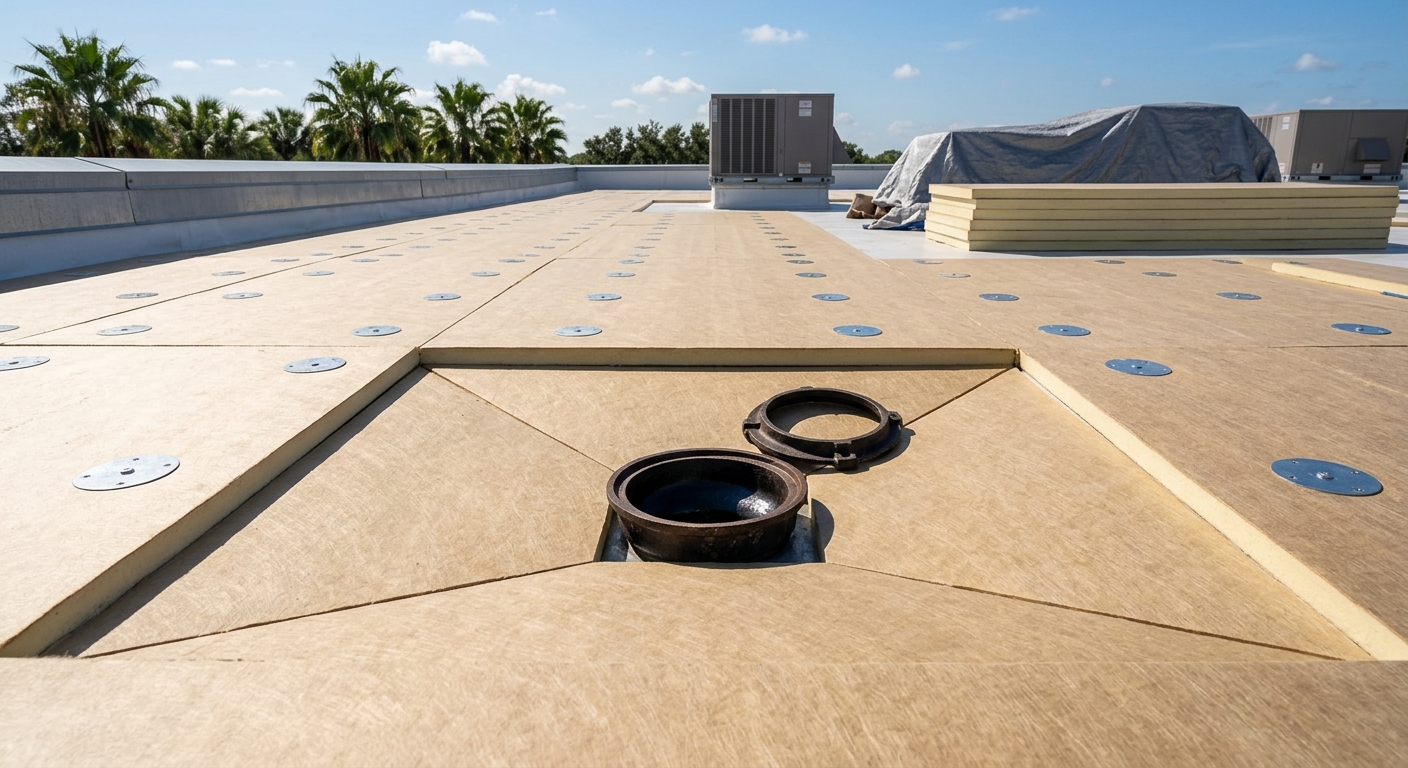
None of these paths makes a roof hurricane-proof, and adding insulation does not change the wind rating on its own. In Miami-Dade and Broward, and wherever Florida Product Approval governs, the insulation type, thickness, and attachment are part of a tested roof assembly, so a thicker board or different cover board must be listed in that assembly; see our guide to wind uplift rating and NOA documents. A repair is a reasonable call on a roof with dry insulation and membrane life left, while spot repairs over saturated boards only postpone replacement.
What drives the cost and schedule of meeting the R-value on a reroof
Advanced Roofing does not publish insulation pricing, and a cost per square foot quoted without the existing assembly, deck, and edge conditions is a sales number. These variables move price and schedule between bids; thickness figures are from PIMA’s Florida fact sheet (December 2023).
- Added thickness. Two layers of 1.75-inch polyiso reach R-20.0 at 3.5 inches; two layers of 2.2-inch polyiso reach R-25.2 at 4.4 inches; two 2.0-inch layers under a 0.5-inch HD polyiso cover board reach R-25.3 at 4.5 inches.
- Existing insulation. A roof with 1.5 to 2 inches of older board needs roughly twice that thickness to reach R-25, which is where curb, flashing, and edge changes begin.
- Wet boards found at tear-off. Quantities stay unknown until cores and a moisture survey are done, and wet insulation often travels with deck rot or rust found during a reroof.
- Perimeter and penetrations. A higher roof means taller nailers and edge metal and re-flashed or extended curbs; see our guide to curb and penetration flashing.
- Code edition and permit date. A design prepared for one edition may need revision for the other.
Ask every bidder to state the target R-value and its source column, the board thicknesses and cover board, and a unit price for wet insulation replacement; our guide to compare commercial roofing bids covers the rest. On a small building with a simple scope, a statewide contractor built for occupied commercial work may not be the lowest bid.
What changes on an occupied Florida building during an insulation upgrade
On an occupied building, insulation goes down in the same daily sequence as tear-off, and Florida’s afternoon weather sets the sequence. Crews remove only the area that can be insulated and made watertight the same day, because polyiso that takes on rain before the membrane is installed has to be replaced. Pallets are craned up before tenant hours where the site allows, staged on protected areas set back from the edge, and covered.
Tenants notice noise and odor. Fastening insulation into a steel deck transmits drilling noise below, so work over operating suites, classrooms, or broadcast space is scheduled with the property manager. Low-rise foam adhesives and primers can be drawn into rooftop unit outside-air intakes, so economizers near the work area are closed or the units are coordinated with the mechanical contractor for that shift.
Raising the roof several inches touches operations too. Rooftop units may need curb extensions and a planned zone shutdown, door thresholds and parapet guardrail heights are checked against the new elevation, and lightning protection or solar attachments may need resetting. Our guide to occupied building roof replacement covers the notice and phasing plan, and a commercial drone roof survey before bidding records where equipment and penetrations sit.
Does a Florida reroof trigger the energy code? Code and permit timing for 2026 and 2027
Whether a reroof must reach the new-construction R-value is the most disputed point in this topic, and the building official decides it for each permit. The 8th Edition energy code contains a roof replacement section, C503.2.1, renumbered from C503.3.1 per the Commission’s Analysis of Changes for the 8th Edition energy code. In the model 2021 IECC, that section sends roof replacements with above-deck insulation to the new-construction tables, and PIMA’s fact sheet states the Florida minimums apply to roof replacements on existing buildings.
FRSA’s 2022 analysis of the 7th Edition reached a different reading. In that reading, a typical reroof is a Level 1 alteration, the code sets no specific reroofing R-value, and the controlling test is that the building not become less energy efficient. Our post on when a recover is allowed instead of a tear-off cites the same reading. Both positions are published by credible sources, so the designer should get the building department’s answer in writing before bids are leveled.
In the High-Velocity Hurricane Zone, reroofing follows Sections 1512 through 1525 of Chapter 15 of the 2023 Florida Building Code, Building, with insulation attachment set by the application standards referenced in the assembly’s NOA. For permits filed on or after December 31, 2026, re-check the adopted 9th Edition text on the day of application.
Reroof insulation checklist before the bid goes out
- Roof consultant or architect: take the climate zone from the Florida table and pick the correct occupancy column, Group R or all other.
- Designer with the building department: confirm in writing whether the project is reviewed as a roof replacement under C503.2.1 or as an alteration held to the no-less-efficient test, and which edition applies to the permit date.
- Roofing contractor: core the roof and run a moisture survey, then report insulation type, thickness, and condition by roof area.
- Designer: specify the target R-value or U-factor, the compliance method, and the tapered calculation method for the governing edition.
- Contractor and designer: confirm the insulation, cover board, and attachment are listed in the approved assembly (Florida Product Approval or Miami-Dade NOA).
- Property manager: map curbs, doors, and equipment affected by added height, and schedule shutdowns.
- Owner or board: decide whether to exceed the minimum, knowing that energy savings depend on the building, its operating hours, and the utility tariff.
Frequently Asked Questions
What R-value is required for a commercial roof in Florida?
Under the 8th Edition (2023) Florida Building Code, Energy Conservation, roofs with insulation entirely above the deck need R-20ci in Climate Zone 1 and R-25ci in Climate Zone 2 for most occupancies, and R-25ci in both zones for Group R buildings such as condominiums and hotels. U-factor and performance paths are also allowed. Take the zone from the Florida county table.
Does a commercial reroof in Florida have to meet the energy code R-value?
It depends on how the building official classifies the work. The 8th Edition carries a roof replacement section, C503.2.1, which in the model code points replacements with above-deck insulation to the new-construction tables. FRSA has published a reading that a typical reroof only has to avoid reducing existing efficiency. Get the building department’s answer in writing before bidding.
How thick does polyiso roof insulation need to be for R-25?
PIMA’s Florida fact sheet shows two layers of 2.2-inch polyiso reaching R-25.2 at 4.4 inches, or two 2.0-inch layers under a 0.5-inch HD polyiso cover board reaching R-25.3 at 4.5 inches. The manufacturer’s published LTTR values for the specific product govern.
Which Florida counties are in Climate Zone 1 for the commercial energy code?
The Florida Building Code, Energy Conservation lists Broward, Collier, Hendry, Lee, Miami-Dade, Monroe, and Palm Beach as Climate Zone 1, with every other county in Zone 2. The model 2021 IECC places only four Florida counties in Zone 1, so national templates can assign the wrong minimum in southwest Florida.
What changes for roof insulation in the 9th Edition Florida Building Code?
The 9th Edition takes effect December 31, 2026. It bars area-weighted averaging for R-value compliance, with an exception that lets tapered insulation comply by rated R-value per inch times average thickness, and it lets the upper of two roof coverings be removed while an adequate lower substrate stays. Roof minimums for Zones 1 and 2 are not listed as changed.
Can wet roof insulation stay in place during a recover?
No. The Florida Building Code, Existing Building requires removal down to the deck where existing roof components are water-soaked or deteriorated, and the 9th Edition keeps that condition. A coating or new membrane over wet boards traps the water. Cores and a moisture survey show which areas can stay.
Set the R-value target before the bid, not at tear-off
The minimums are simple once the inputs are fixed. Under the 8th Edition, Zone 1 needs R-20ci for most occupancies, Zone 2 needs R-25ci, and Group R needs R-25ci in both. What moves a project is the Florida county list, the occupancy column, the tapered method, the condition of the existing insulation, and the permit date against December 31, 2026. Cores, a moisture survey, and a written answer from the building department settle each one, and none is settled well during tear-off. Afterward, a roof maintenance program that keeps water out of the boards protects the R-value the owner paid for.
Written by The Technical Team at Advanced Roofing. Founded in 1983, Advanced Roofing is 100% employee-owned and was named the #13 largest roofing contractor in the United States on Roofing Contractor magazine’s 2026 Top 100 list.
To scope insulation on an upcoming reroof, including cores, a moisture survey, and a code-target review with your designer, request a free commercial roofing quote or call (800) 638-6869.