At a glance: A commercial roof wind uplift rating is a tested pressure for one specific roof assembly, not a wind speed and not a promise about a storm. This article explains how FM and HVHZ ratings are tested, why an NOA’s maximum design pressure is half the tested pressure, how perimeter and corner zones and edge metal are handled, what changes on an occupied building, which 9th Edition dates apply, and what to check before accepting an HVHZ re-roof bid.
A commercial roof wind uplift rating is a tested pressure, in pounds per square foot, that one specific roof assembly held in a laboratory, and in Miami-Dade and Broward counties it protects a building only when it is matched to the design pressure an engineer calculates for each zone of that roof. Owners comparing High-Velocity Hurricane Zone (HVHZ) re-roof bids often see a Miami-Dade Notice of Acceptance (NOA) number on every proposal and treat the wind question as settled. The cost of that assumption is a roof with field-of-roof attachment at its corners, or edge metal no one tested, found when a storm peels it back. This article does not argue that a higher rating is always better, and it makes no engineering or code determination; those belong to the engineer of record and the building official.
Why does the uplift rating on an HVHZ roof matter more before December 31, 2026?
In the HVHZ, roof assemblies are approved, permitted and inspected against tested pressures, and the code edition that sets those rules changes this winter. Miami-Dade County’s permitting notice states that the 9th Edition (2026) Florida Building Code takes effect December 31, 2026, and that permit applications and plans submitted on or after that date must comply with it. The Florida Building Commission’s analysis of changes to the HVHZ test protocols lists revisions owners will meet indirectly: TAS 124, the field uplift test, now counts an upward deflection of 1 inch as reaching the limit, and TAS 106 field verification now uses the ASCE 7 names Zone 1, Zone 2 and Zone 3.
The HVHZ covers Miami-Dade and Broward counties, where the roofing sections of the Florida Building Code, 1512 through 1525, apply with their own Roofing Application Standards (RAS) and Testing Application Standards (TAS), as Miami-Dade’s roofing plans review presentation on the 8th Edition changes summarizes. Broward projects, including commercial roofing in Fort Lauderdale, follow the same sections. Storm preparation is covered in the commercial roof hurricane season guide; this article covers what the rating on the approval document means and how to check that it fits the building.
How is a commercial roof wind uplift rating tested, and what does the number mean?
A wind uplift rating is the highest pressure a full roof assembly sample held for a set time without any component failing, and it describes that assembly as built on the test frame. ANSI/FM 4474-2020, the FM Approvals standard for simulated wind uplift, raises pressure in 15 psf steps, holds each for 60 seconds, and assigns the highest level held while every component met its acceptance conditions. The standard states that its results do not describe actual exposure conditions, which vary widely.
The test works this way because of how wind loads a low-slope roof. Wind crossing a parapet or roof edge separates from the surface and drops the pressure above the membrane, while air leaking into the building raises the pressure below the deck. The difference pulls up on every component and is strongest at edges and corners. An assembly fails at its weakest link: a fastener backing out, a plate pulling through insulation, an adhesive bond letting go, or a seam opening.
In the HVHZ, the number on the product approval is not the raw test pressure. The Florida Product Approval evaluation for an HVHZ PVC system, Versico VersiFlex evaluation FL14318-R21, defines Maximum Design Pressure (MDP) as the ultimate passing pressure under TAS 114 divided by 2, so an assembly listed at -60 psf held -120 psf in testing. That 2:1 margin is already applied in the listing, and the owner’s engineer compares the MDP with the calculated design pressure for each roof zone.
Table 1. Uplift ratings and tests on HVHZ roof submittals (sources accessed October 28, 2026)
| Term | What it measures | Where it appears | Source |
|---|---|---|---|
| FM class rating (for example, 1-90) | Highest pressure in psf held 60 seconds in a lab test, in 15 psf steps | FM Approvals listings and specifications | ANSI/FM 4474-2020 |
| Maximum Design Pressure (MDP) | Tested ultimate pressure divided by 2 under TAS 114 | Miami-Dade NOAs and HVHZ Florida Product Approvals | FL14318-R21, rev. Feb. 21, 2024 |
| Design pressure, by roof zone | Calculated wind load each zone of this building must resist | Engineer’s calculations and permit drawings | FBC HVHZ 1620 and RAS 128, as cited in FL14318-R21 |
| TAS 105 withdrawal value | Pullout resistance of a fastener in the actual existing deck | Re-roof and recover submittals | FL14318-R21 limitations |
| TAS 124 field uplift test | In-place uplift resistance of existing or adhered membrane assemblies | Recovers and re-roofs over questionable substrates | Miami-Dade 8th Edition presentation; FL14318-R21 |
| Edge securement test | Resistance of fascia, coping and gravel stop | RAS 111 in the HVHZ; ANSI/SPRI/FM 4435/ES-1 elsewhere | FL14318-R21; IIBEC Interface, Dec. 2019 |
FM rating, Miami-Dade NOA or Florida Product Approval: what does each prove, and where does each fall short?
Each document answers a different question. HVHZ product approval comes from a Miami-Dade NOA or from a Florida Product Approval whose evaluation covers HVHZ use, as FL14318-R21 states it does; the permit reviewer confirms which documents are accepted. An FM class rating is a separate system built around FM Global’s insured properties.
Table 2. HVHZ uplift documents compared
| Document | What it proves | Who relies on it | Where it falls short |
|---|---|---|---|
| Miami-Dade NOA | The assembly or component passed HVHZ testing and county review, with listed limits of use | Miami-Dade and Broward plan reviewers and inspectors | Expires on a stated date; covers only the listed deck, fasteners and spacing |
| Florida Product Approval with HVHZ evaluation | Statewide approval with an engineer’s evaluation against the HVHZ code sections | Plan reviewers; HVHZ use only when the evaluation says so | Acceptance in place of an NOA is a building-department decision; FL14318-R21 excludes edge termination and fire classification |
| FM class rating | The assembly held a stated test pressure in FM’s lab | FM Global-insured owners and specifiers who cite FM | Not a code approval; 1-90 means 90 psf held in a test, not 90 mph |
| Engineer’s design pressure calculation | The load each roof zone of this building must resist | Permit drawings and the bid’s attachment pattern | Only as reliable as its inputs: height, exposure, deck and risk category |
The comparison that decides the roof is the approved assembly’s MDP against the design pressure in each zone. The FL14318-R21 evaluation requires a mechanically attached assembly to meet at least the Zone 1 prime design pressure, and it allows the higher-pressure perimeter and corner zones to be handled with a denser attachment pattern designed by a qualified design professional under RAS 117 or RAS 137. Asterisked assemblies are excluded, so their MDP must meet every zone. A bid with one fastener pattern for the whole roof and no zone plan has skipped that step. Advanced Roofing’s Miami commercial re-roofing page states that every system it installs in Miami-Dade carries an NOA.
Edge metal is the most common gap. The FL14318-R21 evaluation states that it does not cover roof edge termination and refers to RAS 111 for low-slope edge securement. An article in IIBEC Interface (December 2019) reports that storm studies by the Roofing Industry Committee on Weather Issues with FM and SPRI attributed nearly 60 percent of damaged roofs to failure at the perimeter, citing poor workmanship and lighter-gauge substitutions, and notes that no edge supplier holds a blanket ES-1 certification because edge requirements are project-specific. Advanced Roofing fabricates coping and fascia in its in-house sheet metal fabrication division; whoever makes the edge, the bid should name the test or approval that covers it.
What sets the design pressure and the attachment an HVHZ roof needs?
Design pressure is set by the building, and the attachment that meets it is set by the deck and the approved assembly. For HVHZ roofs, the FL14318-R21 evaluation points to FBC HVHZ Section 1620 and RAS 128 for design wind loads; the engineer of record confirms the ASCE 7 edition each code edition references. Building height, exposure, risk category and roof zone move the required pressure; deck type and condition decide which listed assemblies can meet it.
Table 3. Maximum design pressures listed in one HVHZ approval, by deck and attachment (FL14318-R21, revision dated Feb. 21, 2024, 8th Edition evaluation)
| Listed system | Deck | Attachment | MDP (psf) |
|---|---|---|---|
| W-10 | 19/32-in. plywood, 24-in. span | Insulation fastened 1 per 4.0 sq ft; adhered cover | -45.0 (all zones; no extrapolation) |
| W-29 | 19/32-in. plywood, 2-ft span | Insulation fastened 1 per 2.0 sq ft; adhered cover | -60.0 |
| SC-2 | 22-ga., Grade 33 steel, 6-ft span | Insulation and cover fully adhered | -105.0 |
| SC-33 | 22-ga., Grade 80 steel or 2,500 psi structural concrete | Insulation fastened 1 per 1.0 sq ft; fully adhered cover | -135.0 |
The table is not a product recommendation; it shows that one membrane can be listed at three times the pressure depending on deck and attachment. An existing deck’s fastener resistance is unknown until tested, so the evaluation requires TAS 105 withdrawal testing, with a sealed revised spacing if results fall short. Wet substrate changes the system choice, and an infrared moisture survey with cores finds it before the bid is final. Rooftop solar adds attachments with their own approvals; Advanced Green Technologies outlines HVHZ requirements for rooftop solar racking in Miami.
What changes when an HVHZ re-roof is on an occupied building?
On an occupied building, uplift requirements shape the schedule as much as the specification. A mechanically attached system drives fasteners through the deck, so drilling noise and dust reach the space below; an adhered system trades that for adhesive odor and cure time. The property manager should know which method the bid uses before tenant notices go out.
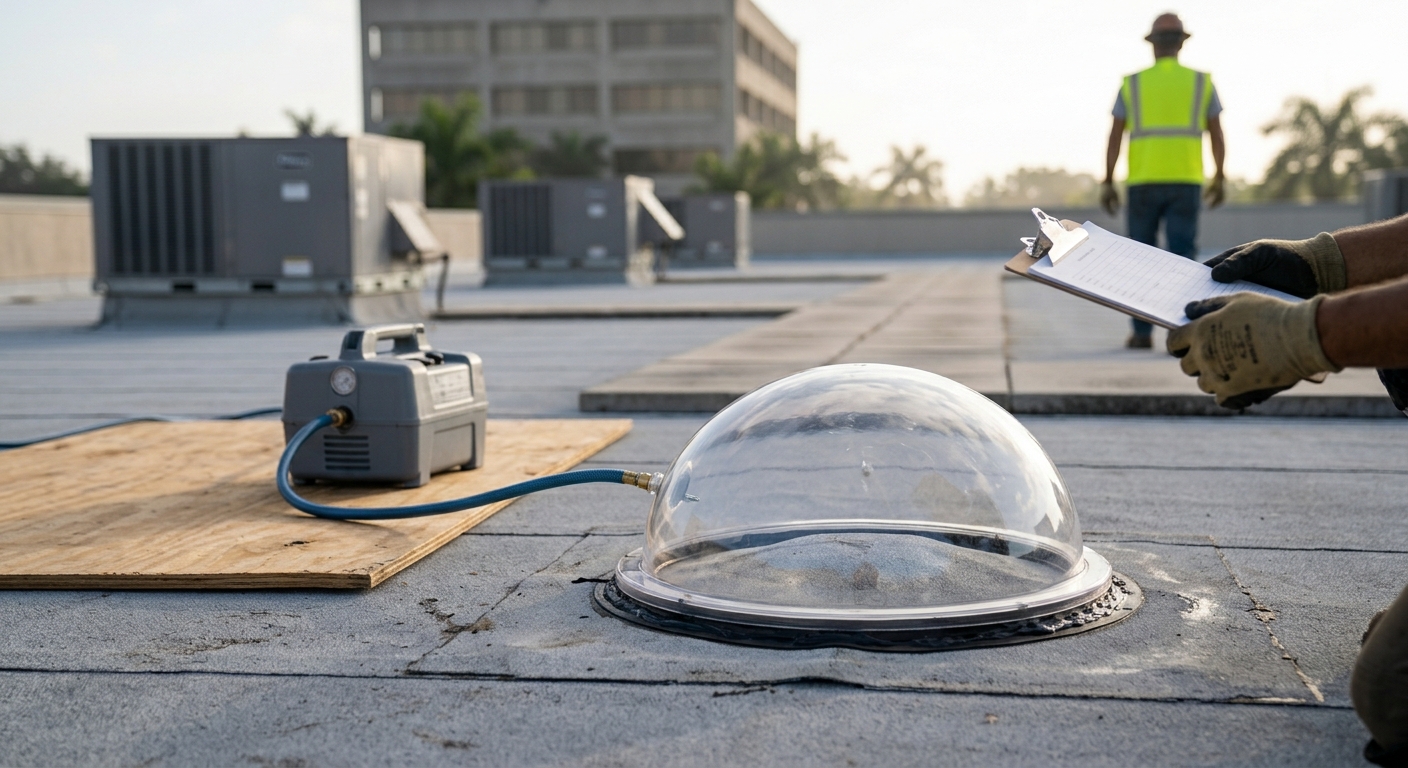
Testing needs calendar time. Deck pullout tests precede the final fastening pattern, and TAS 124 field uplift tests run when an adhered system goes over an existing surface or a recover is proposed. Miami-Dade’s presentation notes that the bell chamber version of TAS 124 suits systems tested under TAS 114 Appendix C or J, and the bonded pull test only fully adhered coverings. For a recover, FL14318-R21 requires the existing roof to resist design pressures on its own merit, documented by TAS 124.
Phasing matters in the HVHZ because a partly installed roof is weaker than either the old roof or the finished one. Sections opened for tear-off are dried-in the same day with their perimeter secured, and edge metal on a finished section does not wait for the next phase. Required inspections become fixed points in a schedule built around tenant hours, as the occupied building roof replacement guide describes.
Which code and permit dates apply to an HVHZ roof permitted around December 31, 2026?
As of October 28, 2026, the 8th Edition (2023) Florida Building Code governs HVHZ roofing, and the 9th Edition (2026) takes effect December 31, 2026. Miami-Dade’s notice ties the edition to the submittal date of the permit application, so a re-roof drawn to the 8th Edition and submitted later has to be redrawn. The Florida Building Commission’s product approval search shows which code version a listed approval covers.
Repairs follow a separate statute. Section 553.844(5), Florida Statutes, provides that when 25 percent or more of a roofing system or roof section built, repaired or replaced under the 2007 Florida Building Code or later is repaired, replaced or recovered, only the portion being worked on must meet the code in effect. For uplift, the repaired portion is attached to current design pressures. Whether a roof qualifies depends on its permit history, which the building official and roof consultant determine.
What should a property manager check before accepting an HVHZ re-roof bid?
To check an HVHZ roof’s wind uplift design, find the approval’s maximum design pressure for the exact deck and attachment proposed, compare it with the engineer’s design pressure for each roof zone, confirm a sealed attachment design for the perimeter and corners, and confirm which RAS 111 edge securement covers the roof edge.
- Property or asset manager: require each bidder to name the NOA or Florida Product Approval number, revision and expiration date, and to attach the full approval document.
- Roof consultant or engineer of record: confirm the design pressure for each roof zone, compare it with the assembly’s MDP, and obtain the sealed RAS 117 or RAS 137 calculation wherever the perimeter or corners use an extrapolated pattern.
- Roof consultant: confirm the approval’s listed deck and attachment match the existing deck, and schedule TAS 105 withdrawal tests.
- Roofing contractor: state in the bid which test or approval covers the edge metal and who fabricates and installs it.
- Facility manager: for recovers or adhered systems over existing surfaces, put TAS 124 field testing in both the scope and the schedule.
- Asset manager: confirm the permit application goes in before December 31, 2026, or that the design and approvals are current to the 9th Edition.
- Owner: compare bids on assembly and zone plan as well as price; the consultant decides whether a larger margin matters for this building.
- Property manager: file the approvals, test reports and inspection records with the warranty; the commercial roof warranty guide explains how warranted wind speed differs from the uplift rating.
A statewide contractor built for occupied buildings may not be the lowest bid on a small, simple roof; on a larger HVHZ commercial re-roofing project, the zone plan is where bids differ most.
Frequently Asked Questions
What does a commercial roof wind uplift rating mean?
A commercial roof wind uplift rating is the uplift pressure, in pounds per square foot, that a specific roof assembly withstood in a laboratory test. Under ANSI/FM 4474, the rating is the highest pressure held for 60 seconds without any component failing; in HVHZ product approvals, the maximum design pressure is the tested ultimate pressure divided by 2. Either number applies only to the assembly as tested.
Is an FM 1-90 rating the same as 90 mph wind resistance?
No. In an FM class rating such as 1-90, the 90 is a test pressure in pounds per square foot, held for one minute on a test frame. It is not a wind speed. Converting a wind speed into a roof pressure depends on building height, exposure, risk category and roof zone, so whether a 1-90 assembly suits a given building is a calculation for the engineer of record.
What are the HVHZ roofing requirements for a commercial re-roof?
In Miami-Dade and Broward counties, a commercial re-roof follows the Florida Building Code’s HVHZ roofing sections, 1512 through 1525. The assembly needs product approval valid for HVHZ use, a design pressure for each roof zone, an attachment pattern that meets it, RAS 111 edge securement, a permit and staged inspections. The engineer of record and building official decide compliance.
Does every roofing component need a Miami-Dade NOA?
In the HVHZ, roof components and assemblies need product approval valid for HVHZ use, typically a Miami-Dade NOA or a Florida Product Approval whose evaluation covers the HVHZ. Components from other manufacturers carry their own approvals, and NOAs expire, so each must be current. The permit reviewer confirms which documents are accepted.
What is a TAS 124 field uplift test?
TAS 124 is the HVHZ procedure for measuring the uplift resistance of existing membrane roofs and of in-place assemblies on reroof and new construction projects. It is commonly required for recovers and for adhered systems over existing surfaces, run with a bell chamber or as a bonded pull test on fully adhered coverings.
Does the 9th Edition Florida Building Code change HVHZ roofing requirements?
Yes, in part. The Florida Building Commission’s analysis of the 9th Edition HVHZ test protocols lists revisions including the TAS 124 deflection limit, ASCE 7 zone names in TAS 106, and a RAS 117 clarification. The 9th Edition takes effect December 31, 2026, and Miami-Dade applies it to permit applications submitted on or after that date. Confirm adopted text with the building department.
Match the uplift rating to every zone of the roof
A commercial roof wind uplift rating describes how one assembly performed on a test frame, and in the HVHZ that number does its job only when the engineer has matched it to the design pressure in every zone of a specific roof. The approval document, the zone plan, the deck tests and the edge securement are four separate checks, and a bid that answers only the first leaves the perimeter, where most wind failures start, unverified. No roof system is immune to hurricane damage; assemblies are tested to rated pressures a storm can exceed. An owner who asks for all four checks before December 31, 2026 also controls which code edition the roof is built under.
Written by The Technical Team at Advanced Roofing. Founded in 1983, Advanced Roofing is 100% employee-owned and was ranked the #13 largest roofing contractor in the U.S. on Roofing Contractor magazine’s 2026 Top 100 list.
To review the uplift design and approvals on an upcoming HVHZ re-roof, request a free quote or call Advanced Roofing at (800) 638-6869.