
At a glance: A rooftop HVAC roof leak on a Florida commercial building usually starts at a transition: curb base flashing, the joint at the top of the curb, a pipe or conduit penetration, the unit cabinet, or a condensate line. This guide maps each leak path to the clue it leaves indoors and the trade that owns it, compares sealant, re-flashing, curb rebuilds and section reroofing with their limits, lists cost and schedule drivers, covers occupied-building and 2026 code timing, and ends with a checklist by role.
A rooftop HVAC roof leak on a Florida commercial roof typically enters at a transition: the base flashing on the equipment curb, a penetration beside it, the joint between the unit and the curb, or a condensate line discharging where it should not. Treating every drip near a unit as a roof problem sends the wrong trade up the ladder, and repeated sealant on a short or badly flashed curb buys a few dry months while wet insulation spreads under the membrane. This article explains how water gets in, how to tell a roof leak from a unit leak, and which repairs hold. It does not size equipment, design wind attachment, or interpret a warranty or insurance policy; those decisions belong to the mechanical engineer, the engineer of record, the roof manufacturer and the insurer.
Why does a rooftop HVAC roof leak need a different response in Florida?
Rooftop equipment turns a continuous membrane into a series of joints. The Canadian Roofing Contractors Association made the point in a 1995 technical bulletin on rooftop equipment: it warned that leaks close to a rooftop unit are often blamed on the roofing when the source is a breach in the unit enclosure, and that such leaks should be investigated before the roofing contractor is called.
Wind adds a second failure path. SPRI’s 2022 white paper on rooftop equipment attachment explains that equipment displaced by wind can puncture and tear roof membranes and let water directly into the building, and it quotes Section 1522.2 of the 2020 Florida Building Code, which requires rooftop equipment in the High-Velocity Hurricane Zone to be secured to the structure under the loading requirements of Chapter 16. FEMA’s guidance on rooftop equipment attachment adds a coastal point: within 3,000 feet of a body of water producing salt spray, it recommends nonferrous metals, stainless steel, or steel with at least a G-90 hot-dip galvanized coating for equipment, stands and anchors, because corroded equipment and anchorage are among the reasons units are torn off in high winds.
The code calendar also moves this quarter. Miami-Dade County’s notice on the Florida Building Code 9th Edition states that the new edition takes effect December 31, 2026, and that permit applications submitted on or after that date must comply with it. An owner with a leaking curb and a unit replacement planned for 2027 should decide now whether the two pieces of work go together.
Where does water get in around a rooftop unit, and which trade owns it?
Most leaks around rooftop HVAC equipment enter at one of six places: the curb base flashing, the top of the curb where the unit or counterflashing laps it, pipe and conduit penetrations, the unit cabinet or outside-air hood, a condensate line, or membrane damage from service traffic. Each path leaves a different clue indoors.
Table 1. Rooftop unit leak paths, the clue each leaves, and the trade that owns the fix
| Leak path | How water enters | Clue that points here | Who owns the fix |
|---|---|---|---|
| Curb base flashing | Flashing loses adhesion, splits at corners, or sits low enough for ponded water to reach its top edge | Leak follows rain and worsens when water stands against the curb | Roofing contractor |
| Top of the curb | Gap in the curb gasket, loose or missing counterflashing, failed sealant at the top edge | Water inside the curb or running along the supply or return duct | Roofing and mechanical contractors together |
| Pipe and conduit penetrations | Pitch-pan filler shrinks, pipe boots split, lines added later without proper flashing | Intermittent drip near a line set, gas line or conduit drop | Roofing contractor |
| Unit cabinet and outside-air hood | Wind-driven rain enters panels or hoods, more easily when the unit is off | Leak only in storms, often with wind from one direction | Mechanical contractor |
| Condensate | Clogged trap or drain line overflows inside the curb or discharges onto the membrane | Water on dry days during heavy cooling | Mechanical contractor |
| Service traffic damage | Dropped panel screws, tools or refrigerant work puncture the membrane near the unit | Leak begins after an HVAC service visit | Roofing contractor repairs; owner settles cost allocation |
Curb flashing fails most often because it is the tallest and most worked detail on the roof. According to the Professional Roofing technical column on NRCA curb details, NRCA’s curb details carry a minimum recommended flashing height of 8 inches and recommend sealing material between the curb and the equipment frame. A curb that met that height when it was set can fall short after a reroof adds insulation and cover board, because the roof surface rises while the curb stays where it was. Ponded water then reaches the top edge of the base flashing, and Florida’s summer downpours supply that water through the wet season.
Penetrations beside the curb fail for a different reason. Pitch pans filled with pourable sealer and single-ply pipe boots depend on the sealant or clamp staying bonded while the line expands, contracts and vibrates, and lines added after the roof was installed are often flashed by whoever ran them.
Two leak sources sit inside the mechanical scope. Wind-driven rain can enter a unit through access panels and the outside-air hood, especially when the unit is off and the cabinet is not under pressure. Condensate is the other: the Florida Building Code, Mechanical requires condensate to be conveyed from the drain pan outlet to an approved place of disposal, as restated in the Broward County Board of Rules and Appeals Formal Interpretation #38, and a clogged trap can overflow inside the curb and imitate a roof leak on a dry afternoon. Advanced Air Systems covers that failure in its guide to commercial HVAC condensate drain problems. A roof technician who finds dry flashing and a wet duct liner should hand the call to the HVAC contractor.
Re-seal, re-flash or rebuild: which commercial roof penetration flashing repair holds?
Commercial roof penetration flashing repairs fall into five approaches. The right one depends on the curb height, the membrane condition around the curb, the moisture in the insulation below, and whether the unit is due for replacement within the next few years.
Table 2. Curb and penetration repair approaches compared
| Repair approach | Fits when | What it involves | Where it falls short |
|---|---|---|---|
| Sealant or mastic touch-up | A small, visible gap on otherwise sound flashing, or a same-day stopgap | Clean, prime and seal with a product compatible with the membrane | Temporary; fails again if the cause is low curb height, movement or wet insulation |
| Re-flash the curb | Base flashing has failed but curb height and the surrounding membrane are sound | Remove old flashing, install new membrane flashing to a termination, add or reset counterflashing | Does not correct a curb that sits too low or wet insulation around it |
| Replace pitch pans with prefabricated flashings | Pans keep shrinking or have been refilled repeatedly | Prefabricated boots or a curbed penetration housing matched to the membrane | Lines may need to be regrouped, which needs the mechanical trade on site |
| Raise or replace the curb | Flashing height is below the manufacturer’s minimum, the curb is rusted, or a unit change-out is planned | Lift the unit, extend or replace the curb, re-flash, reset and reattach the unit | Crane day, cooling shutdown and possibly a permit and engineered attachment; highest cost per curb |
| Reroof the affected section | A moisture survey finds wet insulation spreading from several curbs | Remove and replace insulation, membrane and flashings in that area | Larger scope; code requirements for the section may apply |
Sealant has a place as a stopgap on the day a leak is found. It becomes a problem when it is the only repair in a curb’s history. Layers of sealant on the same corner usually mean the flashing is moving, the curb is too short, or water is already inside the assembly, and the next storm will find the same path. Before any re-flash, the roof beside the curb should be cored or scanned for moisture; Advanced Roofing’s infrared roof inspection guide explains how far wet insulation can travel from the point where water entered.
Raising a curb is the repair owners most often defer, because it means lifting the unit. It is also the repair that fits naturally with a planned unit replacement, when the old unit is coming off and a curb adapter is being made anyway; Advanced Air Systems’ guide to commercial rooftop unit replacement in South Florida covers that timing from the mechanical side. A single leaking curb on a simple one-story roof may be served more cheaply by a small local roofer; a large contractor earns its place when curb work must be sequenced with cranes, shutdowns and tenants below.
What drives the cost and schedule of roof curb waterproofing?
Advanced Roofing does not publish pricing, and no general per-curb cost figure is given here, because the scope changes too much from one curb to the next. The drivers below are the line items to require in every proposal for commercial roof repair service around rooftop equipment, so bids can be compared on the same scope.
Table 3. What moves the cost and schedule of curb and penetration work
| Driver | Effect on schedule | Effect on cost | Who sets it |
|---|---|---|---|
| Curb height and condition | Raising or replacing a curb adds a lift and fabrication time | Sheet metal, crane and mechanical labor | Roofing contractor with the mechanical contractor |
| Moisture in the surrounding insulation | Wet areas are removed before new flashing goes on | Insulation and membrane replacement | Moisture survey and cores |
| Membrane type and age | Flashing must be compatible with the existing system | Transition details on older or discontinued systems | Roof manufacturer requirements |
| Number and type of penetrations | Each line set or conduit is its own detail | Labor per penetration; regrouping lines | Mechanical and electrical contractors |
| Unit lift required | Crane day and a cooling shutdown window | Crane time, rigging, disconnect and restart | Owner, property manager and mechanical contractor |
| HVHZ attachment and permit | Engineering and permit review before the unit is reset | Engineering and permit fees | Engineer of record and building official |
Ask each bidder to state, curb by curb, the existing flashing height, the proposed repair, whether a moisture check is included, and whether the unit has to be lifted. A bid far below the others usually assumes sealant where the others priced re-flashing.
What changes when a curb leak sits over an occupied Florida building?
On an occupied building, both the leak and the repair reach the tenants. A curb that leaks over a medical suite, a classroom or a server room needs temporary protection inside the same day, and the permanent repair often needs a cooling shutdown for the zone the unit serves. Advanced Roofing’s occupied building roof replacement guide covers tenant notices, crane picks and odor at air intakes; the same controls apply to a single curb rebuild.
Every service visit to a rooftop unit is also a fall-protection question. For general industry work on low-slope roofs, OSHA 29 CFR 1910.28(b)(13) requires a guardrail, safety net, travel restraint or personal fall arrest system for work less than 6 feet from the roof edge, and for work 15 feet or more from the edge it requires a work rule keeping employees from going within 15 feet without fall protection. A unit set near the edge turns every service visit into a fall-protection setup, which is worth weighing when a curb is moved or added.
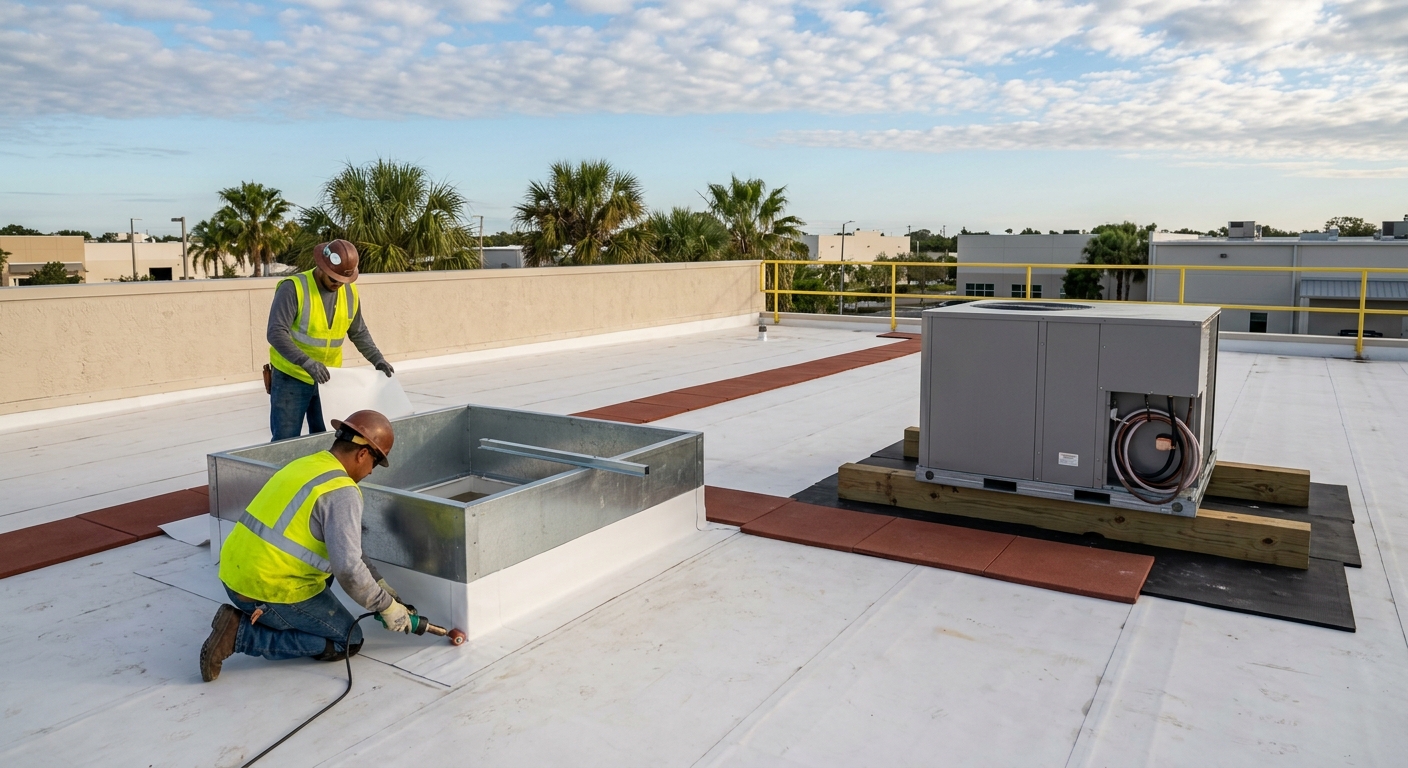
Lifting a unit to raise a curb puts a crane, a mechanical crew and a roofing crew on one schedule. Advanced Roofing’s in-house commercial roofing crane division works with the company’s roofing and air conditioning divisions, and its commercial air conditioning division carries the mechanical side, so the roof can be opened and closed inside one shutdown window. Counterflashing, curb extensions and coping can be made in-house by the sheet metal fabrication division.
Buildings in Miami-Dade and Broward sit in the High-Velocity Hurricane Zone, where attachment of a reset or relocated unit is a determination for the engineer of record and the building official. Broward work is handled from the Fort Lauderdale commercial roofing office.
Which Florida code dates affect curb and penetration work planned now?
As of October 20, 2026, four items bear on curb and penetration work, and each should be re-checked on the day a permit application is filed.
- Florida Building Code, 9th Edition. Miami-Dade’s notice gives December 31, 2026 as the effective date, and applications submitted through the county portal after 4 p.m. on December 30, 2026 fall under the new edition. Confirm cutoffs with the local building official elsewhere.
- HVHZ rooftop equipment attachment. SPRI quotes Section 1522.2 of the 2020 code; confirm the section in the edition that will govern the permit, and leave attachment design to the engineer of record.
- Condensate disposal. Broward’s Formal Interpretation #38, effective September 12, 2025, addresses Section 307.2.1 of the 2023 code, including cooling-tower collection for larger systems; the designer of record applies it.
- Hurricane season. The season runs through November 30, so a curb opened during a change-out needs a same-day closure plan; see Advanced Roofing’s hurricane season resources.
Rooftop HVAC roof leak checklist: who owns each step?
- Facility manager: record the date, rainfall, wind direction and whether the unit was running when the leak appeared; mark and photograph the ceiling location.
- Property manager: when a leak sits within a few feet of a unit, schedule a joint visit by the roofing and mechanical contractors so one finding settles roof versus unit.
- Roofing contractor: measure the base flashing height at each curb against the membrane manufacturer’s requirement and NRCA’s 8-inch recommendation, and core or scan around any curb that has leaked twice.
- Mechanical contractor: check the condensate trap and line, the curb gasket and the cabinet panels, and report whether the unit was off during the storm.
- Owner or asset manager: if a unit is near replacement, decide whether to raise the curb at change-out instead of re-flashing twice; Advanced Roofing’s preventive roof maintenance program logs each curb inspection.
- Property manager: require every rooftop trade to sign in, use walkway pads and report any new penetration to the roofing contractor of record before cutting; the commercial roof warranty guide explains why.
- Engineer of record: confirm attachment for any unit lifted, reset or relocated in the HVHZ.
Frequently Asked Questions
Why does my roof leak near the HVAC unit only when it rains hard?
Heavy rain raises the water level against the curb and drives water sideways. If the base flashing is low or has lifted at a corner, ponded water reaches its top edge only in a downpour. Wind-driven rain can also enter the unit cabinet or outside-air hood. A joint visit by both trades soon after a storm usually separates the two.
How can I tell if the leak is from the roof or the AC unit?
Timing is the best clue. A leak that appears on dry days during heavy cooling points to condensate. A leak only in wind-driven storms points to the unit cabinet or intake hood. A leak that follows ordinary rain and worsens with standing water points to the curb flashing or a nearby penetration. Water inside the curb needs both trades.
How high should a roof curb be above the roof surface?
NRCA’s curb details carry a minimum recommended flashing height of 8 inches above the finished roof surface, and roof manufacturers set their own requirements for warranted systems. A reroof that adds insulation can leave an older curb below that height. Measure each curb before a reroof or change-out.
Can roof curb flashing be repaired, or does the curb need replacing?
Flashing can be repaired or replaced on its own when the curb is sound, square and tall enough, and the insulation around it is dry. A rusted curb, a curb below the required flashing height, or wet insulation spreading from it points to raising or replacing the curb.
Who is responsible when an HVAC contractor damages the roof?
Responsibility is set by the service contracts, the roof warranty terms and the facts of the visit, and the owner’s attorney or insurer decides disputed cases. Owners protect themselves by logging rooftop access, requiring walkway pads, photographing the roof around units before and after service, and sending new penetrations through the roofing contractor of record.
Should the roof curb be replaced when the rooftop unit is replaced?
Often it is the right time. The old unit is coming off, a crane is already scheduled, and a curb adapter is usually needed for the new footprint. If the curb is short, rusted or poorly flashed, raising or replacing it then avoids a second lift.
Fix the transition before the next storm finds it
A leak beside a rooftop unit is a transition problem. The water comes in at a curb flashing that sits too low or has let go, at a penetration that depends on aging sealant, through the unit itself, or from a condensate line, and each path leaves a clue that tells the owner which trade to call. Sealant can stop a drip for a day; it cannot correct a short curb, a moving joint or wet insulation. Owners who log when leaks happen, send both trades up together, measure curb heights and pair curb rebuilds with unit replacements spend less on repeat calls. With a new code edition arriving on December 31, 2026, curb work tied to a 2027 change-out is worth scoping now.
Written by The Technical Team at Advanced Roofing. Founded in 1983, Advanced Roofing is 100% employee-owned and was ranked the #13 largest roofing contractor in the U.S. on Roofing Contractor magazine’s 2026 Top 100 list, announced in August 2026.
To have a leaking curb or penetration assessed, request a free commercial roofing quote or call (800) 638-6869. For water coming through the ceiling now, use Advanced Roofing’s emergency commercial roof repair service.