
At a glance: Commercial roofing bids for the same Florida roof often describe different projects. This guide shows how to level them: require the same scope rows from every bidder, price each exclusion and allowance, compare unit prices for wet insulation and deck repair, check the named product approvals and sample warranty documents, confirm which Florida Building Code edition the permit will fall under before the 9th Edition takes effect December 31, 2026, and review lien releases under section 713.06. It ends with a role-assigned proposal checklist and answers to common questions.
Knowing how to compare commercial roofing bids starts with putting every proposal on the same scope before you look at a single total. On a Florida commercial roof, much of the spread between the lowest and highest number can trace to what each contractor assumed about wet insulation, deck repair, flashings, rooftop equipment, permits and warranty. When those assumptions stay hidden, the low bid returns as change orders, the warranty arrives a tier below what the board approved, or a supplier's Notice to Owner appears after the final check clears. This article shows how to level the scope and how code timing and an occupied building change the comparison. It does not rank contractors, set a price for your roof, or replace your roof consultant, engineer, building official or attorney.
Why Do Bids for the Same Commercial Roof Come In So Far Apart?
Commercial roofing bids diverge because each contractor prices its own reading of an incomplete picture. Without a written specification, every estimator decides how many layers come off, how much wet insulation to expect, what deck and metal work to include, and which warranty to carry. The comparison problem is a scope problem first and a price problem second.
Timing adds a second variable in late 2026. The 9th Edition (2026) Florida Building Code takes effect December 31, 2026, as the Florida Building Commission's Analysis of Changes for the 9th Edition Existing Building code records; until then the 8th Edition (2023) governs. Miami-Dade County's permitting notice on the 9th Edition code change states that permit applications submitted on or after that date must comply with the new edition. A bid priced this fall may be permitted under either edition, and two contractors can assume different answers.
Florida's construction lien law adds a third variable. Under section 713.06, Florida Statutes, a subcontractor or supplier who is not paid can serve a Notice to Owner before, or within 45 days after, it starts furnishing labor or materials, and can then pursue a lien against the property even after the owner has paid the contractor. The same section requires the contractor to deliver a final payment affidavit listing any unpaid lienors before final payment. Advanced Roofing describes how that exposure plays out in the true cost of choosing the wrong roofing contractor.
What Is Actually Different Between Two Commercial Roofing Proposals?
To compare commercial roofing bids, convert each proposal into the same scope: the same tear-off depth, roof system and attachment, insulation thickness, flashing and edge metal, rooftop equipment work, permits, warranty tier and schedule. Price every unknown, such as wet insulation and deck repair, at a stated unit price. Compare totals only after every proposal answers the same lines.
Price hides in the parts of the roof an estimator cannot see and the parts of the scope a proposal leaves unwritten. Wet insulation is the clearest case: water entering at a failed seam travels laterally through the boards, so a roof that looks sound can hold saturated areas. One contractor prices the wet area a survey found, a second carries an allowance, and a third excludes it. Advanced Roofing's guide to infrared roof inspection in Florida explains how a survey and confirming cores establish that quantity before bidding instead of during tear-off.
| Scope line | What every proposal should state | How bids commonly differ |
|---|---|---|
| Tear-off or recover | Number of existing layers removed; replacement or recover | One bid recovers while another tears off; code limits recover over wet or multiple coverings |
| Wet insulation | Square feet included in the base price; unit price per square foot beyond it | Included, carried as an allowance, or excluded |
| Roof deck | Inspection method; unit price per square foot of deck replacement by deck type | Often excluded or listed as time and material |
| Insulation and drainage | Thickness, R-value, tapered layout, crickets and saddles | Different thicknesses change price and energy-code compliance |
| Flashings and edge metal | Coping, counterflashing, edge metal, gauge and finish | Some bids reuse existing metal; others replace it |
| Rooftop equipment | Who disconnects, lifts and resets units; curb raising | Often excluded and left to the owner's mechanical contractor |
| Permits and approvals | Permit fees, wind design, Florida Product Approval or Miami-Dade NOA numbers | Included by some bidders, listed as owner cost by others |
| Warranty | Manufacturer, term, NDL or limited, wind-speed limit, workmanship term | Different tiers presented as equal |
| General conditions | Crane, dumpsters, staging, after-hours work, nightly dry-in | Assumed by some bidders, stated by others |
Ask every bidder to answer these rows in writing, and treat a blank as an exclusion until the contractor confirms otherwise. Rooftop equipment is often split between trades, because a reroof means resetting units and raising curbs. When a roofing contractor runs an in-house commercial air conditioning division, that work can sit inside one proposal; otherwise the owner needs a mechanical contractor's price before the totals mean anything.
How to Compare Commercial Roofing Bids When the Totals Are Far Apart
A wide spread between totals tells the owner where to look. Sort the proposals by scope completeness first, then compare price inside each group. Each approach below has a point where it stops working.
| Approach | How it works | Where it fits | Where it falls short |
|---|---|---|---|
| Lowest total as submitted | Award to the lowest number without adjustment | Public bids against a complete engineered specification | Rewards the narrowest scope when proposals were written to different assumptions |
| Leveled lowest price | Price every exclusion and allowance, add them to each bid, then compare | Private reroofs with three or more qualified bidders | Depends on the owner pricing exclusions fairly; unknown quantities remain estimates |
| Best-value scoring | Weight price, scope completeness, schedule, warranty and safety record | Occupied buildings, phased work, boards that need a documented rationale | Weights can be tilted toward a preferred bidder; scoring still needs leveled prices |
| Consultant-written specification | A roof consultant or engineer writes one scope that every bidder prices | Large roofs, HVHZ projects, insurer-driven assembly requirements | Adds design fees and weeks to the schedule; small, simple roofs rarely justify it |
Company fit belongs in the same honest accounting. On a small, simple roof, an occupied-building contractor carrying crane, safety and supervision overhead may not be the lowest bid, and the owner may not need that overhead. On a hospital or a retail center with tenants under the deck, those costs carry the risk. Advanced Roofing's commercial re-roofing services are organized around the second case, and the comparison method should match the building in front of you.
Warranty lines deserve their own comparison. A no-dollar-limit warranty and a limited material warranty can both appear as a 20-year warranty while covering different things, and wind-speed limits vary by manufacturer. Advanced Roofing's commercial roof warranty guide for Florida walks through what an NDL warranty covers and where coverage stops. Compare the sample warranty documents themselves.
Which Line Items Move a Commercial Roofing Budget the Most?
The largest budget swings on a Florida reroof come from quantities that cannot be known precisely until the old roof comes off. A bid without unit prices leaves each unknown square foot to be negotiated mid-project, when the owner has the least leverage. Request these from every bidder:
- Wet insulation removal and replacement, per square foot, at the specified thickness.
- Deck replacement, per square foot, priced separately for steel, wood and concrete repair.
- Wood nailer and blocking replacement, per linear foot.
- Additional curb, penetration or flashing work found during tear-off, per each or per linear foot.
- Crane time beyond the planned picks, per hour.
- After-hours or weekend work, per crew shift, where tenant operations require it.
A contractor whose base price is lowest but whose wet-insulation unit price is far above the others may finish highest once tear-off reveals the real quantity. Rank each proposal at two or three plausible quantities, anchored to the moisture survey, and see whether the order holds. This article states no dollar figures; Florida roofing costs depend on system, size, access and code edition.
Payment terms belong in the same review. Florida's lien law lets the owner require a contractor's affidavit with progress payments, and the Florida Department of Business and Professional Regulation's license verification tool confirms that the entity named on each proposal holds an active license. Compare deposit size, retainage, and the lien releases delivered with every draw.
How Does an Occupied Florida Building Change the Bid Comparison?
An occupied building turns schedule and logistics into scope. The proposal has to say how the roof is kept watertight each night, when noisy work and crane picks happen, how odor is kept from air intakes, and who gives notice before each equipment shutdown. A bid that omits them is priced for an empty building. Advanced Roofing's guide to occupied building roof replacement covers the tenant-facing plan in detail.
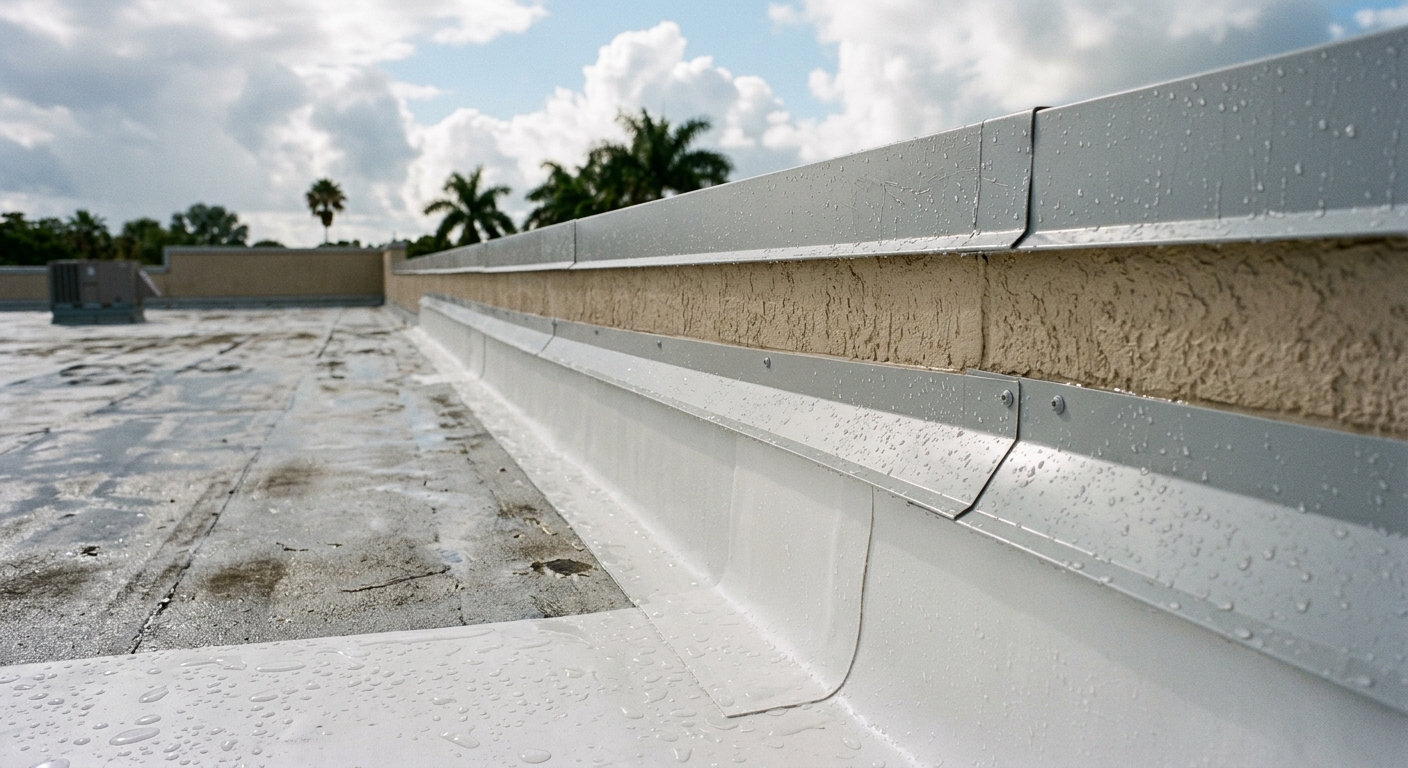
Safety belongs in the same column. OSHA's fall protection standard for construction, 29 CFR 1926.501, requires employees doing roofing work on low-slope roofs with unprotected sides and edges six feet or more above a lower level to be protected by guardrails, safety nets, personal fall arrest, or a permitted combination of warning lines with other systems. Proposals differ in how they staff and price that protection. A credible bid names the method, the safety staffing, and how tenants stay clear of the work zone.
Product approvals are the Florida-specific item. In Miami-Dade and Broward counties, roofing falls under the High-Velocity Hurricane Zone sections of the Florida Building Code, and roof systems carry Miami-Dade Notices of Acceptance; statewide, the permit application lists Florida Product Approval numbers. Some insurers also require an assembly listed in FM Approvals' RoofNav roofing directory. Each proposal should name the approved assembly it will install; the building official and design professional decide whether it meets the code for your building.
Phased work also needs crews and cranes on the dates tenants can tolerate. Advanced Roofing ranked #13 among the largest roofing contractors in the United States on Roofing Contractor magazine's 2026 Top 100 list, as the company reported in its August 2026 ranking announcement. Size alone does not make any contractor the right choice; ask every bidder for its crew plan and backlog.
Which Florida Building Code Edition Will Your Roofing Bid Be Permitted Under?
A reroof bid should state which code edition the contractor priced and what happens if the permit lands under the other one. As of October 28, 2026, the 8th Edition (2023) Florida Building Code is in effect and the 9th Edition (2026) takes effect December 31, 2026. The permit application date generally determines which edition governs, and Miami-Dade County has stated that applications submitted on or after the effective date must comply with the 9th Edition. Confirm your jurisdiction's cutoff with its building department.
The reroofing rules themselves are changing. The Florida Roofing and Sheet Metal Contractors Association's walkthrough of the 9th Edition reroofing modifications reports approved changes to Existing Building Section 706.3, the section that governs when an existing roof may be recovered and when it must come off. FRSA describes the text as pending until the code is final. Ask each bidder whether its recover-or-replace recommendation depends on that language, and have the building official confirm the adopted text.
Bids that span the effective date should carry a code-escalation clause stating who pays if the governing edition changes the work. If one proposal includes that clause and another is silent, the silent one carries a risk the owner has not yet priced.
Commercial Roofing Proposal Checklist: What to Confirm Before You Sign
Use this checklist to level every proposal before the owner or board sees a recommendation. Each item names the role that owns it.
- Property manager: send every bidder the same package: roof plans, moisture surveys, leak history, warranty and tenant constraints.
- Roof consultant: confirm each proposal states tear-off depth, system, attachment, insulation and drainage.
- Property manager: list every exclusion and allowance from each bid on one comparison sheet and price each one before ranking.
- Asset manager or owner: confirm unit prices for wet insulation, deck and nailers, and test the ranking at more than one quantity.
- Mechanical contractor and roofing contractor: confirm who disconnects, lifts and resets rooftop equipment and who raises curbs.
- Design professional or building official: confirm the named product approval or NOA and the code edition the permit will fall under.
- Owner's attorney: review payment terms, lien releases, the final payment affidavit and the code-escalation clause.
- Property manager: obtain each sample warranty and confirm term, wind-speed limit and maintenance duties.
- Risk manager: confirm license status on DBPR, insurance certificates, bonding where required and the site safety plan.
- Property manager: confirm phasing, nightly dry-in, crane schedule and tenant notices in writing.
Advanced Roofing's guide on how to select a roofing contractor covers the qualification side of this decision, and this checklist covers the proposal side. Both belong in the board package.
Frequently Asked Questions
How many commercial roofing bids should I get?
Three qualified bids is a common practice for a private commercial reroof, because three numbers show whether one is an outlier. On public projects, the procurement office sets the process. Three bids against one written scope compare more cleanly than six bids written to six different assumptions.
What should a commercial roofing proposal include?
A complete commercial roofing proposal states the tear-off depth, roof system and attachment, insulation thickness and drainage design, flashings and edge metal, rooftop equipment work, permits and product approvals, unit prices for unknown conditions, warranty manufacturer and term, schedule and phasing, safety plan, payment terms and a list of exclusions. Treat anything missing as excluded until the contractor confirms it in writing.
Is the lowest commercial roofing bid usually the cheapest roof?
The lowest bid is the cheapest roof only when its scope matches the others. A low total often reflects excluded items such as wet insulation, deck repair, edge metal or rooftop equipment work, which can return as change orders. Price each proposal's exclusions, add them in, and compare again. If the low bid still ranks first after that, it may be the right choice.
What is a roofing scope of work?
A roofing scope of work is the written description of what the contractor will remove, install and warrant, including quantities, materials, methods and the conditions that trigger added cost. It is the document that makes two bids comparable. On larger projects, a roof consultant or engineer writes it so every contractor prices the same project.
Do roofing bids in Florida need to account for the 2026 code change?
Yes, for any project that may be permitted near December 31, 2026, when the 9th Edition Florida Building Code takes effect. The permit application date generally decides which edition applies. Each bid should state which edition it priced and include a clause covering changes if the permit falls under the other edition. Confirm the governing edition with your building department before signing.
How do I protect against liens when paying a roofing contractor in Florida?
Florida's construction lien law, section 713.06, Florida Statutes, lets an unpaid subcontractor or supplier that served a Notice to Owner pursue a lien even after the owner pays the contractor. With each payment, collect lien releases from the contractor and from everyone who served a Notice to Owner, and require the contractor's final payment affidavit before final payment. Have a construction attorney review the terms.
The Winning Roofing Bid Is the One You Can Defend Line by Line
Comparing commercial roofing bids apples to apples means the owner can explain every difference before choosing. Once tear-off depth, wet insulation, deck, metal, equipment, approvals, warranty, code edition and payment terms sit on the same sheet, the remaining gap between the low and high numbers becomes something the board can judge on its merits. If your portfolio has several roofs heading toward replacement, Advanced Roofing's guide to roofing capital planning for multiple properties shows how to rank and phase them so each bid package starts from documented conditions.
Written by The Technical Team at Advanced Roofing. Founded in 1983, Advanced Roofing is 100% employee-owned and serves occupied commercial buildings across Florida from seven offices.
To have Advanced Roofing price your roof against a written scope, request a commercial roofing quote or call (800) 638-6869.