At a glance: The 2026 Atlantic season has been quiet so far, and NOAA still forecasts below-normal activity, yet the season runs to November 30 and a secondary peak in mid-October favors the Gulf and the Caribbean. This guide covers where low-slope commercial roofs fail first in hurricanes, how to choose between repairs, temporary dry-in, and replacement for the rest of the season, how to run storm response on an occupied building, which Florida code and insurance rules apply, and a task checklist assigned by role.
A below-normal forecast lowers the odds that a storm reaches a given building; it leaves the wind pressure on a roof edge unchanged when one does. With the 2026 season running to November 30, the remaining commercial roof hurricane season work on a Florida building is specific: secure the perimeter and rooftop equipment, clear the drains, document the roof’s condition, and assign every storm task to a named person before a watch is issued. Skipping that work risks interior water damage that closes tenant spaces, a claim with no dated pre-storm record, and a storm-driven replacement permitted under a new code edition on a compressed schedule. This guide does not argue that every aging roof needs replacement before the season ends, and it makes no insurance, code, or engineering determination; those belong to the insurer, the building official, and the roof consultant or engineer.
Why does a quiet 2026 hurricane season still call for a commercial roof plan?
The 2026 Atlantic hurricane season runs through November 30, and a quiet season to date shortens the list of storms without shortening the list of exposures on a roof. NOAA’s August 6, 2026 outlook update held its forecast for a below-normal season at 7 to 13 named storms, 2 to 6 hurricanes, and 0 to 2 major hurricanes, with a 75 percent probability of below-normal activity, and attributed the suppressed outlook to El Niño conditions. The NOAA Climate Prediction Center’s outlook page states that the seasonal outlook is not a landfall forecast and does not predict activity for any particular location.
As of September 22, 2026, the Atlantic had produced six named storms and no hurricanes, based on advisories from the National Hurricane Center, which remains the source of record for any active storm. The calendar still matters for Florida. The National Weather Service office in Tampa Bay notes in its Atlantic hurricane climatology summary that the season peaks around September 10 and has a secondary peak around mid-October, concentrated in the Caribbean Sea and the Gulf, the waters that send storms toward the Florida peninsula and the Keys. A roof plan written in late September is written for that window.
Where do commercial roofs fail first in a hurricane?
On a low-slope commercial roof, hurricane damage usually starts at the edges and at whatever sits on top of the membrane. FEMA’s Fact Sheet 3.3.2 on low-slope roof systems, part of its Hurricane and Flood Mitigation Handbook for Public Facilities, states that the roof border is at greater risk from wind uplift and wind-driven rain than the rest of the roof, and that low-slope membrane roofs often fail when metal edge flashing, coping, or fascia lifts and peels. Once the edge metal lets go, the membrane edge behind it is exposed to the same suction, and the tear travels inward across the field of the roof.
Rooftop equipment is the second failure path. Mitigation Assessment Team report on Hurricanes Irma and Maria (FEMA P-2021) documented inadequately anchored rooftop equipment turning into wind-borne debris that punctured roof coverings at schools, hospitals, and airports, and a hospital where lost coping and parapet base flashing let significant water into the emergency operations center below. The same FEMA fact sheet notes that HVAC access panels blown off units can tear membranes, and that gutters lifted by wind can drag the edge flashing with them. Drainage is the third path: tropical rainfall outruns a partially blocked drain, and held water finds every open lap.
| Failure point | What happens in high wind or heavy rain | What to check before the next storm |
|---|---|---|
| Perimeter edge metal, coping, gutters | Lifts and peels, exposing the membrane edge to uplift | Loose or missing fasteners, open coping joints, separated gutter straps |
| Rooftop equipment (HVAC, fans, vents, lightning protection) | Panels and cowlings blow off; units shift; debris punctures the membrane | Missing panel screws, unsecured cowlings, detached conductors, curb flashing |
| Drains, scuppers, overflows | Blocked flow causes ponding and overflow at flashings | Debris in strainers, clogged scuppers, missing overflow paths |
| Seams and penetrations | Wind-driven rain enters open laps and failed boots | Open seams, cracked sealant, deteriorated pipe boots |
| Roof hatches and skylights | Frames lift or glazing breaks; water enters directly | Latches, curb flashing, glazing condition |
Repair now, dry-in later, or replace: which option fits the rest of the season?
The late-September decision is about what can be done well before the next threat. Every option below leaves some risk in place, because no roof system is immune to hurricane damage: roof assemblies are designed and tested to rated pressures, storms can exceed them, and manufacturer warranties carry wind-speed limits and exclusions.
To prepare a commercial roof for the rest of hurricane season, have a roofing contractor inspect the perimeter edge metal, rooftop equipment attachments, drains, and open seams; complete targeted repairs now; photograph and date the roof’s condition; and adopt a written storm plan naming who secures the roof, who calls the contractor, and who documents damage.
| Option | When it fits | What it accomplishes | Where it falls short |
|---|---|---|---|
| Targeted repairs | Roof has service life left and a dry assembly | Closes the most common wind and water entry points within days | Does not correct wet insulation, deck deterioration, or a roof at end of life |
| Temporary dry-in after damage | A storm has opened the roof and permanent work is not yet possible | Stops water entry and protects interiors and tenants | Temporary by definition; the permanent repair still needs its own scope, permit, and warranty review |
| Re-roof started before November 30 | Roof is past service life and phasing can keep each section dried-in daily | Replaces the assembly and edge details | Opening a roof during an active threat adds exposure; work pauses and sections are secured when a storm is forecast |
| Replacement scheduled after the season | Roof is aged but stable, and repairs can carry it to November 30 | Avoids tear-off in peak weather and allows full consultant review | The roof carries its risk through the season; a later permit may fall under the 9th Edition code |
Repairs have limits. A roof that needs leak repairs after every storm season is usually near the end of its service life, and repeated patching past that point costs more over time than replacement; a roof with years left and a dry assembly is the opposite case. Before committing to either, the roof consultant should core and moisture-scan the assembly, because wet insulation found before the contract costs less than wet insulation found during tear-off. The contractor choice has limits too: a statewide firm built for occupied commercial buildings may not be the lowest bid for a pre-storm tune-up on a small, simple roof.
What do the 2026 season numbers actually tell a facility manager?
The 2026 numbers describe fewer storms than average and say nothing about any single building’s exposure. The comparison uses NOAA’s figures; the date math shows how much season remains and how close its end sits to the Florida Building Code change.
| Measure | Average Atlantic season (NOAA, 1991–2020) | NOAA 2026 outlook (Aug. 6 update) |
|---|---|---|
| Named storms | 14 | 7–13 |
| Hurricanes | 7 | 2–6 |
| Major hurricanes (Category 3+) | 3 | 0–2 |
Days of season remaining = days left in September + October + November
Days remaining (counted from September 24, 2026) = 6 + 31 + 30 = 67 days
Days from season end to the 9th Edition effective date = November 30 to December 31, 2026 = 31 days
A season with two to six hurricanes can still put one over a given county, and NOAA’s August update noted that inland rainfall from tropical storms, as Tropical Storm Arthur showed this year, is a major cause of damage. Scheduling is the second takeaway: a roof damaged in October or November has about a month before the code change, rarely enough time to finish design, bidding, and permitting.
How do you protect an occupied building before, during, and after a storm?
On an occupied building, storm response is built around the tenants as much as the roof. Once the National Hurricane Center places the building inside a watch, roof tasks narrow to what can be secured in hours: staged materials and loose equipment are removed or tied down, open work areas are dried-in, drains are cleared, and the roof is photographed with dates. On a building with active re-roofing, that work belongs to the contractor under the contract; on a building without active work, it belongs to the commercial roof maintenance contractor or the facility team, assigned by name in advance. No one goes on the roof during the storm.
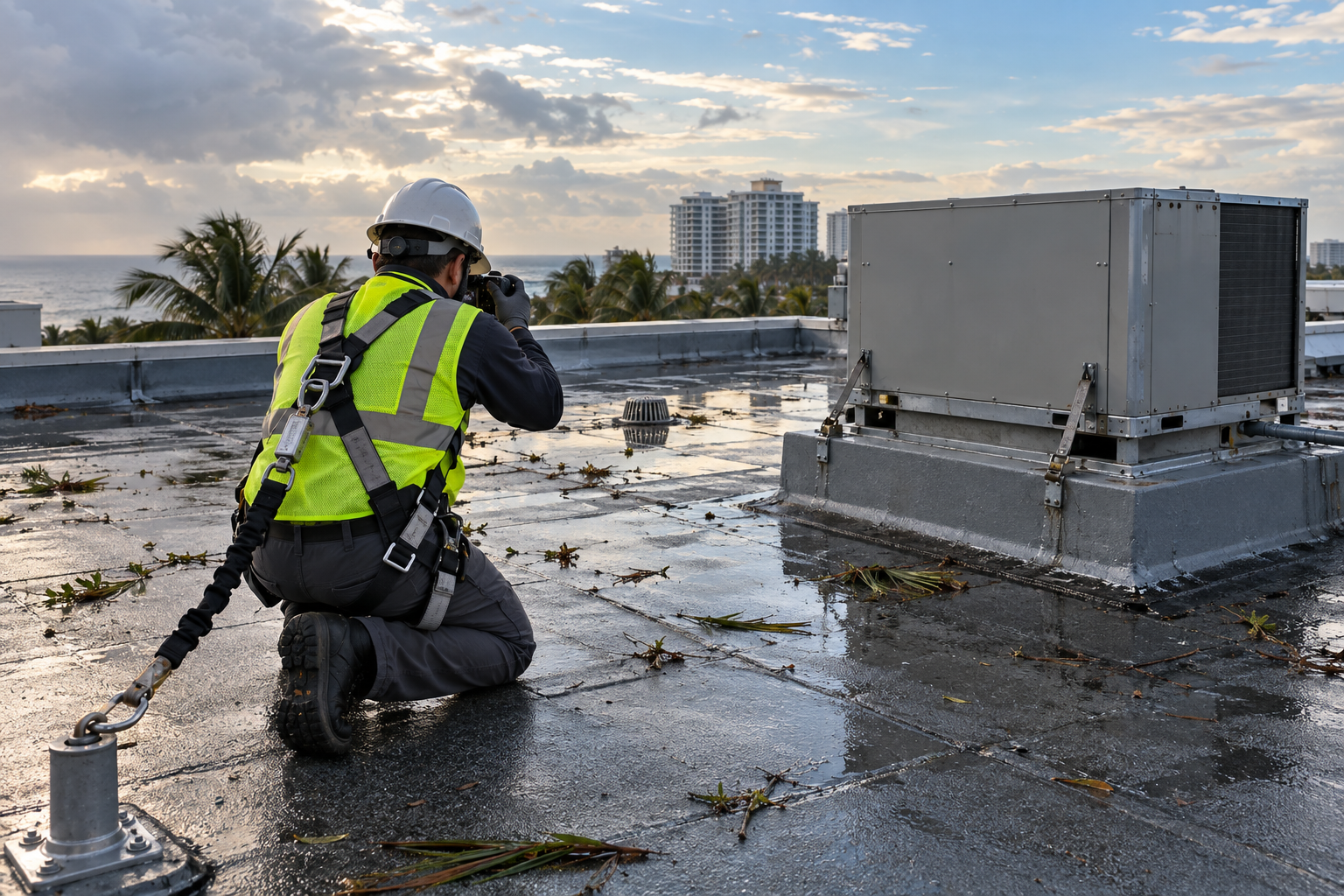
After the storm, the first roof visit is an inspection. OSHA’s storm-recovery guidance issued after Hurricanes Milton and Helene lists the hazards: unstable structures and walking surfaces, fall protection on elevated surfaces, and downed power lines that must be treated as live. Where walking the roof is unsafe, a commercial drone roof survey can capture the condition first. The sequence that protects tenants and the record is document, then dry-in, then repair: dated photographs and a written condition report, then emergency flat roof repair to stop water entry, then a permanent scope. Property managers should receive a daily report showing what was opened and closed, plus notice of crane picks and noise windows.
Equipment access is often the bottleneck. Advanced Roofing’s in-house crane division is part of its storm response, and the company reports on its Miami commercial re-roofing page that after Hurricane Wilma its cranes were back on-site with existing Miami clients within 24 hours. Recovery work has also extended beyond Florida: Advanced Roofing received the 2021 CNA/NRCA Community Involvement Award from the National Roofing Contractors Association and CNA for coordinating repairs to 30 homes in the Bahamas after Hurricane Dorian.
Which code, permit, and insurance rules shape storm repairs in Florida?
As of September 24, 2026, the Florida Building Code 8th Edition (2023) is in effect, and the 9th Edition (2026) takes effect December 31, 2026, according to the Florida Building Commission. Miami-Dade County’s 9th Edition permitting notice states that permit applications submitted on or after that date must comply with the new edition. A roof damaged this fall and permitted in January will likely be designed to the 9th Edition, and the roof consultant and building official determine which edition governs a specific permit. Miami-Dade and Broward buildings sit in the High-Velocity Hurricane Zone, with separate roofing sections and product approval requirements, including Miami-Dade Notices of Acceptance.
Florida law also draws a line around contractors in the claim process. Section 489.147, Florida Statutes, prohibits a contractor from interpreting policy provisions, advising an insured about coverage or policy duties, or adjusting a claim unless the contractor holds a public adjuster license. A roofing contractor supplies the physical record: dated photographs, a written condition report, and an itemized repair estimate. Coverage questions go to the insurer, a licensed public adjuster, or the association’s attorney.
Commercial roof hurricane season checklist: who owns each task?
Each item is assigned to a role, written to be forwarded to an owner, asset manager, or board as the building’s storm plan. Advanced Roofing’s printable hurricane preparation checklist (PDF) and hurricane season resource page carry the same worksheet form.
- Facility or property manager: confirm the roofing contractor’s 24/7 emergency number and escalation contact, and circulate both to on-site staff and security.
- Facility manager: schedule a perimeter and rooftop equipment inspection now, with a written report and dated photographs of edge metal, coping, curbs, drains, and seams.
- Maintenance contractor: complete the fastening, resealing, and drain clearing the report identifies, and record the work.
- HVAC service provider: confirm access panels, cowlings, and equipment tie-downs; FEMA advises that equipment modifications be approved by the manufacturer. Lightning protection conductors are checked in the same visit.
- Roof consultant or engineer: for roofs near end of service life, core and moisture-scan the assembly, recommend repair or commercial re-roofing, and confirm which code edition a permit would fall under.
- Owner, asset manager, or condo board: pull the roof warranty and property policy now, and take coverage questions to the insurer, broker, or attorney.
- Property manager: prepare tenant notices for storm preparation, post-storm roof work, and interior leak reporting.
- Everyone after a storm: no one on the roof until it is inspected; document first, dry-in second, repair third.
Owners planning a replacement after the season can start the budget now with the Florida commercial roofing cost guide.
Frequently Asked Questions
When does hurricane season end in Florida?
The Atlantic hurricane season officially ends November 30. The National Weather Service office in Tampa Bay notes a secondary peak around mid-October, concentrated in the Caribbean Sea and the Gulf, so late-season storms remain possible for Florida after the September 10 peak. Roof plans should stay active through November.
Is it too late to prepare a commercial roof for hurricane season?
No. Targeted work takes days: re-fastening loose edge metal and coping, securing HVAC panels and cowlings, resealing open seams, clearing drains, and photographing the roof with dates. Replacing a roof past its service life usually needs a consultant’s moisture survey first and may be better scheduled after the season.
What should a facility manager do after a hurricane damages a commercial roof?
Keep people off the roof until it is inspected, then document the damage with dated photographs and a written report. Arrange temporary dry-in to stop water entry, notify the insurer, and send coverage questions to the insurer, a licensed public adjuster, or an attorney. The permanent repair follows with its own scope and permit.
Should a commercial roof be replaced during hurricane season?
It can be, when the roof is past its service life and the work is phased so each section is dried-in the same day, with work paused whenever a storm is forecast. For an aged but stable roof, repairs through November 30 and a replacement afterward often carry less exposure. Confirm which code edition the permit will follow.
Can a roofing contractor help with an insurance claim in Florida?
A roofing contractor can provide dated photographs, a written condition report, and an itemized repair estimate. Section 489.147, Florida Statutes, prohibits a contractor from interpreting policy provisions, advising on coverage, or adjusting a claim without a public adjuster license. Coverage questions go to the insurer, a public adjuster, or an attorney.
How often should a commercial roof be inspected in Florida?
FEMA’s low-slope roof fact sheet recommends inspecting at least twice a year, ideally in spring and fall, and again after high-wind events, with repairs completed promptly. In Florida, the fall inspection falls in the late hurricane season, the right time to check edge metal, rooftop equipment, drains, and seams.
The roof plan that still matters after September
A quiet season changes the odds and leaves the work unchanged. NOAA expects fewer storms than average in 2026, FEMA’s post-storm reports keep finding the same failure points at roof edges, rooftop equipment, and drains, and Florida’s code and claim rules put specific decisions with specific professionals. The owners who come through a late-season storm in the best position are the ones who secured the perimeter, recorded the roof’s condition, and named who does what before the watch was issued. That plan costs little in September. This week, that means one inspection report with dated photographs, one list of repairs closed before October, and one page naming who calls whom when the National Hurricane Center issues the next watch.