At a glance: Commercial roof storm damage in Florida is best handled in a fixed order during the first 72 hours, starting with safety and interior containment, then documentation before cleanup, insurer notice, an emergency dry-in under a next-business-day permit, interior drying, and a roof and moisture survey before any permanent decision. This article explains where low-slope roofs fail, compares temporary and permanent repairs with their limits, lists the Florida statutes and code dates that apply as of November 2026, and ends with a role-by-role checklist.
Commercial roof storm damage is handled in two stages: the first 72 hours, when the owner’s job is to make the building safe, stop the water, and record the roof’s condition before anything is cleaned up, and the weeks that follow, when a tested roof supports a repair-or-replace decision. Owners who merge the two by signing a permanent repair or replacement before the roof is documented and moisture-tested risk paying again when wet insulation surfaces months later, and risk weakening an insurance claim that Florida law gives them a fixed window to file. This article sets out what a Florida facility or property manager should do, in order, after a storm damages a low-slope roof on an occupied building; it does not say what any policy covers, whether a roof needs replacement, or which code path applies, because those determinations belong to the insurer, the roof consultant or engineer, and the building official.
Why do the first 72 hours after commercial roof storm damage matter in Florida?
Three dated rules and one physical clock shape the first three days after a storm. The clock comes from the U.S. Environmental Protection Agency, whose guide Mold Remediation in Schools and Commercial Buildings frames its water-damage response table around the first 24 to 48 hours, because materials dried inside that window usually do not grow mold. EPA describes the window as a guideline and notes that growth can occur even when materials are dried in time.
The first dated rule is notice. Under section 627.70132 of the Florida Statutes (2025 text, checked November 2026), a property insurance claim is barred unless notice reaches the insurer within one year after the date of loss, and a supplemental claim within 18 months. For hurricanes, windstorms, severe rain, and other weather events, the statute sets the date of loss as the landfall date or the date the event is verified by NOAA. Recording the storm date and the time damage was found belongs in the first 72 hours; coverage is a question for the insurer, a licensed public adjuster, or an attorney.
The second rule is the emergency permit. Section 105.2.1 of the Florida Building Code’s administrative chapter, as reproduced in Broward County Board of Rules and Appeals Formal Interpretation 36 (September 2025), lets emergency repairs proceed provided the permit application reaches the building official within the next working business day. Chapter 1 is amended locally, so the property’s jurisdiction sets the exact procedure. The third rule is the code calendar. The Florida Building Code, 9th Edition (2026), takes effect December 31, 2026, and Miami-Dade County’s permitting center states that applications submitted on or after that date must comply with the new edition. A late-2026 storm can put emergency work under the 8th Edition and the permanent repair under the 9th.
Where does storm damage start on a low-slope commercial roof?
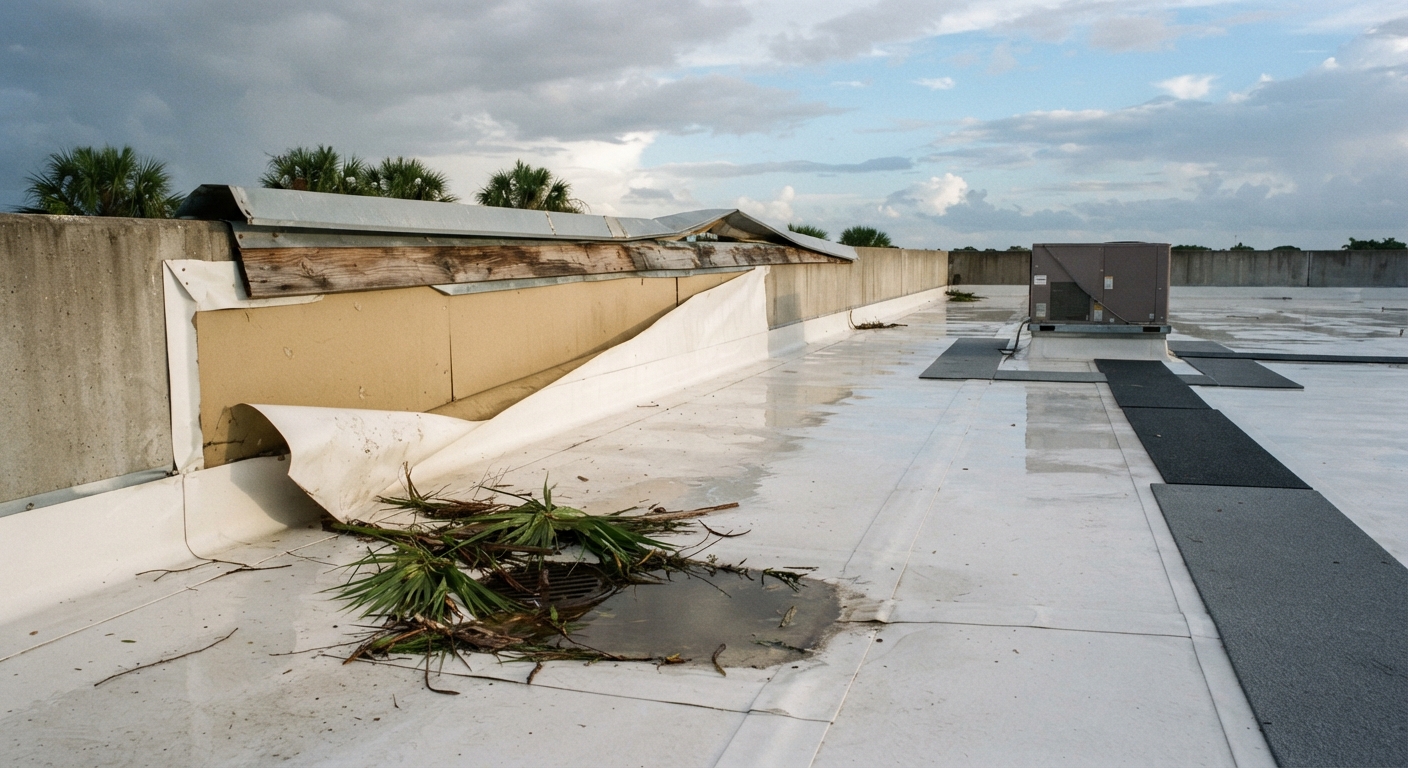
Wind damage on a low-slope roof usually starts at the perimeter, the corners, and the flashings, where uplift concentrates and the membrane changes direction. The Insurance Institute for Business & Home Safety assessed 327 light commercial buildings in Southwest Florida after Hurricane Ian in 2022 and reported damage rates above 50 percent on low-slope roofs, with most affected roofs showing related flashing or coping failures, including buildings built after newer code provisions took effect. Once a section of commercial roof edge metal and coping lifts, wind gets under the membrane and peels it from the edge inward, and every rain that follows enters the roof assembly.
Water inside the assembly moves before it drips. Rain entering at a torn seam or lifted flashing runs along the deck flutes and insulation board joints, so the leak in a tenant suite can sit well away from the opening on the roof. Board insulation that absorbs water loses thermal resistance and can stay wet for months under a membrane that looks intact, which is how a roof that looks repaired keeps leaking.
Drains are the third failure point. Leaves, gravel, and debris from neighboring buildings collect at drains and scuppers, and a roof built to shed water within hours can then hold ponded water against seams never meant to sit submerged. The table lists where a technician looks first.
| Location | What storm damage looks like | Why it matters in the first 72 hours |
|---|---|---|
| Edge metal and coping | Lifted, bent, or missing sections; exposed nailers | Lets wind peel the membrane; first item to secure |
| Field seams (single-ply) | Open laps, fishmouths, peeled sheet | Direct water path into insulation |
| Curb and wall flashings | Base flashing pulled from curbs and parapets | Water enters behind the membrane, often under rooftop units |
| Penetrations | Displaced pipe boots, torn pitch pans, loose vent caps | Small openings that leak into occupied space |
| Drains and scuppers | Blocked strainers, debris dams, ponding | Adds load to the deck and submerges seams |
| Rooftop equipment | Shifted units, lost panels and cowlings | Debris punctures the membrane; open curbs admit water |
| Field membrane | Punctures, hail fractures, scoured surface | May not leak yet; confirm with a moisture survey |
Temporary vs. permanent commercial roof repair: what belongs in the first 72 hours?
Emergency work in the first 72 hours exists to keep water out until the roof can be documented, tested, and scoped. A secured temporary dry-in is usually the right first step even on a roof that will be replaced, and a replacement contract signed on day two is usually premature. Emergency commercial roof repair in Florida covers that stabilization; the permanent decision follows the survey.
Each option has a limit. A temporary cover is not designed for the next storm, and one that is not mechanically secured or ballasted can become debris itself. A patch over wet insulation stops the drip and seals the water inside the roof, so targeted repairs suit discrete openings in an otherwise dry roof. When a survey finds wet insulation across large areas, or the system is near the end of its service life, repeated repairs cost more over time than commercial re-roofing; when the roof is dry with years left, a permanent commercial roof repair is the better use of the budget.
Two outside rules can change the answer. A manufacturer’s warranty may require notice to the warranty holder before anyone other than an approved contractor works on the system. The Florida Building Code’s existing-building provisions decide when a repair becomes a replacement, and the 9th Edition modifies them; the roof consultant or building official should confirm which edition and section govern the permanent scope.
| Option | When it fits | Where it falls short |
|---|---|---|
| Interior containment | Always, from the first hour | Does nothing to stop water entering the roof assembly |
| Temporary dry-in (secured cover, temporary membrane, edge securement) | Roof opened by wind or debris; more rain forecast | Not built for the next storm; must be removed before permanent work |
| Targeted emergency repair (seams, flashings, penetrations) | Discrete openings on a roof that is otherwise dry | Can trap wet insulation if done before a moisture survey |
| Permanent repair after survey | Wet areas are limited and the roof has service life left | Takes days to weeks; needs a permit; code edition may change |
| Replacement (reroof) | Widespread wet insulation, deck damage, or a system at end of life | Longest lead time; permit, product approval, and insurer coordination |
Advanced Roofing is not always the fastest or least expensive answer; for a single small leak on a simple building, a local roofer with an open schedule may arrive sooner. A statewide contractor fits when several buildings are hit at once, the building stays occupied, or the work needs a crane, sheet metal, and rooftop equipment on one schedule.
What drives the cost and timeline of emergency roof work after a storm?
The variables below move both budget and schedule, and each is set by the building. Advanced Roofing does not publish pricing, and no figure in this article is a company price.
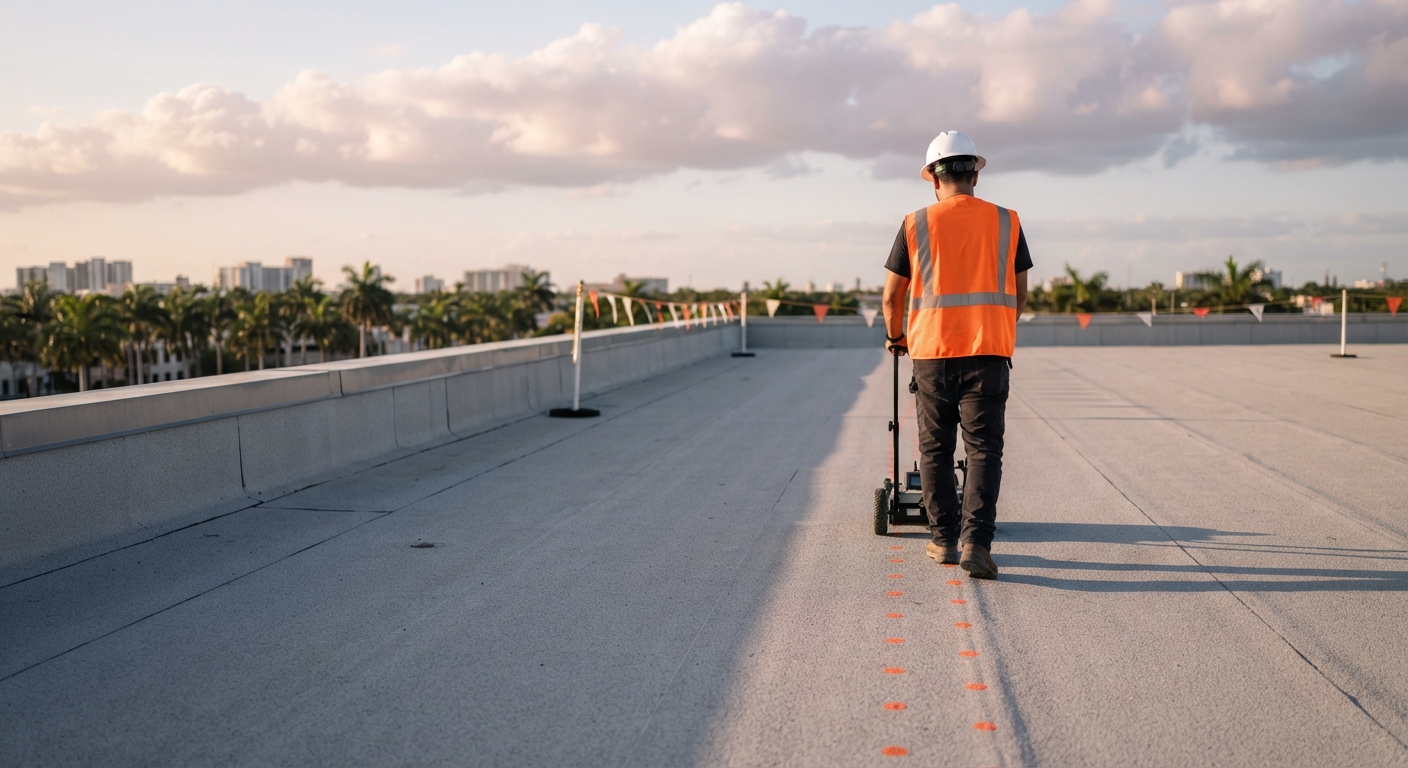
- Extent of wet insulation. A nondestructive moisture survey under a method such as ASTM D7954 for electrical impedance scanners maps wet areas so the scope removes only what is wet; ASTM states the method does not suit black EPDM or metal surfaces, so the survey method follows the roof type.
- Access and lifting. Roof height and crane picks over occupied entrances set crew size and hours.
- Roof system and warranty. Membrane type, attachment, and manufacturer requirements decide which materials and installers qualify.
- Regional demand. When one storm damages many buildings, crews and materials are shared across a wide area.
- Permit and code edition. Emergency and permanent permits, plus High-Velocity Hurricane Zone product approvals in Miami-Dade and Broward, add review time.
Documentation shortens most of these steps. A commercial drone roof survey records the whole surface before cleanup changes it, and Advanced Roofing states that all of its work is time stamped and photo documented.
What changes when the storm-damaged building stays occupied?
When a building stays open after a storm, the first 72 hours are run around tenants and staff. OSHA’s hurricane eMatrix sheet on roof inspection, tarping, and repair directs crews to control access outside and inside the structure and keep occupants out of spaces beneath roof work. It requires guardrails, safety nets, or personal fall arrest on low-slope roofs with unprotected edges six feet or more above a lower level, and fall-arrest anchorages rated for 5,000 pounds.
OSHA also directs crews to treat power lines as energized until proven otherwise and to keep generators outdoors and off building wiring unless an electrician has installed a transfer switch. Rooftop units that took water or debris stay off until a mechanical technician checks them, so the property manager plans temporary cooling for the zones they serve and gets notice of every lockout and crane pick.
Advanced Roofing lists 24/7 emergency roof repair service and operates an in-house crane division. In Broward and Miami-Dade, the counties served by its Miami office and its commercial roofing office in Fort Lauderdale, the High-Velocity Hurricane Zone sections of the Florida Building Code govern permanent work, so confirm product approvals before it is priced. CNA and NRCA gave Advanced Roofing first place in their 2021 Community Involvement Award for Bahamas relief work after Hurricane Dorian.
Which Florida rules apply to a commercial roof leak emergency and the claim that follows?
Section 489.147 of the Florida Statutes (2025 text, as of November 2026) bars contractors from interpreting policy provisions, advising on coverage, or adjusting a claim for the insured unless they also hold a public adjuster license, and bars offering a waived deductible or other incentive for an inspection or a claim. It also requires a good-faith, itemized estimate with any repair agreement. The contractor documents, stabilizes, and prices the roof; coverage questions go to the insurer, a licensed public adjuster, or an attorney (see hurricane damage and the claim process).
After a state of emergency is declared for a natural emergency, section 553.7922 of the Florida Statutes directs affected local governments to expedite permits that need no technical review, naming roof repairs and reroofing, and lets them waive fees. The season-long view of these rules is in the commercial roof hurricane season guide; re-check every date against the statute and the building department on the day work is scoped.
Commercial roof storm damage checklist: who does what in the first 72 hours?
After commercial roof storm damage, the first 72 hours follow a fixed order. Make the building safe, contain interior water, photograph everything before cleanup, notify the insurer, secure the roof with a temporary dry-in, file the emergency permit by the next working business day, start interior drying, and complete a moisture survey before choosing repair or replacement.
- Hours 0 to 6, property manager: confirm everyone is safe, keep people away from wet or sagging ceilings, and treat downed lines as live, per IBHS guidance on what to do after a damaging thunderstorm.
- Hours 0 to 6, facility staff: contain water, move contents, and mark leak points, following the roof leak action steps for property managers.
- Hours 0 to 12, property manager: record the storm date, photograph conditions before cleanup, and call the roofing contractor and any warranty holder.
- Hours 0 to 24, owner or risk manager: notify the insurer and broker; log the claim number.
- Hours 6 to 48, roofing contractor: secure edge metal and openings, clear drains, install the dry-in, and file the emergency permit.
- Hours 24 to 48, restoration contractor: start interior drying against EPA’s guideline and log readings.
- Hours 24 to 72, roofing contractor and roof consultant: complete the roof and moisture survey and issue a written report with photos.
- Hours 48 to 72, owner: hold the permanent decision until the report, the adjuster’s inspection, and the code-edition question are settled.
Frequently Asked Questions
How soon should a commercial roof be inspected after a storm?
As soon as the storm has passed and the roof can be reached safely, ideally within the first 24 hours. The first visit secures openings, clears drains, and photographs conditions. A full roof and moisture survey usually follows within three days, once interior water is contained. A roof can be damaged without leaking right away, so a dry building still warrants a roof inspection.
Should I make repairs before the insurance adjuster inspects the roof?
Temporary repairs that prevent further damage usually should not wait, and IBHS tells businesses to cover damaged roofing to keep water out. Permanent repairs are different. Photograph everything before temporary work starts, keep removed materials and receipts, and ask your insurer, licensed public adjuster, or attorney before permanent work begins.
How long do I have to report commercial roof storm damage to my insurer in Florida?
Under section 627.70132 of the Florida Statutes (2025 text), notice of a property insurance claim must be given within one year after the date of loss, and notice of a supplemental claim within 18 months. For weather events, the date of loss is the landfall date or the date NOAA verifies the event. Report damage promptly and confirm deadlines with your insurer or attorney.
Does emergency commercial roof repair need a permit in Florida?
Generally, yes. Section 105.2.1 of the Florida Building Code’s administrative chapter lets emergency repairs proceed, with the permit application submitted to the building official within the next working business day. Local amendments can change the procedure, so the contractor confirms it with the jurisdiction. After a declared state of emergency, section 553.7922 of the Florida Statutes directs affected local governments to expedite permits for roof repairs and reroofing.
How do I know if storm damage means the roof must be replaced?
Testing the roof answers it. A roof survey and a moisture survey show how much insulation is wet, whether the deck is damaged, and how much service life the system has left. Limited wet areas on a sound roof usually point to repair; widespread wet insulation, deck damage, or an aging system point toward replacement. Your roof consultant or engineer and the building official confirm the code path.
The first 72 hours buy time for the right roof decision
Commercial roof storm damage rewards a set order of work, with safety, water control, documentation, insurer notice, and testing ahead of any decision about the roof. Each step rests on a source an owner can check. Owners who keep that order protect the claim file and avoid paying twice for a roof repaired over wet insulation. The repair-or-replace decision is better made with a moisture survey, an adjuster’s inspection, and a confirmed code edition in hand.
Written by The Technical Team at Advanced Roofing. Founded in 1983, Advanced Roofing is 100% employee-owned, and Roofing Contractor magazine’s 2026 Top 100 list, published August 3, 2026, ranks Advanced Roofing #13 in the United States.
For storm damage on a commercial roof, call Advanced Roofing at (800) 638-6869 or request a commercial roof assessment. The company lists 24/7 emergency roof repair service across its seven Florida offices.