
At a glance: Roofing Contractor magazine’s 2026 Top 100 Roofing Contractors list ranks Advanced Roofing Inc. #13 in the United States, its first ranking as a 100% employee-owned company. This article explains what the list measures (self-reported revenue) and what it does not (workmanship, safety, warranty service), how employee-owned, private equity, and founder-held contractors compare, what a large occupied reroof involves using the Orange County Convention Center project, and the license, bonding, and code-date checks to complete before signing.
Roofing Contractor magazine’s 2026 Top 100 Roofing Contractors list ranks Advanced Roofing Inc. #13 among the largest roofing contractors in the United States, the company’s first appearance on the list as a 100% employee-owned firm. For a facility manager or procurement officer, the top 100 roofing contractors list is a useful first screen for capacity: crew depth, bonding, and the ability to run a large reroof on a building that stays open. Read as proof of workmanship, it can steer an owner toward a contractor whose size fits the job on paper while its proposed crew, warranty terms, or safety program go unchecked. This article explains what the ranking measures, what it leaves out, and how to verify the rest before a contract is signed; it does not rank contractors against each other or comment on any competitor.
What Does the Top 100 Roofing Contractors List Measure?
The Top 100 Roofing Contractors list is an annual ranking published by Roofing Contractor magazine that orders North American roofing companies by self-reported annual revenue. It is a size ranking and is not compiled by NRCA. The 2026 Top 100 Roofing Contractors list, published August 3, 2026, places Advanced Roofing Inc. of Fort Lauderdale at #13.
According to Roofing Contractor’s description of its method, contractors submitted revenue figures through an online form over roughly six months, and the magazine ranks them on those figures alone. Entrants also disclose whether they belong to a private equity group or platform, and the published table reports peak staff, the share of commercial and residential revenue, and private equity status next to revenue. A company that does not submit is not ranked, so the list describes only the firms that chose to report.
Advanced Roofing’s 2026 entry, as published in that table, lists $205,718,515 in revenue, a peak staff of 750, a work mix of 99% commercial and 1% residential, and no private equity ownership. The company held the same #13 position on the 2019 Top 100 Roofing Contractors list, which Advanced Roofing’s announcement at the time tied to 2018 revenue of $95 million. The 2026 entry is the first submitted since the company became 100% employee-owned through an Employee Stock Ownership Plan, a change described on the Employee Ownership at Advanced page and in the company’s August 2026 ranking announcement.
None of those figures is a state credential. In Florida, the authority to contract for roofing comes from Chapter 489 of the Florida Statutes, and licenses are issued and tracked by the Department of Business and Professional Regulation, whose DBPR online licensee search is open to the public. A ranking sits on top of that licensing baseline and never replaces it.
What Does a Revenue Ranking Tell an Owner, and What Does It Leave Out?
Revenue is a reasonable proxy for capacity. A contractor billing more than $200 million a year in roofing work needs the crews, equipment, supervision, and surety relationships to carry several large projects at once. For an owner planning a reroof on a 300,000-square-foot distribution center or a hospital campus, that capacity matters, because a contractor stretched across too many jobs has to choose which site gets its crews, and an occupied building with an open roof section cannot wait for that choice.
Revenue says nothing direct about workmanship, warranty performance, or safety. A ranking built on self-reported revenue does not inspect seams, review leak-call histories, or audit fall-protection programs. Size also cuts both ways on small jobs: a statewide contractor built for large occupied buildings carries overhead that can make it a higher bid on a simple 15,000-square-foot single-story roof than a well-run local firm. Owners should read the table as one input and then confirm each implication with a document.
Each column in the Roofing Contractor table answers a different question. The table below pairs each one with the document that confirms or rules out what it implies.
| Top 100 column | What it suggests | What it does not show | What to ask the contractor for |
|---|---|---|---|
| Revenue rank | Capacity to staff and finance large projects | Workmanship, profitability, or local crew depth | A list of completed projects of similar size and building type, with owner references |
| Peak staff | Workforce available at the busiest point of the year | How many crews are local to your building, or how much work is subcontracted | A crew plan naming the superintendent and the office that will run the job |
| Commercial / residential share | Whether volume comes from low-slope commercial or steep-slope residential work | Experience with your specified system (PVC, TPO, modified bitumen, coatings) | Manufacturer authorization for the specified system and warranty tier |
| Private equity status | Who owns the company today | How ownership affects your project team or future warranty service | Who signs the warranty, who services it, and what happens if ownership changes |
| Self-reported revenue | Scale as stated by the contractor | Independent verification; firms that do not submit are absent | A bonding letter from the surety and the DBPR license record |
How Do Employee-Owned, Private Equity, and Founder-Held Roofing Contractors Compare?
Ownership structure is one of the clearest dividing lines on the list. Roofing Contractor’s coverage of the 2026 rankings names private equity consolidation, through multi-regional platforms built by acquiring regional roofers, as one of the trends the list has tracked, and the table discloses which entrants are private equity backed. The remaining firms are held by founders, individual owners, or their employees.
An employee-owned company in the United States is usually structured as an ESOP. The IRS describes an employee stock ownership plan (ESOP) as a qualified defined contribution plan, either a stock bonus plan or a combined stock bonus and money purchase plan, designed to invest primarily in the employer’s own stock. Shares are held in trust for participating employees instead of being sold to an outside buyer. Advanced Roofing completed that transition in 2026, and the company states that every eligible employee is now an owner.
For an owner, the practical differences show up in continuity and in who answers for the work years after close-out. No ownership structure guarantees good roofing.
| Ownership model | What it can offer a building owner | Where it falls short | Question to ask |
|---|---|---|---|
| Employee-owned (ESOP) | Continuity of leadership and staff; the people on site share in company results | Ownership does not inspect a seam; quality still depends on supervision, training, and the specification | Who is the named superintendent, and how long has the proposed field team worked together? |
| Private equity platform | Access to capital and resources across several regions | Ownership can change again on the investor’s timeline, and local management can turn over | If the company is sold during the warranty period, who honors service calls? |
| Held by founders or individual owners | Direct owner accountability and long local relationships | Succession can be unsettled, and capacity may not match a large project | Is there a written succession plan, and what bonding capacity is available for this project? |
Advanced Roofing chose employee ownership over a private equity acquisition to keep its leadership and culture in place, and the company describes the result for clients as long-term stability, accountability, and consistent service. Those are the company’s own statements. An owner evaluating any contractor, employee-owned or not, should test such statements against references, warranty records, and the specific team proposed for the job.
What Drives Schedule, Risk, and Cost on a Large Commercial Reroof?
Large reroofs are priced and scheduled around a short list of physical drivers, and the Orange County Convention Center North-South Building in Orlando shows how they stack up on a single building. Orange County selected Advanced Roofing and Advanced Green Technologies through a competitive public bid, and Advanced Roofing served as the single point of coordination for all trades, according to the project record published by Advanced Green Technologies. All figures in the table below come from that record.
| Driver | OCCC North-South Building | Why it moves budget and schedule |
|---|---|---|
| Roof area | 1,374,000 sq ft | Sets crew count, material volume, and the number of phases |
| Tear-off scope | Existing single-ply membrane removed to the deck | Full removal exposes deck conditions that a recover would leave hidden |
| New assembly | 2-inch polyiso insulation under an 80-mil Johns Manville PVC membrane on the RhinoBond attachment system; 25-year manufacturer warranty | System choice fixes the installation method, the wind-design path, and the warranty terms |
| Drainage | 300+ roof drains replaced; new overflow scuppers | Plumbing work has to run in sequence with the membrane crews |
| Rooftop equipment | 130+ rooftop fans installed | Every curb is a flashing detail and a coordination point with the mechanical trade |
| Solar | 2.2 MW DC array installed after the membrane was complete | The membrane must be finished before racking goes down |
| Building height | 80 to 100 ft, varying by roof section | Drives crane picks, hoisting, and material staging |
| Daily crew | 30 to 40 workers | Determines supervision ratio and safety staffing |
None of those figures is a price, and Advanced Roofing does not publish pricing. They are the variables an estimator works from. On a smaller building the same list applies at a different scale: roof area, tear-off versus recover, deck condition, drain count, rooftop equipment, and access will set the budget for commercial re-roofing long before membrane color or brand preference does.
What Changes When a Large Florida Building Stays Open During the Reroof?
An occupied building turns a roofing schedule into an operations plan. At the convention center, the facility stayed open throughout the work, daytime roofing was prohibited during major events, and crews worked night and weekend shifts with out-of-sequence planning, according to the AGT project record, which reports zero event disruptions. Tear-off proceeded in staged sections small enough to keep the roof watertight, which matters on a Central Florida building exposed to sudden summer storms. Advanced Roofing’s Orlando commercial roofing office lists the convention center among its Central Florida work.
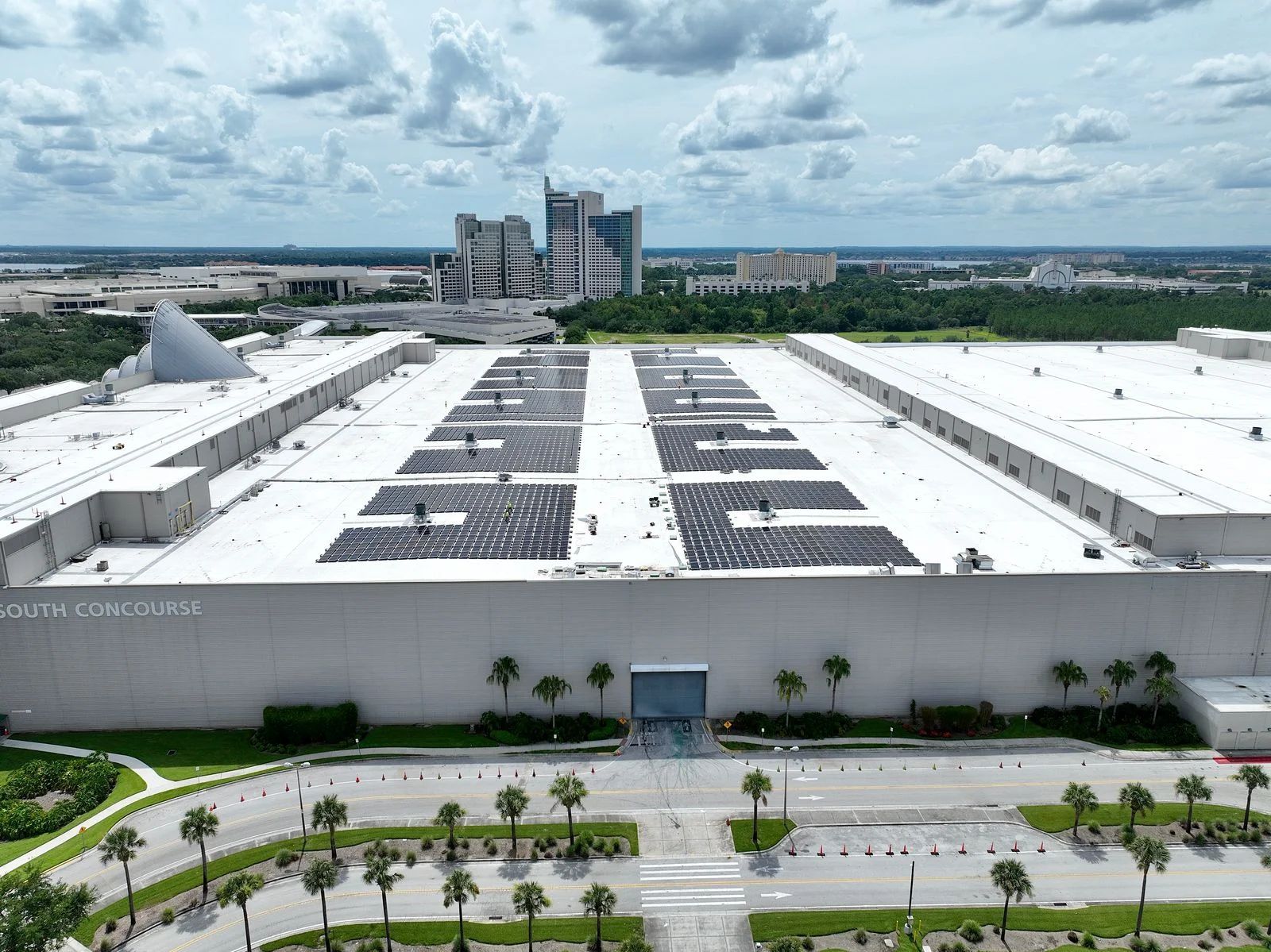
Sequencing between trades is where occupied-building risk concentrates. On the convention center roof, the membrane was completed before solar installation began, so the array went down on a finished surface instead of being worked around. Drain replacements, lightning protection, fire alarm work, and rooftop fan installations each touched the roof and had to be scheduled against both the membrane crews and the event calendar. A single contractor coordinating those trades removes a hand-off between the roof warranty holder and the trades cutting into the roof.
Safety on a roof 80 to 100 feet up is a staffing and equipment question. OSHA’s fall protection requirements apply at six feet in the construction industry, and the convention center crews used perimeter clamp systems for fall restraint along with OSHA 10-hour and 30-hour training. On any large occupied building, an owner should expect a written fall-protection plan, a staging plan that keeps material hoisting away from public entrances, and a named contact who issues notice before work begins near occupied space.
Which Florida License, Bonding, and Code Dates Should Owners Check Before Signing?
Three checks apply to every Florida roofing contract, wherever the contractor ranks. The first is the license. A roofing contractor must be certified or registered under Chapter 489, and the DBPR licensee search shows the license type and whether it is current.
The second is bonding. On public and large private projects, owners and their attorneys can check the surety issuing performance and payment bonds against the U.S. Treasury’s Department Circular 570, which lists the companies approved to write federal bonds. Advanced Roofing publishes a bonding capacity of $50 million per project and $150 million in aggregate on its About Us page.
The third is the code edition. As of November 21, 2026, the Florida Building Code 9th Edition (2026) takes effect December 31, 2026, and permit applications submitted on or after that date must comply with it. Miami-Dade County’s permitting notice on the 9th Edition states that applications submitted through its online portal after 4 p.m. on December 30, 2026 fall under the new edition, and other jurisdictions set their own cutoffs. Which edition governs a given reroof is a determination for the design professional and the building official, working from the code text published by the Florida Building Commission.
How Should You Use the Top 100 Roofing Contractors List When Choosing a Commercial Roofer?
A ranking narrows the field. The checklist below turns that short list into a decision a board or procurement committee can defend, with each item assigned to an owner. Advanced Roofing’s guide on how to select a roofing contractor covers the same ground from the contractor’s side.
- Procurement officer: Confirm each contractor’s Florida roofing license on the DBPR licensee search and record the license number in the bid file.
- Facility manager: Request three completed projects of similar roof area and building type from the last five years, with owner contacts.
- Owner’s attorney: Request the surety’s bonding letter for the project value and check the surety against Treasury Circular 570.
- Roof consultant or engineer: Confirm the specified system, the manufacturer warranty tier, and whether the contractor is authorized to install it.
- Facility manager: Require a phasing plan showing dry-in, staging, crane picks, and shutdown notices built around tenant or event schedules.
- Risk manager: Request the written fall-protection plan and the contractor’s experience modification rate letter from its insurer.
- CFO or board: Ask who owns the company, who signs the warranty, and how warranty service continues if ownership changes.
- Design professional: Confirm which Florida Building Code edition governs the permit before final pricing.
- Facility manager: Ask how inspections, maintenance, and warranty records will be kept after close-out, for example through a roof management program.
Public agencies can run the same checks when they buy through a cooperative contract instead of a new solicitation. Advanced Roofing’s public procurement page lists the cooperative purchasing vehicles it holds; the agency’s own procurement rules decide whether piggybacking applies.
Frequently Asked Questions
What is the Top 100 Roofing Contractors list?
The Top 100 Roofing Contractors list is an annual ranking from Roofing Contractor magazine that orders North American roofing companies by self-reported annual revenue. Contractors submit figures through an online form, and the published table also shows peak staff, commercial and residential revenue shares, and private equity status. It measures size, so owners should pair it with license, bonding, and reference checks.
Is the Top 100 Roofing Contractors list published by NRCA?
No. The Top 100 Roofing Contractors list is published by Roofing Contractor magazine. The National Roofing Contractors Association (NRCA) is a trade association that publishes Professional Roofing magazine and runs its own programs and awards, but it does not compile the Top 100 revenue ranking. Cite the ranking as Roofing Contractor magazine’s, with the year.
Where did Advanced Roofing rank on the 2026 Top 100 list?
Advanced Roofing Inc. of Fort Lauderdale ranked #13 on Roofing Contractor magazine’s 2026 Top 100 Roofing Contractors list, with self-reported revenue of $205,718,515, a peak staff of 750, and a 99% commercial work mix. It is the company’s first Top 100 entry as a 100% employee-owned firm.
Does a Top 100 ranking mean a contractor is right for my building?
Not on its own. A Top 100 ranking shows that a contractor reported enough annual revenue to place on the list, which suggests capacity for large projects. It does not measure workmanship, safety, or warranty service, and a large statewide firm may not be the lowest bid on a small, simple roof. Verify the license, bonding, comparable projects, and the proposed field team before choosing.
What does 100% employee-owned mean for a roofing customer?
A 100% employee-owned roofing company is owned by its employees, usually through an Employee Stock Ownership Plan that holds company stock in trust for participating employees. Advanced Roofing became 100% employee-owned in 2026 and states that ownership extends to project managers, service technicians, field crews, and support teams. Owners should still verify performance through references and warranty records.
How do I verify a Florida roofing contractor’s license?
Search the contractor’s name or license number on the Florida Department of Business and Professional Regulation’s online licensee search. The record shows the license type and whether it is current. Roofing contractors are licensed under Chapter 489 of the Florida Statutes, and no ranking or award substitutes for that record.
Why a Revenue Ranking Is the First Check in Contractor Selection
The 2026 Top 100 list confirms that Advanced Roofing is among the largest roofing contractors in the country by self-reported revenue, at #13, and that it reached that position in its first year as a 100% employee-owned company. For a building owner, the ranking answers one question well: whether a contractor has the scale to take on a large, occupied, multi-trade reroof. Every other question, from license status and bonding to warranty service and the people who will be on the roof, is answered by documents and references, and the checklist above assigns each of those to the person who should collect it.
Written by The Technical Team at Advanced Roofing. Founded in 1983, Advanced Roofing is 100% employee-owned and ranked #13 on Roofing Contractor magazine’s 2026 Top 100 Roofing Contractors list.
Planning a commercial reroof in Florida? Request a quote from Advanced Roofing or call (800) 638-6869 to talk with a project manager about scope, phasing, and schedule.