At a glance: A commercial roof inspection before purchase measures what a standard property condition assessment only observes: wet insulation, the number of coverings on the deck, permit dates, and warranty transfer terms. Florida courts generally apply caveat emptor to commercial sales, so roof problems found after the due diligence period are usually the buyer’s. This guide compares the report types, lists the findings that change a deal and the ways to carry them into the contract, covers testing on an occupied building, dates the Florida code and recertification rules, and ends with a role-by-role checklist.
A commercial roof inspection before purchase is the part of Florida due diligence that tells a buyer whether the roof is a maintenance line or a capital project. The property condition assessment most lenders order is a visual walk-through; it does not core the roof, scan for wet insulation, pull the roofing permit history, or confirm that the manufacturer will transfer the warranty. Florida courts still apply caveat emptor to most commercial sales, so a wet roof that surfaces after the due diligence period closes is generally the buyer’s to pay for, often as a tear-off that was never in the underwriting. This guide does not argue that every acquisition needs destructive testing, and it does not replace the buyer’s attorney, engineer, insurer, or lender requirements.
Why does a commercial roof inspection before purchase matter more in Florida?
Florida law leaves most roof risk with the buyer of commercial property. In Johnson v. Davis (1985), the Florida Supreme Court required sellers of residential property to disclose known latent defects, and Florida appellate courts, including the Third District in Agrobin, Inc. v. Botanica Development Associates (2003), have held that this duty does not extend to commercial transactions. Active concealment can still create liability, but silence about a roof that leaks every August is generally protected; how that applies to a given contract is a question for the buyer’s real estate attorney.
The standard due diligence report does not close that gap on its own. ASTM E2018-24, the current standard guide for property condition assessments, describes a baseline process built on a walk-through survey, document review, and interviews. The guide states that a property condition assessment is not technically exhaustive, relies on representative observations, and speaks only for the point in time of the survey. Coring, moisture scanning, and seam probing are enhancements the buyer has to request.
Timing adds a Florida reason to look closely this year. The Florida Building Code 9th Edition takes effect December 31, 2026, and Miami-Dade County’s Permitting and Inspection Center has stated that permit applications submitted on or after that date must comply with the new edition. A buyer who closes in early 2027 and plans a reroof will be pricing work under rules the seller never faced, and the roof inspection is where that budget gets built.
What does a roof condition assessment check that a property condition assessment does not?
A roof condition assessment is a roof-specific evaluation that measures the assembly in addition to observing the surface. Low-slope Florida roofs fail from the inside out: water enters at a split seam, an open lap, or a failed pitch pan, then travels through the insulation before it shows on a ceiling tile. Wet insulation loses value and holds fasteners poorly while the membrane above can look serviceable for years. Measurement is the only way to find that condition: cores cut through the assembly, a moisture survey that shows where the water sits, and a count of how many coverings are already on the deck.
Each scope below answers a different question, and buyers often pay for the first while assuming they received the third.
| Scope | Typical method | What it answers | Where it falls short |
|---|---|---|---|
| PCA roof section (ASTM E2018-24) | Visual walk-through, document review, interviews | General condition, approximate age, visible deficiencies, opinion of cost | No cores or moisture data; representative observations; one point in time |
| Roof condition assessment | Walk of every roof section, photo log, seam probing, cores, drain and edge review | System type, number of coverings, deck condition at cores, remaining service-life opinion by section | A core speaks only for its spot; access depends on the seller and tenants |
| Moisture survey | Infrared (ASTM C1153) or impedance (ASTM D7954), verified by cores | How much insulation is wet and where it sits | Needs a dry roof and a weather window; ballast and reflective surfaces limit results |
| Records review | Roofing permits, warranty certificate, repair invoices, prior reports | Installation date, code edition, warranty status and transfer terms | Records can be missing, and the seller has no general duty to volunteer them |
The records review is the step buyers skip most often and need most in Florida. The roofing permit and its final inspection date establish which code edition the roof was installed under, and that date controls how future repairs are treated, as the code section below explains. Our infrared roof inspection guide explains how a moisture survey is run, read, and verified with cores before anyone relies on it.
Which commercial property roof due diligence findings should change the deal?
A finding changes the deal when it moves the date or the scope of the next roof. Most findings fall into five groups: wet insulation across a meaningful share of a roof section, two or more existing coverings, a roof installed before the 2007 Florida Building Code, a warranty that lapsed or will not transfer, and deferred maintenance at edges, drains, and penetrations. The first three can turn a planned recover into a full tear-off under Section 706.3 of the Florida Building Code, Existing Building.
Once a finding is documented, the buyer chooses how to carry it into the contract. Each option depends on what the seller accepts and what the lender and attorney approve.
| Option | When it fits | Where it falls short |
|---|---|---|
| Price reduction or closing credit | Scope is defined by cores and a contractor proposal | An estimate made in escrow can miss deck damage found at tear-off |
| Seller repairs before closing | Discrete repairs to seams, flashings, and drains | The seller picks the contractor; repairs may not be registered with the warranty holder |
| Escrow or holdback | Larger work the buyer wants to manage after closing | Needs lender and attorney agreement; the amount is fixed before full scope is known |
| Extension for further testing | Findings point to moisture but the data is incomplete | The seller can refuse, and the clock runs against financing deadlines |
| Termination within the due diligence period | Replacement scope erases the investment case | Reports are a sunk cost; only available if the contract allows it in time |
A contractor-prepared assessment carries an obvious tension, because the firm that finds the problem may also bid to fix it. ASTM E2018-24 addresses consultant independence directly, and some buyers and lenders require an independent roof consultant for that reason. A contractor’s assessment adds constructability and pricing knowledge; confirm in advance which kind of report the lender accepts. Our commercial roof repair vs replacement guide covers the tests that decide scope once the data is in.
What drives the cost and timeline of a roof condition assessment?
The cost and timeline of a roof condition assessment are driven by roof area, the number of separate roof sections, the testing ordered, and access. Advanced Roofing does not publish assessment pricing, and online inspection prices are mostly residential.
- Roof area and section count: each section with a different system or age needs its own cores and notes.
- Testing scope: visual only, cores at a set spacing, or a full moisture survey; infrared scanning adds a night visit and depends on weather.
- Access: hatches, ladders, lifts, tenant-controlled roof areas, and after-hours escorts.
- Contract clock: a roof report ordered in the final week of due diligence leaves no time to act on it.
- Deliverable: a photo log tied to a roof plan, a core log, a wet-area map, and a remaining-service-life opinion by section.
Order the roof work in the first days of the due diligence period. Aerial imagery such as Advanced Roofing’s commercial drone survey can map a large roof quickly and show where to core, but it remains a screening tool; the cores and the records review set the budget. Our guide to commercial roofing cost in Florida covers replacement budgets.
How do you inspect the roof of an occupied Florida building during escrow?
Inspecting the roof of an occupied Florida building during escrow means working on property the buyer does not yet control, above tenants the buyer does not yet serve. The purchase agreement’s access clause should state whether invasive testing is allowed, who patches the cores, what insurance the inspector carries, and how much notice the seller and tenants receive. Coring without the seller’s written consent can start a warranty dispute before the buyer owns the warranty, so the scope should name the number and approximate location of cores in advance.
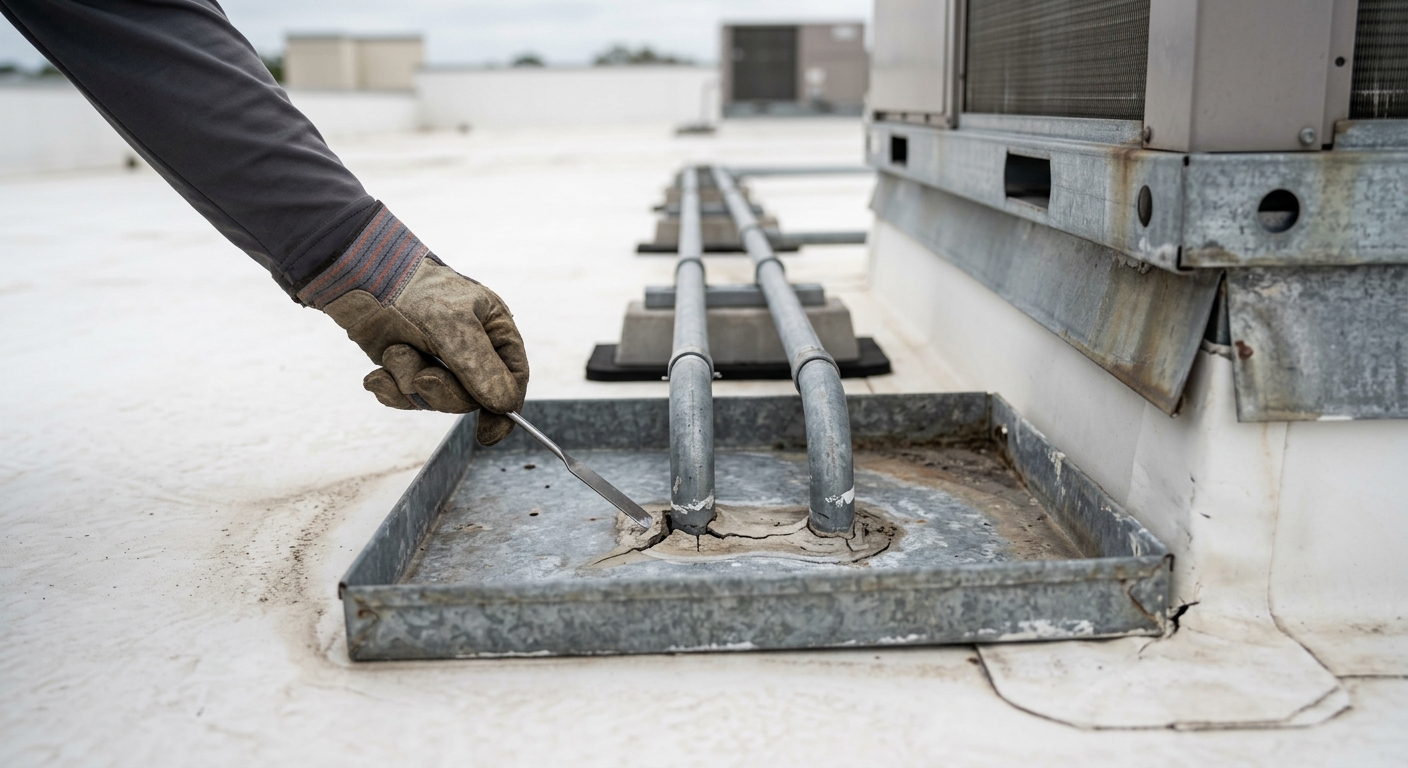
Tenant operations shape the schedule. Some tenants run rooftop equipment that cannot be shut down, and some leases give tenants control of their roof areas. Plan the walk around business hours, keep the crew clear of kitchen exhaust and active equipment, and confirm that every core is patched the same day with materials compatible with the existing system. Stained ceiling tiles and leak entries in maintenance logs often locate a problem faster than the membrane does.
Weather is the other constraint. A survey run the week after a storm reads storm water as well as chronic leaks, and infrared scanning needs a dry surface and a clear evening. In Miami-Dade and Broward, any repairs the findings call for fall under the High-Velocity Hurricane Zone sections of the Florida Building Code, and the roofing contractor and building official decide what those repairs require. If the answer is a new roof, our guide to occupied building roof replacement covers how that work is phased after closing.
Which Florida code and inspection rules should a buyer check before closing?
Three Florida rules change the value of the roof a buyer inherits, and each should be dated in the due diligence file. Section 553.844(5), Florida Statutes, provides that when a roof or roof section was built, repaired, or replaced in compliance with the 2007 Florida Building Code or a later edition, a repair, replacement, or recover of 25 percent or more requires only the repaired portion to meet the current code. A roof installed under an earlier code does not get that exception, which is why the permit date belongs in the report.
The second rule governs recovering. Section 706.3 of the Florida Building Code, Existing Building, prohibits installing a new covering over an existing one in listed conditions, including a water-soaked roof and a roof that already carries two or more coverings. FRSA’s technical director published the approved 9th Edition modifications to that section, which add roof system components to the water-soaked condition and allow certain substrates to stay when an upper roof system is removed. As of October 2026, confirm the adopted text on the Florida Building Commission website before relying on it for a permit decision.
The third is the local inspection calendar. Miami-Dade County’s building recertification program now starts at 30 years, or 25 years for coastal condominium and cooperative buildings three stories or taller, repeats every 10 years, and lists roof covering condition among the structural elements reviewed. Broward County follows a similar 30- and 25-year schedule under Board of Rules and Appeals Policy 05-05, and condominium and cooperative buildings three habitable stories or taller statewide fall under the milestone inspection law in Section 553.899, Florida Statutes. Ask the building department whether a recertification is due, open, or overdue before closing; our condo milestone inspection roof guide covers how those reports treat the roof.
What should a commercial roof inspection before purchase checklist include?
- Buyer’s attorney: write roof access, invasive testing, core patching, and inspector insurance into the due diligence clause, and confirm how findings can be used before the period ends.
- Acquisitions lead: order the roof condition assessment in the first week, separate from the PCA, with cores and a moisture survey priced as options.
- Seller, through the broker: deliver roofing permits, the warranty certificate, repair invoices, leak logs, and prior inspection reports.
- Roof consultant or contractor: identify the system and number of coverings on every section, log cores, map wet areas, and state a remaining-service-life opinion by section.
- Acquisitions lead: ask the manufacturer in writing for warranty transfer requirements, fees, inspection conditions, and deadlines; our commercial roof warranty guide lists the terms to read.
- Asset manager: confirm the permit history, the code edition of the existing roof, and any open recertification or milestone requirement with the building department.
- Insurance broker: share the report with the carrier early, since roof age and condition feed underwriting; our article on insurers requiring roof replacement explains what underwriters look for.
- Owner after closing: enter the purchase report, core log, and warranty file into a roof management program so the first maintenance visit starts from that baseline.
Frequently Asked Questions
Is a property condition assessment enough to evaluate a commercial roof?
Usually not for a low-slope roof of any age. A property condition assessment under ASTM E2018-24 is a visual, representative walk-through with document review. It notes visible roof deficiencies and gives an opinion of cost, but it does not cut cores or survey for wet insulation unless the buyer adds that scope. On a Florida roof, those additions decide whether the next roof is a repair, a recover, or a tear-off.
What does a commercial roof inspection before purchase include?
A full commercial roof inspection before purchase covers every roof section, with a photo log tied to a roof plan; probing of seams, flashings, and penetrations; drain and edge review; cores that show the number of coverings, the insulation, and the deck; and, where warranted, an infrared or impedance moisture survey. It also covers records: roofing permits, warranty status and transfer terms, and repair history.
Who should perform a roof condition assessment for a commercial purchase?
Either an independent roof consultant or a qualified commercial roofing contractor, depending on what the lender and investment committee will accept. Independent consultants, such as those holding IIBEC’s Registered Roof Consultant credential, avoid the conflict of bidding the repair. Contractors bring constructability and pricing knowledge. Ask whoever performs the work to disclose whether they intend to bid on the resulting scope.
Does a commercial roof warranty transfer to a new owner?
Sometimes. Transfer depends entirely on the warranty’s own terms, and many commercial manufacturer warranties require written notice, a transfer fee, an inspection, or repairs before they recognize a new owner. Read the certificate and contact the manufacturer during due diligence, because a missed deadline after closing can leave the buyer without coverage on a roof that was still under warranty.
Can a seller refuse core samples during due diligence?
Yes. Cores open the roof, and a seller can refuse or limit invasive testing unless the purchase agreement grants it. Negotiate testing rights before signing, specify who patches each core and with what materials, and confirm that coring will not breach the seller’s warranty terms. If the seller refuses, the buyer can price that missing information into the offer or into a holdback.
What does the 25 percent roof rule mean for a buyer in Florida?
Under Section 553.844(5), Florida Statutes, a roof built, repaired, or replaced under the 2007 Florida Building Code or later can have 25 percent or more repaired with only the repaired portion brought to current code. Roofs installed before that code lack the exception, so large repairs can trigger full compliance. Your roof consultant and the building official determine how it applies to a specific building.
What a roof inspection should settle before the due diligence period ends
A Florida buyer gets one practical chance to learn the truth about a commercial roof, and it closes with the due diligence period. A visual assessment records what the roof looks like; cores, a moisture survey, and a records review record what the roof is. That difference decides whether the roof is a maintenance budget, a negotiated credit, or a replacement under a code edition the seller never had to meet.
Written by The Technical Team at Advanced Roofing. Founded in 1983, Advanced Roofing is 100% employee-owned and was ranked the #13 largest roofing contractor in the U.S. on Roofing Contractor magazine’s 2026 Top 100 list.
To discuss a roof survey or roof condition assessment on a Florida commercial property, request a free quote or call (800) 638-6869.