At a glance: Choosing between coating, restoring and replacing an aging commercial roof depends on what sits under the membrane. This guide explains which roof conditions a coating can and cannot fix, how ASTM moisture surveys and core samples decide the scope, the Florida Building Code limits on covering an existing roof, and what changes on occupied buildings and in the High-Velocity Hurricane Zone. It closes with the code, condo and insurance dates that matter before December 31, 2026, and a checklist assigned by role.
Commercial roof restoration vs replacement is a moisture question before it is a price question. An aging low-slope roof qualifies for a coating or a restoration system only when core samples and a moisture survey show dry insulation, a membrane that is still adhered, and a single existing roof covering; when those tests fail, a coating seals the problem inside the roof and the owner pays for the roof twice. This article gives Florida owners the tests that decide the choice and the code limits behind them. It does not argue that restoration is always the cheaper path, and it does not decide the code path, insurance outcome or reserve treatment for any specific building.
Why is the coat-or-replace decision harder in Florida in 2026?
The Florida Building Code, 8th Edition (2023), governs permits today, and the 9th Edition takes effect statewide on December 31, 2026, according to the Florida Building Commission. The Florida Roofing and Sheet Metal Contractors Association has published the approved 9th Edition modifications to Existing Building Section 706.3, the section that decides when a new roof covering may go over an existing one and when everything comes off down to the deck.
Section 706.3 already lists the conditions that force a tear-off: a covering or roof system that is water soaked or deteriorated to the point it is not an adequate base, two or more existing roof coverings, blisters that are not cut open and secured, and an existing covering that cannot meet the securement provisions of Section 1504.1 when it is used for attachment. Buildings in Miami-Dade and Broward follow the High-Velocity Hurricane Zone provisions in Sections 1512 through 1525 under the section’s first exception. Whether a liquid-applied restoration counts as a recover is the building official’s call; the water-soaked and two-covering tests still come first, because a coating over a failed base inherits the failure.
Under section 553.844(5), Florida Statutes, when a roof system or section built, repaired or replaced under the 2007 Florida Building Code or a later edition has 25 percent or more repaired, replaced or recovered, only that portion must meet the code in effect. Older roofs stay under the Existing Building code’s repair provisions, so the permit record’s installation date matters.
What is actually failing on an aging low-slope roof?
An aging low-slope roof fails from the surface down and from the edges in, and a coating can answer only the first of those. Ultraviolet exposure dries and crazes the surface of a modified bitumen cap sheet or a single-ply membrane, seams open at laps that have moved through years of daily heat cycles, and ponding water holds against the membrane long after a storm. A coating over a clean, sound and dry surface addresses those directly.
The conditions a coating cannot reach sit below the membrane and at the perimeter. Water that enters through an open seam or a failed flashing travels laterally through the insulation well beyond the leak, where it cuts thermal value, adds weight, weakens the bond between layers and corrodes the fasteners in a steel deck. Sealing the surface over wet board leaves that water inside the assembly. FEMA’s Hurricane and Flood Mitigation Handbook fact sheet on low-slope roofs (FEMA P-2181, March 2022) reports that low-slope membrane roofs often fail at the edges when wind lifts and peels edge flashings, copings and fascia covers. A coating does not re-fasten loose edge metal, so a restoration scope has to include that work or the roof keeps its weakest point.
| Condition | Where it sits | Can a coating address it? | How it is confirmed |
|---|---|---|---|
| Surface crazing, alligatoring, UV chalking | Top surface | Yes, over a sound and adhered substrate | Visual survey, adhesion test patch |
| Open or fishmouthed seams | Membrane laps | Yes, with fabric-reinforced seam treatment in a restoration scope | Seam probing |
| Ponding water | Low areas and drains | Partly; the product must be rated for ponding, and drainage should be corrected | Post-rain observation, drain inspection |
| Wet insulation | Below the membrane | No; wet areas are removed and replaced first | Infrared or impedance survey confirmed by cores |
| Widespread loss of adhesion | Membrane to substrate | No | Cores, pull tests, billowing in wind |
| Loose edge metal and coping | Perimeter | No; requires re-fastening or replacement | Hands-on perimeter check |
| Deck corrosion or rot | Structure | No | Cores, underside inspection |
Coat, restore, or replace: what is the difference, and where does each fall short?
Commercial roof restoration vs replacement comes down to what the roof below the surface can still do. A coating protects a sound, dry roof. A restoration system repairs wet and failed areas, reinforces seams and flashings, then coats to a specified thickness. Replacement removes the roof when moisture, adhesion loss, deck damage or two existing coverings rule the other options out.
In this article, a coating means a reflective maintenance coat applied over a roof that is watertight and dry, mainly to slow ultraviolet aging and lower surface temperature. A restoration means a specified system: cleaning, removal and replacement of wet or failed areas, fabric-reinforced treatment of seams, flashings and penetrations, primer where the manufacturer requires it, and base and top coats applied to a stated dry film thickness. Replacement means tear-off to the deck, or a recover over a single dry covering where Section 706.3 allows it, followed by new insulation, cover board, membrane and edge metal.
| Option | Where it fits | What stays in place | Where it falls short |
|---|---|---|---|
| Maintenance coating | Dry, adhered, watertight roof with years of service left | Everything below the surface | Does not repair seams, flashings, wet insulation or edge attachment; any warranty covers the coating only |
| Restoration system | Dry roof with localized wet areas that can be cut out; one existing covering | Membrane, insulation and deck outside the repaired areas | Not appropriate over widespread wet insulation, lost adhesion or a deteriorated deck; future recoats must use a compatible product; warranty excludes conditions in the roof below |
| Recover | One dry, adequate covering that meets Section 706.3 | Existing covering and, where adequate, insulation | Prohibited where the existing roof is water soaked, deteriorated or already has two coverings; traps moisture if cores are skipped |
| Full replacement | Widespread wet insulation, deck damage, two coverings, or a system past its service life | Structural deck only | Highest first cost; opens the building to weather during tear-off; most tenant disruption |
Advanced Roofing’s commercial roof coating and waterproofing services cover acrylic, silicone and elastomeric systems, and the company’s guide to extending roof service life with a coating states that a coating is not a substitute for replacement where widespread wet insulation or loss of adhesion exists. On a roof with years of service left, targeted commercial roof repair may be the right first step, and the smallest scope that fixes the roof is the one to fund.
FEMA’s fact sheet supports both sides: it reports that liquid-applied roof systems have performed reliably in high winds, and it recommends removing an old covering down to the deck when upgrading, so the structure can be evaluated.
What moisture data should decide commercial roof restoration vs replacement?
The deciding evidence is a moisture survey confirmed by core samples, taken before any restoration or replacement bid is priced. ASTM C1153 sets the practice for locating wet roof insulation with nighttime infrared imaging, and ASTM D7954/D7954M sets the practice for moisture surveys with nondestructive electrical impedance scanners. Both standards call for verification with invasive tests, which on a roof means cores cut through the assembly. D7954 excludes metal coverings and black EPDM, so the survey method has to match the roof.
The survey produces an area, and the area drives the scope. A restoration manufacturer’s specification sets how much wet material may be removed and replaced before the roof no longer qualifies; ask for that limit in writing before the survey, so the result is read against the manufacturer’s number. Cores also show the number of existing coverings, the insulation type and the deck condition, which are the Section 706.3 facts. A commercial drone survey maps the roof for the consultant. A documented survey supports either decision in front of a board.
| Survey finding | Points toward | Reason |
|---|---|---|
| Dry insulation, adhered membrane, one covering, sound edges | Coating or restoration | The base can carry a new surface |
| Localized wet areas within the manufacturer’s written limit | Restoration | Cut-out and replacement returns the base to a dry, adequate condition |
| Widespread wet insulation | Replacement | Section 706.3 and restoration limits both point to removal |
| Two existing coverings | Tear-off to the deck | Section 706.3 prohibits another covering |
| Deck corrosion or deterioration | Replacement with deck repair | The deck is repaired before any covering goes on |
| Roof installed before the 2007 FBC | Scope review with the building official | The 553.844(5) partial-scope exception does not apply |
What drives the budget, schedule, and results of each option?
Restoration usually costs less up front than replacement because it keeps the insulation and avoids most tear-off and disposal, but the gap depends on the roof, and published ranges vary widely between sources. Advanced Roofing does not publish pricing. The 2026 commercial roofing cost guide for Florida prices assemblies from an independent source and shows how wet insulation found in cores moves a replacement budget.
| Driver | Effect on coating or restoration | Effect on replacement |
|---|---|---|
| Share of wet insulation | Each wet area is cut out and replaced first; past the manufacturer’s limit, restoration is off the table | Sets tear-off and new insulation quantity |
| Existing covering type | Sets cleaning, primer and product compatibility | Sets removal method and disposal |
| Seams, flashings and penetrations | Reinforcement labor scales with the detail count | Flashing and curb work scales with the detail count |
| Specified thickness and warranty term | Confirm in the manufacturer’s warranty what thickness the term requires | Assembly and attachment set the warranty |
| Edge metal condition | Re-fastening or replacing edge metal adds scope | Included in a full system |
| Occupancy and weather | Cure windows and afternoon rain shorten work days | Same-day dry-in limits the area opened per day |
Energy savings are a variable, not a promise. The U.S. Department of Energy’s guidance on cool roofs states that savings depend on climate, insulation level, roof type and the efficiency of the cooling system, and that cool roofs achieve the greatest cooling savings in hot climates. The Cool Roof Rating Council’s rated roof products directory reports solar reflectance and thermal emittance for rated products, which gives the owner a common number to compare between coating bids.
What changes when the roof is over an occupied Florida building?
On an occupied building, the schedule and the air intakes decide as much as the roof does. A restoration keeps the building covered throughout, which removes the tear-off exposure that makes replacement the most disruptive option. It brings its own constraints: product cure times set against afternoon storms, odor and overspray near rooftop air intakes, and cleaning and primer work that has to finish before coating starts. Rooftop units near application areas are shut down or their outdoor-air intakes protected, with notice to the property manager before each window.
Replacement on an occupied building is sized to the day. Tear-off areas are limited to what the crew can dry in before afternoon weather, crane picks over entrances move to early mornings or weekends where the site allows, and interior protection sits under open sections. Advanced Roofing’s in-house crane division handles material and rooftop equipment lifts, and commercial re-roofing on occupied buildings is the company’s core work.
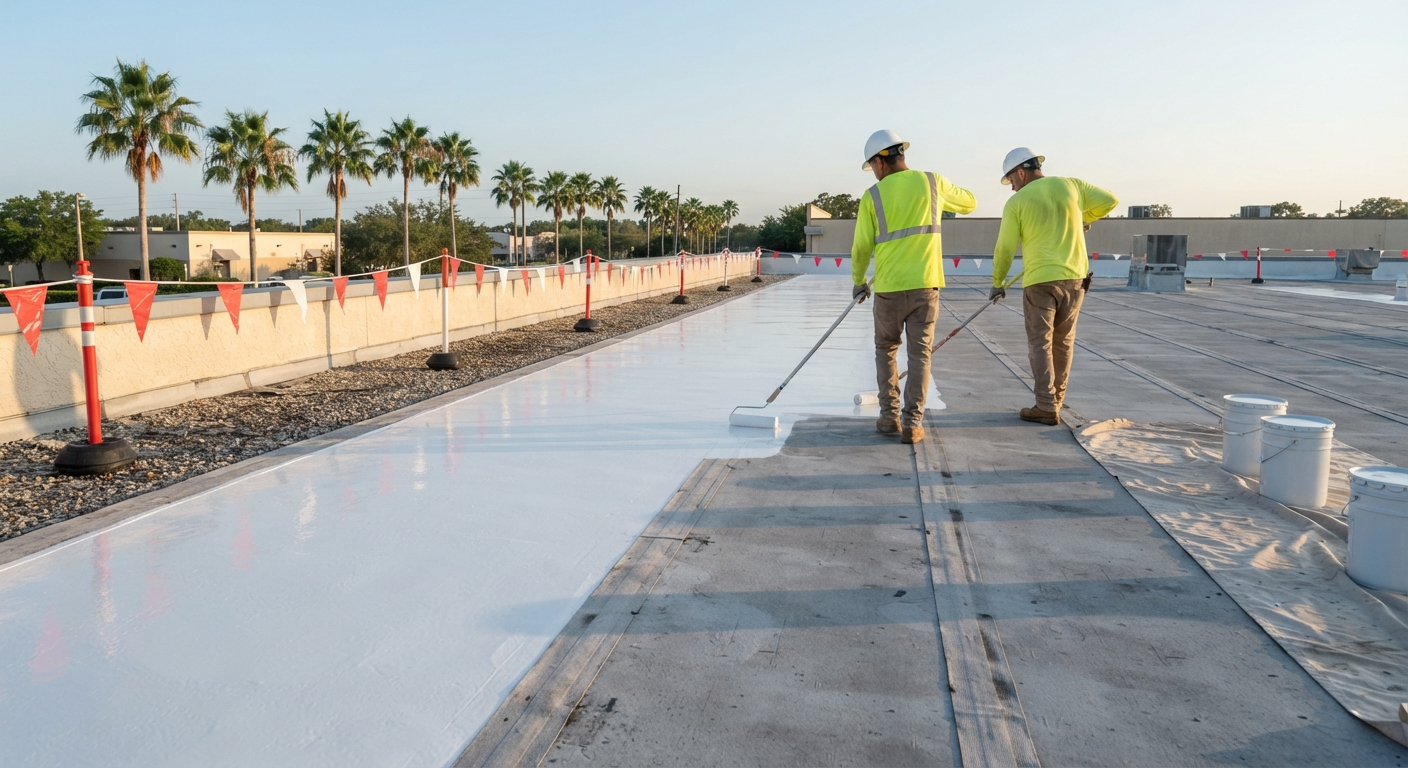
Location adds requirements. In Miami-Dade and Broward, the High-Velocity Hurricane Zone sections govern the roof assembly and Miami-Dade Notices of Acceptance apply to roofing products, so ask the building official whether the restoration scope requires a permit and which product approval the coating must carry. Advanced Roofing’s commercial roof coating team in Miami works under those requirements. Where solar is planned, an array shares the service life of the roof under it, so the rooftop solar plan belongs in the same decision.
Which code, condo, and insurance dates affect the decision?
As of September 30, 2026, four dated items belong in the decision file.
- Florida Building Code, 9th Edition, effective December 31, 2026. The permit application date generally determines which edition governs. FRSA’s published modification to Section 706.3 adds an exception that could let an adequate existing substrate remain when an upper roof system is removed; confirm the adopted text with the building official before relying on it.
- Section 553.844(5), Florida Statutes. The partial-scope exception applies to roofs built under the 2007 code or later, and the statute bars local governments from amending it by ordinance.
- Condominium reserves. Section 718.112(2)(g), Florida Statutes, lists the roof among the components of a structural integrity reserve study. A restoration may change the remaining useful life the reserve professional assigns, so boards should take both options to their engineer, reserve professional and association attorney.
- Insurance. Some carriers do not treat a coating as a roof replacement when they review roof age. Owners answering an underwriting requirement should read the guide to insurance requiring roof replacement and get the carrier’s written answer through their agent before contracting.
Decision checklist: who owns each step before either contract is signed?
- Facility or property manager: order a moisture survey under ASTM C1153 or D7954 with core verification, and pull the permit history showing the roof’s installation date and code edition.
- Roof consultant or engineer: read the survey against the manufacturer’s restoration limits and the Section 706.3 conditions, and write one scope that restoration and replacement bidders both price.
- Restoration bidder: name the product, the dry film thickness, the reinforcement at seams and flashings, the edge metal work and the warranty document with its exclusions.
- Replacement bidder: carry unit prices for wet insulation and deck replacement.
- Building official: confirm whether the restoration needs a permit, which code edition the permit date triggers and, in Miami-Dade and Broward, the required product approval.
- Owner, asset manager or board: compare proposals on remaining roof life and warranty terms as well as first cost; a large statewide contractor built for occupied buildings may not be the lowest bid on a small, simple coating job.
- Operations: fund semiannual commercial roof maintenance and keep the inspection records any warranty requires; Advanced Roofing’s roof management program holds inspection reports and repair history in one place.
Frequently Asked Questions
Is it cheaper to restore or replace a commercial roof?
Restoration usually costs less up front because it keeps the existing insulation and avoids most tear-off and disposal. The gap depends on how much wet material must be removed, how many details need reinforcement, the specified coating thickness and the edge metal work. Price both options against the same moisture survey.
What is the difference between a roof coating and a roof restoration?
A roof coating is a surface layer applied to a roof that is already dry and watertight. A roof restoration is a specified system that removes and replaces wet or failed areas, reinforces seams, flashings and penetrations with fabric, and then applies coatings to a stated thickness, often with a manufacturer inspection and a system warranty.
Can you coat a commercial roof with wet insulation?
Wet insulation has to be removed and replaced before any coating goes on. A coating sealed over wet board leaves the water inside the assembly, where it keeps reducing insulation value, weakening adhesion and corroding deck fasteners. If the survey shows wet areas beyond the restoration manufacturer’s limit, replacement is the path the evidence supports.
Can a new roof covering go over two existing roofs in Florida?
Florida Building Code, Existing Building Section 706.3 prohibits installing a new roof covering where the existing roof already has two or more applications of roof covering; the roof comes off down to the deck. Buildings in Miami-Dade and Broward follow the High-Velocity Hurricane Zone sections. The building official decides how the rule applies to a specific restoration scope.
Does a roof restoration count as a roof replacement for insurance?
Only the carrier can answer that, and underwriting guidelines differ. Some carriers do not count a coating or restoration as a replacement when they review roof age. Get the underwriter’s written position through your agent before contracting.
How long does a commercial roof restoration last?
A restoration lasts as long as the base under it stays dry and the coating is maintained at its specified thickness. The documented number is the term in the manufacturer’s warranty for that product and thickness; general ranges quoted online vary widely. Ask for the warranty document and its exclusions before comparing bids.
Let the roof’s condition choose the scope
Commercial roof restoration vs replacement is settled by the roof, and the proof is on paper: a moisture survey confirmed by cores, a count of existing coverings, the condition of the edges and deck, and the manufacturer’s written limits. A dry, adhered, single-covering roof is a restoration candidate, and restoring it defers a tear-off the building does not yet need. A wet, delaminated or double-covered roof is a replacement, and coating it only moves the cost to a later year. With the 9th Edition arriving December 31, 2026, the permit date belongs in the same file. Holding both bids against the same survey lets the owner defend either choice to a board or an underwriter.
Written by The Technical Team at Advanced Roofing. Founded in 1983, Advanced Roofing is 100% employee-owned and was ranked the #13 largest roofing contractor in the U.S. on Roofing Contractor magazine’s 2026 Top 100 list.
To schedule a moisture survey and a coat-or-replace assessment, request a free commercial roofing quote or call (800) 638-6869.