At a glance: Most Florida commercial roofs need two professional inspections a year, one before hurricane season opens on June 1 and one after it closes on November 30, plus an inspection after every named storm, high-wind event, and rooftop job by another trade. This article explains where that baseline comes from (FEMA and manufacturer guidance), when quarterly visits are justified, what a visit on an occupied building involves, how warranties and Florida condo statutes affect documentation, and who owns each task.
A commercial roof maintenance schedule for a Florida building should rest on two professional inspections a year, timed to bracket hurricane season, with an added inspection after every named storm or high-wind event and after any trade crew works on the roof. That baseline comes from FEMA’s hurricane mitigation guidance and from roofing manufacturers’ owner manuals, and the calendar that fits Florida differs from the spring-and-fall, freeze-and-thaw calendar most published schedules assume.
The stake is practical. A clogged drain found in May is a maintenance ticket; the same drain found in September after a tropical storm is a leak into an occupied tenant space and a warranty question about owner maintenance. This article stops short of claiming that more visits are always better. It explains when two visits are enough, when they are too few, and which decisions belong to the building’s engineer, the roof manufacturer, or the insurer.
How often does a commercial roof need maintenance?
A commercial roof needs a documented professional inspection at least twice a year and again after high-wind events, according to the FEMA P-2181 fact sheet on low-slope roof systems published in March 2022 as part of FEMA’s Hurricane and Flood Mitigation Handbook for Public Facilities. The same fact sheet directs owners to complete needed repairs quickly after each inspection so that a small defect does not grow into additional damage. FEMA’s Mitigation Assessment Team report on Hurricane Charley in Florida (FEMA 488) made a parallel recommendation for critical and essential facilities: inspect the roof and rooftop equipment twice a year, and conduct special inspections after storms with 3-second peak gusts above 90 mph.
Short answer: Most Florida commercial roofs should be inspected by a qualified roofing professional twice a year, once before June 1 and once after November 30, with an added inspection after any named storm, any high-wind event, and any rooftop work by another trade. Older roofs, coastal roofs, and roofs with heavy equipment traffic often justify quarterly visits.
Manufacturers set the same floor for their warranted systems. Carlisle SynTec’s owner’s manual for its single-ply membrane systems recommends inspection at least twice a year and after severe storms, and it asks owners to keep a maintenance log with photographs of each event. The National Roofing Contractors Association’s consumer guidance also points owners to fall and spring inspections, written primarily for steep-slope roofs in climates with a real winter. Advanced Roofing’s service page notes that many Florida commercial roofing contractors recommend two inspections per year, and its preventive roof maintenance program addresses drains and scuppers, storm collars, pipe penetrations, flashing seams, and drain bolts on a routine schedule.
Why does a Florida commercial roof maintenance schedule follow hurricane season?
A Florida roof is stressed by wind, rainfall volume, heat, and salt rather than by freeze-thaw cycles, so the inspection calendar should follow the storm season. NOAA’s National Hurricane Center states that the Atlantic hurricane season runs from June 1 to November 30. An inspection in March, April, or May confirms that drains, scuppers, edge metal, and rooftop equipment are ready before the season opens. An inspection in December or January documents what the season did and gives the owner a clean baseline for the next budget cycle.
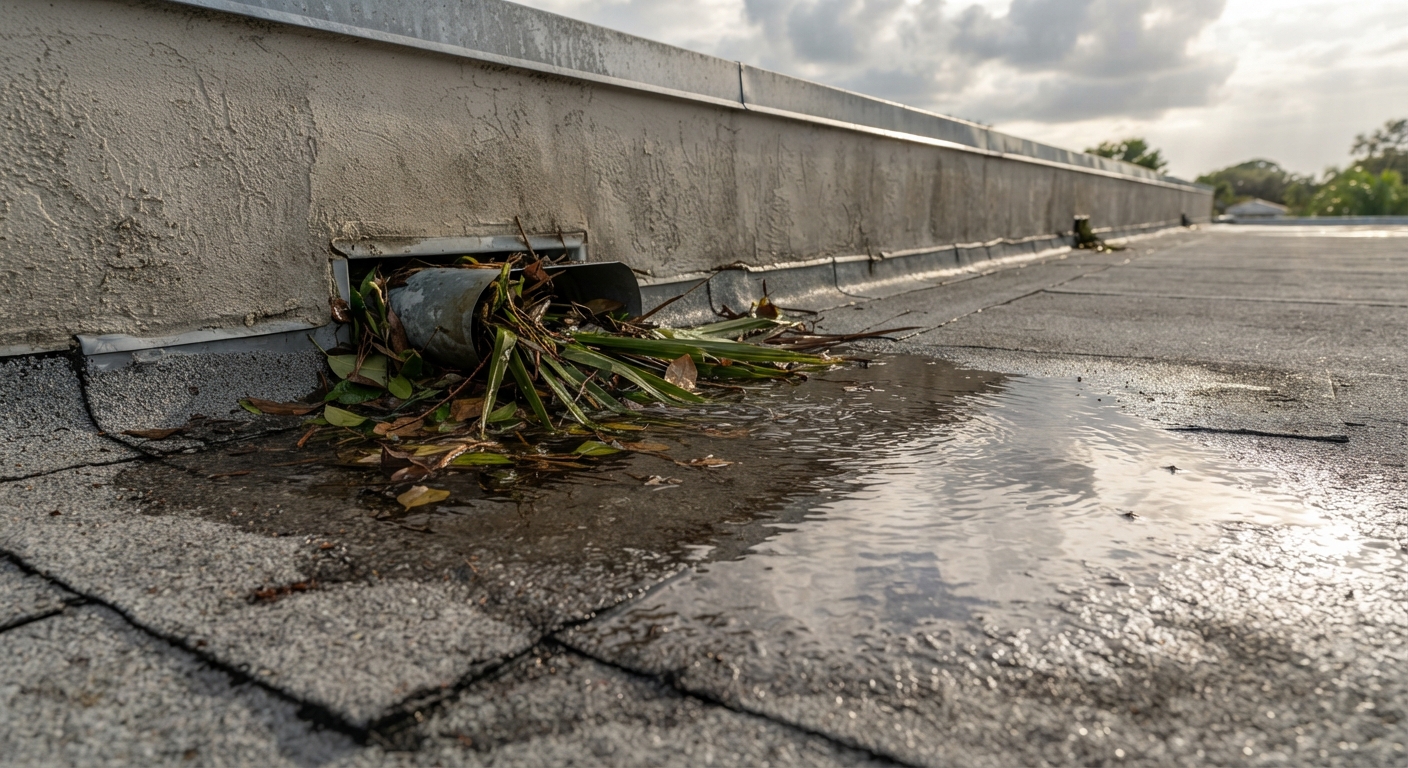
The physical failures follow a predictable path. Leaves, palm fronds, and storm debris collect at drains and scuppers, water backs up, and ponding adds weight and keeps seams and flashings wet for days instead of hours. On low-slope roofs, FEMA P-2181 identifies edge flashings, copings, and gutters as frequent starting points for wind failure, because a lifted edge lets wind get under the membrane and peel it progressively. Loose access panels on rooftop HVAC units are another documented source of damage, since a panel torn off in high wind can puncture the membrane it lands on.
Coastal exposure shortens the interval between problems. FEMA’s fact sheet, citing NFIP Technical Bulletin 8, recommends hot-dipped galvanized or stainless steel for exposed roof connectors and fasteners within 3,000 feet of the coastline because salt spray corrodes ordinary steel. Corroded fasteners at coping, edge metal, and equipment tie-downs are the components an inspector should check before storm season on a beachfront condominium or a port-side warehouse. The storm-specific preparation and recovery steps are covered in the commercial roof hurricane season guide.
| Window | Visit | What it checks | Why this timing |
|---|---|---|---|
| March to May | Pre-season inspection | Drains, scuppers, overflow scuppers, edge metal and coping, equipment tie-downs and access panels, seams, penetrations | Corrects defects before the June 1 season start (NOAA National Hurricane Center) |
| June to November | Event inspection within days of a named storm or high-wind event, once access is safe | Debris, displaced edge metal, punctures, lifted seams, ponding, interior leak reports | FEMA P-2181 calls for inspection after high-wind events |
| Any month | Inspection after rooftop work by another trade | Walkway pads, punctures near equipment, disturbed flashing, loose panels and screws | Carlisle’s owner’s manual cautions trades servicing rooftop equipment to use walkways and protect the membrane |
| December to February | Post-season condition survey and report | Full condition survey, photo log, repair list, budget items for the next year | Documents season damage while it is fresh and feeds capital planning |
Is twice a year enough, or should a commercial roof be inspected quarterly?
Twice a year is enough for a sound roof with a clear warranty, modest rooftop traffic, and no coastal exposure. Other roofs need more attention, and a few can be served with less.
| Frequency | Suits | What it catches | Where it falls short |
|---|---|---|---|
| Annual professional inspection | Newer inland roofs with little equipment and a warranty that accepts an annual interval | Gross defects, drainage problems, year-end condition | Falls below FEMA’s twice-yearly guidance; one visit cannot bracket hurricane season |
| Twice a year, before and after hurricane season | Most Florida commercial roofs in sound condition | Seasonal debris, edge and flashing condition, drain function before and after storms | Misses damage between visits unless event inspections are added |
| Quarterly | Roofs past mid-life, coastal roofs, hospitals and data-critical buildings, equipment-heavy roofs | Developing seam and flashing defects, corrosion, trade damage | Higher annual cost; more rooftop access to coordinate on an occupied building |
| Monthly walk by trained in-house staff plus two professional visits | Campuses and portfolios with a facilities team | Clogged drains and obvious debris between visits | Staff walks do not replace a roofing professional’s assessment; requires fall protection and training |
| Reactive only | No building this article recommends it for | Nothing until water is inside | Leaks surface after insulation and interiors are wet; warranty claims can be disputed without a record |
Documentation often matters as much as frequency. A roof inspected four times a year with no photographs or written findings gives an owner less support in a warranty discussion than a roof inspected twice with complete, dated reports. Advanced Roofing stores inspection reports, photographs, service records, and warranty documents in Advanced Access, its cloud-based roof management portal, so the maintenance history stays with the building when a facility manager or property management firm changes.
What should raise or lower your roof inspection frequency?
Six conditions move the right frequency for a given roof, and most buildings have at least two of them.
| Driver | Effect on frequency | Basis |
|---|---|---|
| Roof age and remaining service life | Roofs past mid-life move toward quarterly | Findings from prior inspections; roof consultant or contractor condition assessment |
| Warranty terms | Must meet or exceed the interval the manufacturer states | Owner’s manual and warranty for the installed system |
| Rooftop equipment and trade traffic | Add an inspection after each service visit by another trade | Carlisle owner’s manual guidance on trades servicing HVAC units and antennas |
| Coastal exposure | Shorter intervals for fasteners, edge metal, and equipment supports | FEMA P-2181 citing NFIP Technical Bulletin 8 (within 3,000 feet of the coastline) |
| Trees and debris sources | Add drain and gutter checks after storms and heavy leaf drop | FEMA P-2181 on regular gutter cleaning and trimming trees back from roofs |
| Building criticality | Hospitals, emergency facilities, and data rooms warrant quarterly and immediate post-storm checks | FEMA 488 recommendations for critical and essential facilities |
System type matters less than most published schedules suggest. A heat-welded TPO or PVC membrane, a two-ply SBS modified bitumen system, and a fluid-applied coating all tend to fail first at the same places: drains, edges, penetrations, and seams around equipment. Exposure and use drive the inspection interval; the system type changes what the inspector looks for at each of those points. Owners of coastal buildings in Miami-Dade can see how the same approach applies locally on the commercial roof maintenance in Miami page.
What does a maintenance visit involve on an occupied Florida building?
A maintenance visit on an occupied building starts before anyone climbs the ladder. The property manager receives notice of the date and access point, the roof hatch or ladder is confirmed safe, and tenants whose spaces sit under rooftop equipment are told to expect foot traffic overhead.
Roof access is regulated work. OSHA’s walking-working surfaces standard, 29 CFR 1910.28, sets fall protection requirements for work on low-slope roofs, and those requirements change with the worker’s distance from the roof edge. For in-house staff, that means training, a defined route, and staying clear of unprotected edges. For most owners, it is a practical reason to limit building staff to visual walks and debris removal and to leave repairs to a roofing contractor.
On the roof, the sequence follows the water. The technician clears and inspects drains, strainers, and scuppers first, then walks edges, copings, and parapet flashings, then penetrations, pipe boots, and storm collars, and finally the field of the membrane and the areas around equipment curbs. Each finding is photographed and located on a roof plan. Larger roofs and portfolio surveys can add a commercial drone survey to document conditions without extended foot traffic across the membrane. If water is already entering the building, the roof leak action steps come first and the scheduled visit comes after.
The visit ends with a written report that separates what was found, what was corrected on the spot, what needs a separate repair proposal, and what should be budgeted. When findings point beyond maintenance, the next step is a commercial roof repair scope or, for a roof near the end of its service life, a re-roofing assessment that includes cores and a moisture survey before any recover option is priced.
Which warranty, condo, and code rules affect a roof maintenance schedule?
Manufacturer warranties treat maintenance as an owner obligation. Carlisle’s owner’s manual, for example, lists routine maintenance items as the building owner’s responsibility and excludes them from warranty coverage, and it requires revision work on a warranted roof to be performed by an authorized applicator. The owner’s manual and warranty for the installed system are the controlling documents. Read both, then match the inspection interval and the documentation to what they require.
Condominium associations carry additional statutory timelines, stated here as of September 26, 2026. Under section 718.112(2)(g), Florida Statutes, the roof is one of the components that must be included in the structural integrity reserve study for covered buildings three stories or more in height, and that study repeats at least every 10 years. The separate milestone inspection under section 553.899, Florida Statutes applies to condominium and cooperative buildings three or more habitable stories in height: first by December 31 of the year the building reaches 30 years of age, then every 10 years, with local agencies allowed to require the first inspection at 25 years for buildings near salt water. The milestone inspection is a structural review by a licensed architect or engineer and does not replace routine roof maintenance. Boards should confirm how both requirements apply to their building with their engineer and association attorney.
The Florida Building Code changes on a date that matters to repair timing. As of September 26, 2026, the 8th Edition (2023) is in effect and the 9th Edition (2026) takes effect December 31, 2026, according to the Florida Building Commission, and the permit application date generally determines which edition governs. Routine maintenance does not usually require a permit, while repairs and replacements often do. Whether a specific repair found on a post-season inspection needs a permit, and under which edition, is a question for the building official.
Commercial roof maintenance schedule checklist: who does what?
A schedule works when each task has an owner on the property.
- Facility or property manager: set two professional inspection dates each year, one between March and May and one between December and February, and put both on the capital-planning calendar.
- Facility or property manager: pull the manufacturer warranty and owner’s manual for the installed roof and confirm the required inspection interval and documentation.
- Roofing contractor: deliver a dated report after every visit with photographs, a roof plan locating each finding, the corrections completed, and a prioritized repair list.
- Building engineer or maintenance lead: log every rooftop access by another trade and request a roof check after HVAC, solar, or telecom work.
- Property manager: after a named storm or high-wind event, schedule a roof inspection as soon as access is safe, notify the insurer under the policy’s reporting terms, and send coverage questions to the insurer or a licensed public adjuster.
- Condo board or community association manager: confirm reserve study and milestone timelines with the association’s engineer and attorney, and keep roof maintenance records available to the reserve study professional.
- Asset manager or owner: review at least two years of reports before approving a repair-or-replace budget, and ask the contractor which findings recur.
Frequently Asked Questions
How often should a commercial roof be inspected in Florida?
Plan on at least two professional inspections a year, one before hurricane season opens on June 1 and one after it closes on November 30, plus an inspection after any named storm or high-wind event. FEMA’s low-slope roof fact sheet (P-2181) recommends inspections at least twice a year and after high winds. Coastal, aging, or equipment-heavy roofs often justify quarterly visits.
Does a commercial roof warranty require regular maintenance?
Most commercial roof warranties make maintenance the owner’s responsibility. Carlisle SynTec’s owner’s manual, for example, recommends inspection at least twice a year and after severe storms, and it lists routine maintenance items as excluded from warranty coverage. Read the warranty and owner’s manual for your installed system, follow its interval, and keep dated reports and photographs of every visit.
Should a roof be inspected after a hurricane if nothing is leaking?
Yes. Wind damage such as lifted edge metal, displaced coping, loosened equipment panels, or punctures from debris often shows no interior leak until the next heavy rain. FEMA recommends inspecting after high-wind events. Schedule the inspection as soon as the roof is safe to access, and direct any coverage questions to your insurer or a licensed public adjuster.
Can building maintenance staff handle roof inspections?
Trained in-house staff can walk the roof between professional visits to clear drains and spot obvious debris, provided they follow OSHA fall protection requirements under 29 CFR 1910.28. Staff walks do not replace a roofing professional’s inspection, and warranted repairs typically must be done by an authorized applicator. Limit staff tasks to observation, logging, and debris removal.
Is a condo milestone inspection the same as a roof inspection?
No. A milestone inspection under section 553.899, Florida Statutes, is a structural inspection by a licensed architect or engineer of load-bearing elements and primary structural systems. It does not replace routine roof maintenance or the roof component of a structural integrity reserve study. Associations should confirm both obligations with their engineer and association attorney.
What happens during a commercial roof maintenance visit?
A technician clears and inspects drains and scuppers, then checks edges, copings, flashings, penetrations, storm collars, and the membrane around equipment. Minor items such as resealing a storm collar are corrected during the visit, and each finding is photographed and recorded. The owner receives a written report that separates completed work, needed repairs, and budget items.
Build the schedule around storm season, then adjust it to the roof
A Florida commercial roof maintenance schedule starts with two professional inspections a year, one before June 1 and one after November 30, because FEMA’s guidance and manufacturers’ owner manuals set twice a year as the minimum and Florida’s greatest roof risk arrives with hurricane season. Event inspections after storms and after rooftop trade work close the gaps between those visits. Roof age, coastal exposure, equipment traffic, and building criticality decide whether the interval should tighten to quarterly, and the warranty and any condominium statutes decide what must be documented. The written record from each visit is what turns a maintenance schedule into evidence an owner can use.
Written by The Technical Team at Advanced Roofing. Founded in 1983, Advanced Roofing is 100% employee-owned and was ranked the #13 largest roofing contractor in the U.S. on Roofing Contractor magazine’s 2026 Top 100 list.
To set up a maintenance schedule for your building, request a preventive maintenance consultation or call Advanced Roofing at (800) 638-6869.