
At a glance: Florida decides most recover vs tear-off questions before the bids do. This guide lists the five conditions in Section 706.3 of the Florida Building Code, Existing Building, that require a tear-off, explains why recovers fail over wet or loose roofs, compares recover, partial tear-off, full tear-off, and the new upper-layer exception, and covers the HVHZ moisture limits, the 25 percent rule, the December 31, 2026 code change, occupied-building logistics, and a role-by-role decision checklist.
In Florida, the commercial roof recover vs tear off decision is made by the existing roof before it is made by the budget. Section 706.3 of the Florida Building Code, Existing Building, lists the conditions that require every existing layer to come off down to the deck, and core samples and a moisture survey are how an owner learns which of those conditions apply. A recover placed over wet insulation, a second existing covering, or an attachment that cannot meet current uplift requirements can be refused at permit, fail early, and leave the next reroof with two roofs to remove. This article explains when an overlay is allowed under the code in force today and after the December 31, 2026 change; it does not determine that any specific roof qualifies, which is the roof consultant’s, engineer of record’s, and building official’s call.
What does the Florida Building Code say about commercial roof recover vs tear off?
The Florida Building Code defines a roof recover as installing an additional roof covering over a prepared existing covering without removing it, and a roof replacement as removing the existing covering, repairing any damaged substrate, and installing a new covering. Both are reroofing, which the Existing Building volume treats as a Level 1 alteration, and both must use materials and methods that comply with Chapter 15 of the Florida Building Code, Building. FRSA’s 2022 column on recovering versus replacement under the Florida code explains why the code, rather than the owner, often makes the choice.
Section 706.3 requires removal of all existing layers down to the roof deck when any one of five conditions exists. The table lists them as FRSA printed the section in its February 2026 summary of approved 9th Edition reroofing changes, with the status of each under the edition taking effect December 31, 2026.
| Condition in Section 706.3 | What it looks like on a low-slope commercial roof | Status in the 9th Edition (pending) |
|---|---|---|
| 1. Existing covering is water-soaked or deteriorated so it is not an adequate base | Wet insulation, rotted or corroded deck, delaminated plies | Wording revised for clarity to cover roof coverings and roof system components |
| 2. Existing covering is wood shake, slate, clay, cement, or asbestos-cement tile | Rare on low-slope areas; found on mansards and steep sections of mixed roofs | Unchanged |
| 3. Two or more applications of any type of roof covering | A roof that has already been recovered once | Unchanged as a condition; new Exception 3 allows removing only the upper system where the lower substrate is adequate |
| 4. Blisters, unless cut or scraped open and secured before new roofing | Blistered built-up or modified bitumen plies | Unchanged |
| 5. Existing covering is used for attachment and cannot meet FBC Building Section 1504.1 securement | Plies or insulation too weak to hold fasteners or adhesive at design uplift | Unchanged |
The exceptions matter as much as the conditions. Buildings in the High-Velocity Hurricane Zone follow Sections 1512 through 1525 of the Florida Building Code, Building, in place of Section 706.3. Complete and separate roof systems that carry their loads directly to the structure, such as a framed standing-seam metal retrofit, do not require removal of the old roof, and a new protective coating over an existing spray polyurethane foam roof is permitted without tear-off. The Florida Building Commission’s analysis of 9th Edition Existing Building changes confirms the two substantive revisions: the new upper-layer exception, and the replacement of the shingle-coating exception with language letting an adhered vapor barrier or self-adhering membrane stay on the deck.
The 25 percent rule in Section 706.1.1 sits beside Section 706.3 and is often confused with it. FRSA reported in its March 2023 review of the 25 percent rule that the 8th Edition limits repair, replacement, or recovery to 25 percent of a roof area or section in any 12-month period unless the covering on the entire roof system or section is replaced or recovered to current code, a revision that removed a reading which had blocked whole-roof recovers. Section 553.844(5), Florida Statutes, adds that where a roof was built, repaired, or replaced to the 2007 Florida Building Code or later, only the portion being worked on must meet the code in effect. Advanced Roofing’s commercial roof repair vs replacement guide covers how the rule applies to repairs. Neither provision makes a wet or doubled roof eligible for a recover.
Why does a recover over a wet or loose roof fail?
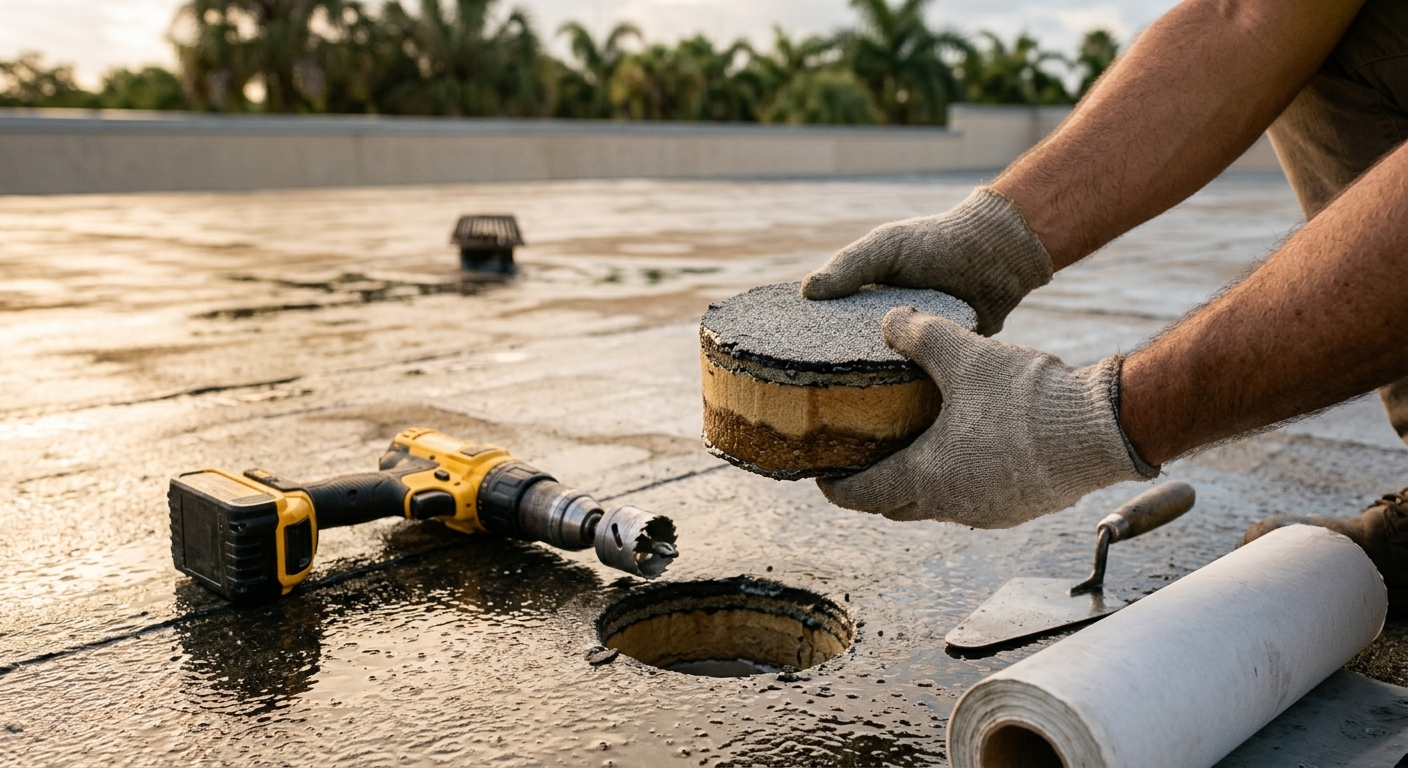
A recover fails from the bottom up when the roof underneath it is wet. Water held in insulation and felts has no way out once a new membrane seals the top, so Florida sun drives it as vapor toward the cooler interior, where it condenses, corrodes steel deck and fasteners, weakens adhesive bonds, and leaves the insulation insulating poorly. Owners usually see the result as new ceiling stains or soft areas underfoot years before the new membrane shows wear.
Attachment is the second failure path. In a mechanically fastened recover, fasteners pass through the old roof into the deck, so the deck has to hold them; in an adhered recover, the new system is only as strong as the old plies and insulation beneath it. One current Florida Product Approval evaluation report for an HVHZ single-ply system states that where insulation or membrane is bonded over an existing roof in a recover, the existing system must resist the project’s design pressures on its own to the building official’s satisfaction. Pull tests and adhesion tests on the existing roof are how Condition 5 is checked in the field.
Drainage is the third. A recover raises the roof surface by the thickness of the cover board or insulation, which changes the depth of drain sumps, the height of scuppers relative to the new surface, and the clearance at door thresholds, curbs, and edge metal. Ponding on a deflected deck stays after a recover, because the overlay adds no slope unless tapered insulation is part of the scope.
| Finding from cores and moisture survey | What it points toward |
|---|---|
| Dry insulation, one existing covering, firm adhesion and fastener pull-out | Recover is a candidate, subject to design pressure, drainage, and manufacturer approval |
| Scattered, mapped wet areas | Remove and replace the wet areas, then evaluate a recover over the dry remainder |
| Widespread wet insulation | Full tear-off; replacement quantities erase the recover’s savings |
| Two existing coverings in the core | Tear-off under the 8th Edition; under the 9th Edition, removing only the upper system may be possible if the lower substrate is adequate |
| Fasteners fail pull tests or plies delaminate | Tear-off, or a separate structural system under Exception 2 |
| Corroded or deflected deck | Tear-off with deck repair after engineering review |
Recover, partial tear-off, or full tear-off: where does each option fall short?
Florida owners usually choose among four reroof scopes, plus a coating that is often bid against them, and each has a limit the proposal should state plainly.
| Option | When it fits | What it delivers | Where it falls short |
|---|---|---|---|
| Recover over the existing roof | Dry, adhered, single existing covering on a sound deck | Avoids most demolition, disposal, and open-deck exposure; keeps dry insulation in service | Leaves the deck unseen; adds a second covering any later reroof must address; warranty terms can be shorter or conditioned on pre-installation inspections |
| Partial tear-off with recover over dry areas | Wet areas limited and mapped by survey and cores | Removes the wet material the survey found | Every transition between torn-off and recovered areas is a detail to flash; the manufacturer must accept the mixed approach |
| Full tear-off to the deck | Any Section 706.3 condition, widespread wet insulation, or deck concerns | Exposes the deck for repair; lets tapered insulation correct drainage; leaves one covering for the next reroof | Most noise, debris, and open-deck weather exposure; longest schedule; deck repair quantities unknown until removal |
| Remove upper of two coverings (9th Edition Exception 3) | Two coverings exist and the lower substrate is adequate | Keeps sound original insulation or lightweight insulating concrete in place | Available only when the 9th Edition governs the permit; adequacy is the building official’s determination |
| Coating or restoration (not a recover) | Dry, sound, well-adhered membrane | Extends a sound roof | Not a new roof covering; does not fix wet insulation, lost adhesion, or a deteriorated deck; a coating warranty is not a new-roof warranty |
A coating belongs in a separate column of the decision because it does not replace the roof covering, and Advanced Roofing’s guide to commercial roof restoration vs replacement explains when one holds. A recover also postpones debris rather than eliminating it, a point FRSA made in its 2022 column, since both layers eventually come off together. A statewide contractor set up for occupied buildings may not be the lowest bidder on a small, simple recover, and an owner with an empty single-story building may not need that capacity.
What drives the cost and schedule of a recover vs a tear-off?
Advanced Roofing does not publish pricing, and a per-square-foot gap between a recover and a tear-off quoted without a core report is a sales number. The 2026 commercial roofing cost guide explains how a Florida reroof budget is built from the assembly up. The drivers below decide how far apart a recover bid and a tear-off bid land on a given building.
| Driver | Why it moves budget or schedule | Who confirms it |
|---|---|---|
| Area of wet insulation | Wet material is removed and replaced in either scope, so the recover’s savings shrink as the wet area grows | Roofing contractor, roof consultant |
| Number and type of existing coverings | Two coverings take a recover off the table under the 8th Edition | Roofing contractor |
| Deck type and condition | Steel, concrete, wood, gypsum, and lightweight fill hold fasteners differently; deck damage is visible only after removal | Engineer of record |
| Design wind pressure and listed assembly | Corner and perimeter zones need denser attachment, which the existing roof must carry in an adhered recover | Engineer of record, building official |
| Drains, scuppers, curbs, and edge height | A recover raises the surface; sumps, scuppers, curb flashings, and edge metal may need rework | Roof consultant, mechanical contractor |
| Added dead load | A recover adds weight to a structure designed for one roof; FBC Existing Building Section 706.2 addresses structural and construction loads | Structural engineer |
| Energy code path | FRSA’s January 2022 reading of the 7th Edition was that a typical reroof does not trigger the Energy Conservation volume but may not reduce existing efficiency under Section 701.2; confirm under the governing edition | Building official |
| Warranty terms | Manufacturers can require pre-installation inspections, adhesion tests, separation layers, or a shorter term on a recover | Manufacturer |
Schedule follows the same logic. A recover removes most of the daily tear-off and dry-in cycle and shortens the time the deck is open, while a tear-off adds debris handling and leaves deck repair quantities unknown until the roof is opened. The commercial roof warranty guide explains how coverage terms can differ between a recover and a full replacement.
What changes when the building stays open during the reroof?
On an occupied building, the recover vs tear-off choice also decides how much tenants hear, smell, and see. Tear-off is the noisiest and dustiest phase of any reroof, and it opens the deck, so the daily rule is to remove only what the crew can dry in the same day, with temporary protection staged ahead of Florida’s afternoon storms. A recover reduces that exposure but brings its own disturbances: fastener drilling through a steel deck carries into the space below, and adhesives used to bond cover boards and fleece-backed membranes produce odor near rooftop fresh-air intakes.
Advanced Roofing’s commercial re-roofing service is built around buildings that stay open, and the sequence is the same whichever scope the cores support:
- A pre-construction meeting sets staging areas, access routes, rooftop unit shutdown windows, and tenant notices.
- Equipment and material lifts by the in-house crane division are scheduled outside business hours where the site allows.
- Adhesive work is coordinated with the mechanical contractor so outdoor-air intakes near the work area are managed.
- Wet areas found during a recover are cut out and replaced on the day they are opened.
- Daily cleanup and photo progress reports give the property manager one record, and close-out delivers the permit final, approval numbers, and warranty registration.
The occupied building roof replacement guide covers tenant communication and phasing in more detail.
Which code dates and HVHZ rules control a recover permit in 2026 and 2027?
As of October 28, 2026, the 8th Edition (2023) Florida Building Code is in effect and the 9th Edition takes effect December 31, 2026. The permit application date generally determines which edition governs, so a recover that depends on the new upper-layer exception should be permitted after the change, and a project designed to 8th Edition text should be permitted before it. FRSA describes the Section 706.3 changes as approved but pending final publication, so the adopted text on the Florida Building Commission’s site is the version to design against.
Miami-Dade and Broward add a measurable test. The Palm Beach County Building Code Advisory Board’s 2017 technical advisory on roof moisture surveys summarizes the HVHZ requirement that moisture in the existing assembly to be covered stay at or below 5 percent by weight in the membrane and 8 percent by weight in commercially manufactured rigid board insulation, verified by a TAS 126 moisture survey submitted with the permit application. The board recommends the same survey for low-slope recover permits in Palm Beach County, which lies outside the HVHZ. Each component of an HVHZ recover also needs a Notice of Acceptance, searchable through Miami-Dade Product Control, and outside the HVHZ the assembly is checked against Florida Product Approval.
Drainage is checked as well. Miami-Dade’s Board of Rules and Appeals issued an interpretation on existing roof drainage in June 2024 requiring building departments to verify that existing drainage at least meets the code in effect when the building was originally permitted, citing the rule that recovering or reroofing may not reduce required drains or scuppers without a new design by a registered design professional. Advanced Roofing’s Miami commercial re-roofing page and Fort Lauderdale commercial roofing page cover HVHZ work in those two counties.
How should owners decide between a recover and a tear-off?
Assign each item to a named person before bids go out, so every bidder prices the same roof.
- Property manager: pull the permit history for each roof section, including dates showing whether the 2007 Florida Building Code or later applied, and list tenant constraints.
- Roofing contractor: cut cores, count existing coverings, and run a moisture survey; the infrared roof inspection guide explains how scans and cores work together, and a commercial drone survey adds an overhead record.
- Roof consultant: map wet areas by square footage and state which scope follows from Section 706.3.
- Engineer of record: confirm design pressures, deck capacity for fasteners and added load, and drainage, and name the listed assembly.
- Manufacturer’s representative: confirm in writing whether the warranty sought is available over the existing roof and what inspections it requires.
- Building official: confirm which code edition governs the permit date and, in Miami-Dade and Broward, what moisture survey documentation the application needs.
- Owner or board: compare bids on the same scope and wet-area quantity, and record why the chosen scope fits the building.
Frequently Asked Questions
Can you put a new commercial roof over an existing roof in Florida?
Yes, when Section 706.3 of the Florida Building Code, Existing Building, allows it. The existing covering must be dry and adequate as a base, must not be one of the listed tile or shake types, must be the only covering on the deck, must have any blisters cut and secured, and must hold the new system to current uplift requirements. Cores, a moisture survey, and attachment tests show whether those conditions are met, and the building official decides.
How many roof layers are allowed on a commercial building in Florida?
Under the 8th Edition Florida Building Code, a roof with two or more existing coverings must be torn off to the deck before a new covering goes on, so one recover over the original roof is the limit. The 9th Edition, effective December 31, 2026, adds an exception that permits removing only the upper covering where the lower substrate is adequate. Confirm the adopted text and the edition that governs your permit.
Do I need a moisture survey before a roof recover in Florida?
In Miami-Dade and Broward, the HVHZ provisions cap moisture in the existing membrane and insulation and require a TAS 126 moisture survey with the permit application, as Palm Beach County’s Building Code Advisory Board has summarized. Elsewhere, the code bars recovering a water-soaked roof, and a survey confirmed by cores is the practical way to show the roof is dry. Manufacturers can add their own pre-installation requirements.
Is a roof recover cheaper than a tear-off?
A recover usually avoids most demolition, disposal, and new insulation, which is where its savings come from. The savings shrink as wet insulation, deck repair, drain and curb rework, and denser attachment for design pressure are added back. Compare recover and tear-off bids only after cores and a moisture survey give every bidder the same wet-area quantity, and treat any gap quoted without them as unverified.
Does the 25 percent rule stop me from recovering a whole roof?
No. As FRSA reported, the 8th Edition revised Section 706.1.1 so the covering on an entire roof system or roof section may be replaced or recovered to current code, which removed a reading that had blocked whole-roof recovers. The 25 percent rule governs how much of a roof can be worked on without bringing the section to code. It does not override the Section 706.3 conditions that require a tear-off.
Let the cores and the permit date decide the overlay
An overlay is allowed in Florida when the existing roof is dry, single, adhered, and strong enough to hold the new system, and when the code edition governing the permit says so. Everything else in the recover vs tear-off comparison, from savings to schedule to tenant disruption, follows from those findings. With the 9th Edition taking effect December 31, 2026, the permit date now belongs in the decision alongside the core report. Owners who settle both before bidding compare proposals on equal terms and avoid paying for the same roof twice.
Written by The Technical Team at Advanced Roofing. Founded in 1983, Advanced Roofing is 100% employee-owned and was ranked the #13 largest roofing contractor in the U.S. on Roofing Contractor magazine’s 2026 Top 100 list.
To have your roof cored, surveyed, and scoped for a recover or a tear-off, request a commercial roofing quote online or call (800) 638-6869.