
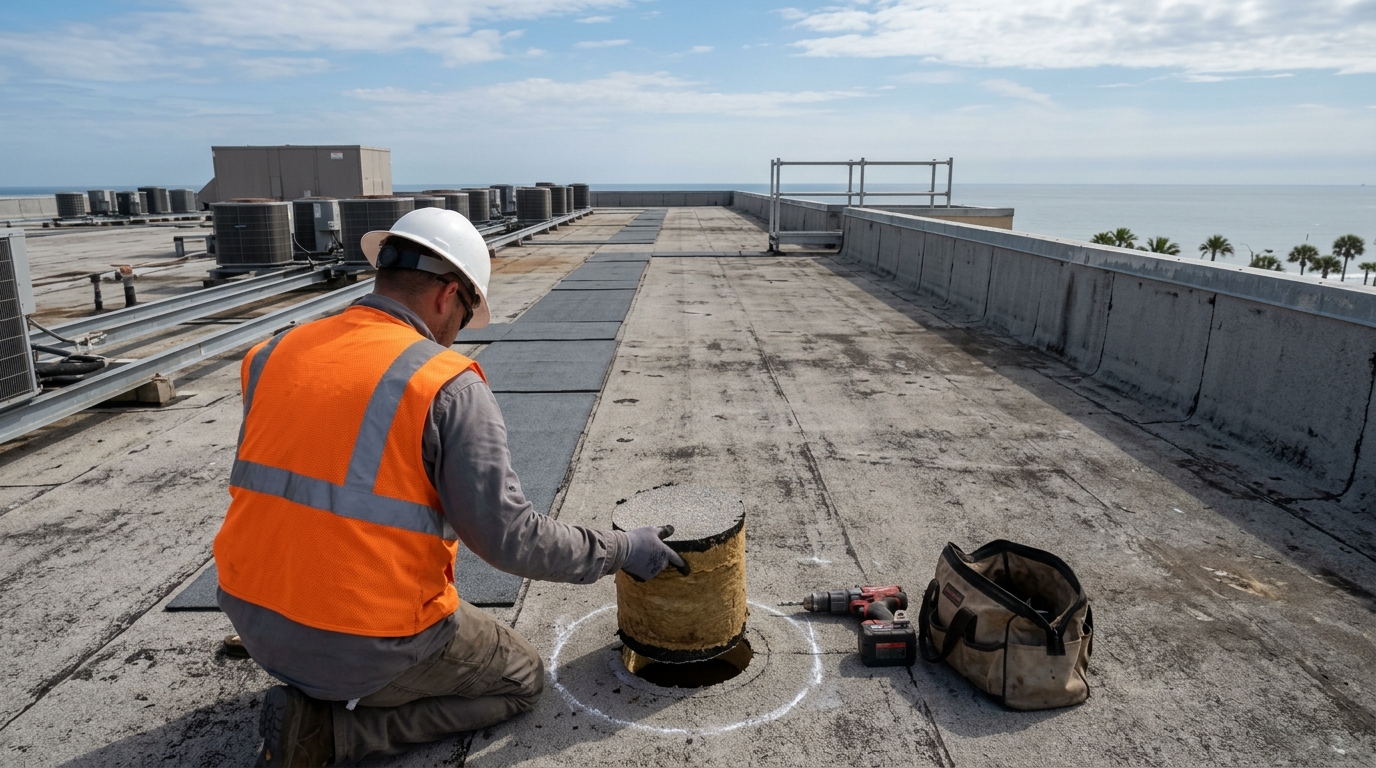
At a glance: For a Florida condominium of three or more habitable stories, the roof replacement date, budget, and funding vote all trace back to the structural integrity reserve study (SIRS). This guide explains how the SIRS roof line becomes a replacement plan, compares the funding paths Florida law currently allows (funded reserves, special assessments, loans or lines of credit, and the temporary milestone pause), lists what moves cost and schedule on an occupied building, and dates the statute, bidding, code-edition, and hurricane-season items a board should confirm with its attorney, engineer, and reserve professional.
A condo roof replacement Florida associations can defend to their owners is planned from the structural integrity reserve study outward, with a funding decision, a bid package, and a permit date set before the roof forces the schedule. Boards that wait for leaks to set the date tend to replace the roof in the wrong season, under a code edition they did not plan for, and with a special assessment that owners first hear about at the meeting where it is voted. This article covers buildings of three or more habitable stories that fall under the SIRS requirement; it does not tell any association what the law requires of its own building, which is a question for the association attorney, the engineer, and the reserve professional.
Why does a condo roof replacement Florida boards plan now start with the SIRS?
The roof is the first component a structural integrity reserve study must cover. Under Section 718.112, Florida Statutes, paragraph (2)(g), a residential condominium association must have a SIRS completed at least every 10 years for each building three or more habitable stories tall, and the statute lists the roof ahead of the structure, fire protection, plumbing, electrical, waterproofing, and windows. The study must identify each item, estimate its remaining useful life and replacement cost, and include a reserve funding schedule built on a baseline plan that keeps the reserve cash balance above zero.
What changed the planning problem is the funding rule. For budgets adopted on or after December 31, 2024, the statute as published in 2026 bars an association subject to the SIRS from providing no reserves or less reserves than the study requires for those components, and it limits the use of those reserves to the listed items. Owners can no longer vote away a roof shortfall, so the roof line in the study becomes a budget line the board has to meet.
The Division of Florida Condominiums, Timeshares and Mobile Homes adds a reporting step. Its SIRS reporting page states that an association must submit the SIRS reporting form electronically within 45 days after the study is completed, and the statute gives owners a copy, or notice of availability, on the same 45-day clock. The board’s replacement plan should be ready by the time owners ask about the roof estimate.
How does the SIRS roof line turn into a replacement date?
A SIRS roof line is two estimates multiplied over time: what the roof will cost to replace and how many years it has left. The reserve professional spreads the cost across the remaining useful life, and the annual contribution rises whenever the remaining life shortens or the cost estimate grows. The Division’s condominium FAQs from the Division of Florida Condominiums, Timeshares and Mobile Homes illustrate the rule with a $100,000 roof due in 10 years: the association reserves enough each year to have the money when the work is due without the balance falling below zero. The study is based on a visual inspection, so the roof line is only as good as what can be seen from the surface.
The condition that shortens a roof’s life on a Florida high-rise is usually water inside the assembly. A failed seam or flashing lets water into the insulation, where it stays because the membrane above and the concrete deck below hold it in. Wet insulation loses thermal value, weakens the bond to the deck, and rules out a recover, so a roof that looks serviceable can lose most of its estimated life once it is cored. Ponding at clogged drains speeds the aging of the membrane around them. A roof consultant’s core cuts and moisture survey give the reserve professional a measured remaining useful life to work from.

Our earlier post on condo milestone inspection roof findings and the SIRS explains what each report records. The table below sets out what each document settles for the replacement project and what it leaves open.
| Document | What it settles about the roof | What it leaves open | Who prepares it |
|---|---|---|---|
| Milestone inspection (F.S. 553.899) | Structural findings; phase two repair obligations where substantial deterioration is found | Membrane condition, moisture, replacement cost | Licensed architect or engineer |
| SIRS (F.S. 718.112(2)(g)) | Estimated remaining useful life, replacement cost, and the reserve funding schedule | Trapped moisture, deck condition, recover eligibility, code path | Engineer, architect, or CAI/APRA-credentialed reserve professional |
| Roof condition assessment | Core cuts, moisture survey, drain and flashing condition, deck observations | Funding, legal approvals | Roof consultant or engineer, with contractor data if requested |
| Contractor bid | Scope, sequence, schedule, price, and warranty for a defined specification | Whether the reserve plan or the vote is adequate | Roofing contractor |
Which funding path fits the roof: reserves, a special assessment, a loan, or a pause?
Florida law gives a SIRS association several ways to pay for a roof replacement, and each one carries an approval requirement and a cost to owners. The 2026 statute text allows reserves for SIRS components to be funded by regular assessments, special assessments, lines of credit, or loans, and it requires approval by a majority of the total voting interests for a special assessment, line of credit, or loan used for that purpose. A separate provision allows a temporary pause or reduction in reserve funding after a recent milestone inspection. The comparison below states each path as of the statute text published for 2026; the association attorney confirms which apply.
| Funding path | How it works | Approval (2026 statute text) | Where it falls short |
|---|---|---|---|
| Fully funded roof reserve | The roof line in the SIRS is met each year, so the cash is in the account when the roof is replaced | Board adopts the budget; SIRS reserves cannot be waived for budgets adopted on or after Dec 31, 2024 | Only works if the remaining-life estimate was right; a shortened life leaves a gap |
| Special assessment | Owners pay the shortfall in one or more installments set by the board | Majority of total voting interests when used to fund SIRS reserves; 14-day notice stating the purpose | Lands on owners at once; collection risk on units that cannot pay |
| Loan or line of credit | The association borrows for the work and repays from future assessments | Majority of total voting interests; terms disclosed in the annual financial statement | Interest cost; lender underwriting of the association’s finances and delinquency rate |
| Milestone pause (F.S. 718.112(2)(f)2.e.) | Reserve contributions are paused or reduced to pay for milestone repairs | Majority of total voting interests; budgets adopted on or before Dec 31, 2028; no more than two consecutive budgets | The roof ages while reserves pause; a SIRS is required before contributions resume |
| Phased replacement | Roof areas or buildings are replaced in separate years to spread cost | Board decision within the adopted budget and reserve plan | Repeat mobilization, tie-ins between old and new roofs, staggered warranty start dates |
The right path depends on the size of the gap, the roof’s condition, and what else the milestone inspection found. A board that pauses reserves to fund concrete restoration is betting that the roof will hold for two more budget years; the roof consultant’s assessment is the evidence for that bet. A board that borrows should ask how repayment will show up in the next SIRS.
What moves the budget and the schedule on a condo roof replacement?
The largest cost and schedule swings on a high-rise condo roof come from conditions found below the surface and around the equipment, and most of them can be measured before the bid. The drivers below are the ones to settle in the roof assessment and write into the specification, so every bidder prices the same work.
| Driver | What moves it | Who confirms it |
|---|---|---|
| Tear-off or recover | Wet insulation, number of existing coverings, adhesion; the code bars recover in listed conditions | Roof consultant; building official |
| Deck condition | Spalled or deteriorated concrete, lightweight insulating concrete, rusted metal deck | Engineer of record |
| Rooftop equipment | Number of condensers, curbs, and penetrations to disconnect, lift, and reset | Mechanical contractor; roofer |
| Height and hoisting | Building height, crane access from the street or drive, pick weights and permits | Contractor; local permitting |
| Product approval and HVHZ | Florida Product Approval or Miami-Dade NOA for the assembly; HVHZ sections in Miami-Dade and Broward | Designer; building official |
| Season and code edition | Permit timing against Dec 31, 2026; tear-off timing against the peak storm months | Board; contractor; building official |
| Concealed conditions | Additional roof systems or deck damage found during tear-off | Contractor and engineer, through a written allowance |
Concealed conditions deserve their own budget line. On the Sea Scape II Condominium re-roof, a 170-foot oceanfront building in Fort Pierce, Advanced Roofing’s crew found a concealed standing seam metal roof beneath plywood on the sloped sections, a condition the specifications had not assumed; the discovery required re-engineering and permit revisions. A contingency allowance in the reserve plan, and a unit-price schedule in the bid, keep a discovery like that from becoming a second special assessment. The roof recover versus tear-off decision is the other line that moves most, and it should be made from core results before bids go out.
What changes when the roof is replaced over occupied units?
A condo roof is replaced over people who live under it, so resident needs set the schedule. Top-floor units sit directly below the tear-off, roof access usually runs through a service elevator and common corridors, and the condensers on the roof serve individual units whose owners need notice before their cooling goes off. The contractor’s daily plan should show which areas open, how each is dried in, and which units lose cooling.
Hoisting is the first logistics item to settle. A high-rise roof is supplied and cleared by crane, which means closing a drive or part of the parking area, protecting the pick zone, and scheduling picks when residents are least affected; Advanced Roofing runs its own crane division. The Sea Scape II main roof carried 62 condensers, which limited movement until the crew reorganized redundant refrigerant lines and sequenced work to limit disruption to residents.
Coordination with the milestone work matters as much. Concrete restoration, balcony repairs, and painting often use the roof for davits, tiebacks, and swing-stage rigging, and those anchors penetrate the membrane. Sequencing the facade work and the roof so the anchors are set, flashed, and tested inside the new roof system avoids cutting into a roof the association just paid for. Both contractors should meet before either schedule is final.
Which statutes and code dates set the timing in 2026 and 2027?
Four dates and rules shape a 2026 or 2027 condo roof schedule, each stated here as of November 24, 2026. The 9th Edition (2026) Florida Building Code takes effect December 31, 2026, according to the FRSA summary of the 2026 reroofing modifications, which also describes approved changes to Existing Building Section 706.3 on recovering versus replacement. The permit application date generally determines which edition governs, and the building official makes that call for a specific permit.
Under Section 553.844, Florida Statutes, subsection (5), when 25 percent or more of a roof built, repaired, or replaced to the 2007 Florida Building Code or later is repaired, replaced, or recovered, only that portion must meet the current code. Section 553.899, Florida Statutes requires local ordinances to have repairs for substantial structural deterioration begin within 365 days after the local agency receives the phase two report, which can put the roof and the structural repairs in the same budget year.
Weather sets the last constraint. National Hurricane Center climatology gives the Atlantic season as June 1 through November 30, with most activity between mid-August and mid-October. Scheduling tear-off outside that window and writing daily dry-in into the contract reduces exposure over occupied units.
Condo roof replacement checklist: who owns each step before the vote?
Each step below names the person who should own it, so the board can assign the work and show owners the plan was built on evidence.
- Board president: put the roof on the agenda as a project with a target permit date alongside its reserve line.
- Community association manager: assemble the current SIRS, the milestone reports, roof warranties, leak logs, and prior repair invoices in one file.
- Roof consultant or engineer: core the roof, run a moisture survey, and report remaining life and recover eligibility in writing.
- Reserve professional: update the roof line from the consultant’s findings and show the effect of each funding path on the next budget.
- Association attorney: confirm the approvals, notices, and bidding requirements that apply to the chosen funding path and contract.
- Treasurer: compare the reserve balance with the bid range and document the gap the board must close; see how to compare commercial roofing bids.
- Insurance agent: confirm what the carrier requires on roof age, condition, or documentation at the next renewal.
- Selected contractor: deliver a phasing, hoisting, resident-notice, and daily dry-in plan before the contract is signed.
Under Section 718.3026, Florida Statutes, contracts for materials, equipment, or services that exceed 5 percent of the association’s total annual budget, including reserves, require competitive bids, though the association is not required to accept the lowest bid and the statute preserves emergency purchases. If the carrier is pushing the date, see what to do when an insurer requires a roof replacement; tile-roofed buildings follow our condo tile roof replacement guide.
Frequently Asked Questions
Is the roof a required SIRS component in Florida?
Yes. Section 718.112(2)(g), Florida Statutes, lists the roof first among the items a structural integrity reserve study must cover for each condominium building three or more habitable stories tall. The study must estimate the roof’s remaining useful life and replacement cost and include a reserve funding schedule. The visual inspection portion must be performed or verified by a licensed engineer or architect, or by a reserve professional credentialed by CAI or APRA.
Can a condo board waive or reduce roof reserves?
Not for an association subject to the SIRS, for budgets adopted on or after December 31, 2024, according to the 2026 statute text. Owners cannot vote to provide no reserves or less than the study requires for SIRS components, including the roof. A separate, time-limited pause tied to recent milestone inspection repairs exists for budgets adopted on or before December 31, 2028. The association attorney confirms whether that pause applies.
How do condo associations pay for a roof when reserves fall short?
The 2026 statute text allows SIRS reserves to be funded through regular assessments, special assessments, lines of credit, or loans, with a majority vote of the total voting interests for a special assessment, line of credit, or loan. The reserve professional models each option’s effect on future budgets, and the attorney confirms the vote and notice steps.
Does a condo association need competitive bids for a roof replacement?
Usually. Section 718.3026, Florida Statutes, requires competitive bids for contracts for materials, equipment, or services that exceed 5 percent of the association’s total annual budget, including reserves, and a full roof replacement on a high-rise commonly crosses that line. The lowest bid is not required, emergency work is treated differently, and the attorney confirms the threshold.
Should the SIRS be updated after the roof is replaced?
It is worth doing. The 2026 statute text states that a SIRS may be updated to reflect changes to the useful life of reserve items after they are repaired or replaced, and it requires an updated study before the board adopts a budget whose reserve funding departs from the study. A new roof resets the remaining useful life, which changes the annual roof contribution.
Does the December 31, 2026 code change affect a condo roof replacement?
It can. The 9th Edition (2026) Florida Building Code takes effect December 31, 2026, and the permit application date generally determines which edition governs, subject to the building official’s decision. A replacement permitted before that date and one permitted after it may be designed to different requirements, so confirm the edition before bidding.
Plan the condo roof from evidence, then fix the permit date
The SIRS made the roof a budget obligation for every Florida condominium of three or more habitable stories, and the funding rules leave a board with fewer ways to delay it. The boards that replace a roof on their own terms measure the roof before they trust the reserve line, choose a funding path with their attorney before owners are asked to vote, bid a specification that prices the same work, and set a permit and tear-off date against the code edition and the storm season. The determinations belong to the engineer, reserve professional, and attorney.
Written by The Technical Team at Advanced Roofing. Founded in 1983, Advanced Roofing is 100% employee-owned and replaces roofs on occupied condominium towers across Florida with in-house roofing, crane, sheet metal, HVAC, and lightning protection divisions; its condominium roofing page notes Florida Community Association Journal Readers’ Choice recognition from 2015 through 2021.
Planning a condo roof replacement? request a condo roof assessment and quote or call (800) 638-6869. Our commercial re-roofing team can provide core and moisture data for your reserve professional and a phasing plan for your board.