At a glance: This guide helps Florida commercial property owners, asset managers and facility directors choose between repairing a roof, replacing one roof section and replacing the whole roof. It explains how to read a repair log for systemic failure, how Florida Building Code Section 706.1.1 limits repairs inside a roof section over 12 months, which survey results end the repair option, what changes on an occupied building, and the code, condo and tax items to settle before December 31, 2026.
Commercial roof repair vs replacement is decided by whether a roof’s failure is local or systemic, and Florida adds a code test on top of that judgment. A roof with isolated defects, dry insulation and years of service left should be repaired, and repaired well. A roof whose leaks keep moving, whose insulation is wet across large areas, or whose repairs keep adding up inside one roof section has stopped being a repair problem. Funding patches on that second roof means paying for it twice, once in repairs and again in a replacement that arrives on a storm’s schedule instead of the budget’s. This article gives owners the evidence that separates the two cases and the Florida rules that can decide the question for them. It does not cover coatings or restoration systems, and it does not make a code, tax or insurance determination for any specific building.
Why does Florida law shape the commercial roof repair vs replacement decision?
In Florida, the size of a repair can legally require a replacement. Section 706.1.1 of the Florida Building Code, Existing Building, limits repair, replacement or recovering to 25 percent of the total roof area or of a roof section in any 12-month period, unless the entire roofing system or roof section is replaced to meet the current code. The rule’s text is reproduced in the Florida Building Commission staff analysis of Declaratory Statement DS 2021-007, which also quotes the code’s definition of a roof section: an area divided by expansion joints, parapet walls, flashing, elevation changes, roof type or legal description.
Two later clarifications narrow the rule. The Commission answered DS 2021-007 by holding that removing and reinstalling undamaged components only to connect a repaired area to an unrepaired one does not count toward the 25 percent threshold. FRSA’s summary of that ruling works through low-slope examples. The answer was issued under the 7th Edition (2020), so confirm with the building official how it is applied under the edition in effect at permit. Separately, section 553.844(5), Florida Statutes, provides that where a roofing system or roof section was built, repaired or replaced under the 2007 Florida Building Code or a later edition, only the portion being repaired, replaced or recovered must meet the current code once 25 percent or more is affected. Local governments may not amend that exception.
The permit history therefore matters as much as the leak. A pre-2007 roof with no section dividers can cross into a required replacement through ordinary repairs inside one year. The Florida Building Code, 9th Edition, takes effect December 31, 2026, and FRSA’s review of the pending reroofing changes describes a new exception in Section 706.3.
Is the roof failing at one location or across the whole system?
A local defect has one cause at one location, and fixing that location ends the leak. A punctured membrane beside a rooftop unit, a split base flashing behind a curb and a failed pipe boot are local. A systemic failure shows the same mechanism in many places because the assembly has aged past holding a repair. Seams opening across the field, membrane shrinking from parapets, and leaks returning a few feet from the last patch, a sign of water moving through wet insulation, all point that way.
NRCA guidance summarized in Professional Roofing’s article on low-slope reroofing guidelines lists four conditions under which re-cover or replacement should be considered: repair spending becomes excessive, leakage becomes intolerable, damage reaches structural components, or damage reaches interior finishes and contents. The same guidance treats wet insulation and a deteriorated deck as replacement triggers and recommends confirming nondestructive moisture surveys with test cuts. ASTM C1153 sets the practice for locating wet insulation with nighttime infrared imaging, including verification by invasive methods.
Edges deserve their own look. FEMA’s Hurricane and Flood Mitigation Handbook fact sheet on low-slope roofs (FEMA P-2181, March 2022) reports that low-slope membrane roofs often fail at the edges in high wind, when metal edge flashings, copings and fascia covers lift and the membrane peels behind them. Loose perimeter metal on a sound roof is an urgent repair in hurricane season; metal corroded along every run belongs in a replacement scope.
| Finding | Local or systemic? | How it is confirmed | Usually points to |
|---|---|---|---|
| Single puncture, or split flashing at one curb | Local | Visual inspection; water test at the detail | Repair |
| Leaks recurring within a few feet of past patches | Often systemic | Moisture survey confirmed by cores | Survey before any further repair |
| Seams opening across the field of a single-ply roof | Systemic | Seam probing across multiple runs | Section or full replacement |
| Wet insulation in isolated, contained areas | Local | Infrared or impedance survey confirmed by cores | Repair with wet-area removal |
| Wet insulation across large areas of a roof section | Systemic | Survey map confirmed by cores | Section or full replacement |
| Corroded or deteriorated deck | Systemic in the affected area | Cores and underside inspection | Replacement with deck repair |
| Loose edge metal on a sound roof | Local | Hands-on perimeter check | Repair before storm season |
Repair, section replacement or full replacement: where does each fall short?
Three paths cover most decisions, and each fails under a different condition. A repair fixes defined defects and leaves the rest of the assembly in place. A section replacement tears off one roof section, as the code defines it, and ties the new system into the existing roof at its boundary. A full replacement removes the roof to the deck, repairs the deck and installs a new system with new edge metal. Coatings are a fourth path, covered in the guide to commercial roof restoration vs replacement.
Section replacement fits a building where one section, such as the roof over a warehouse bay, has wet insulation and failed seams while the rest is dry. It stops the leaks without a whole-building reroof where the roof has real section boundaries and the other sections have life left. The tie-in is a permanent detail to maintain, and the building carries roofs of two ages.
| Path | Where it fits | What stays in place | Where it falls short |
|---|---|---|---|
| Repair | Local defects on a roof with dry insulation and years of service left | Everything outside the repaired area | Does not stop a systemic failure; repaired area inside one roof section counts toward the 25 percent limit over 12 months |
| Section replacement | One section with widespread wet insulation or seam failure while other sections are sound | Other roof sections | Needs real section boundaries; leaves a permanent tie-in and roofs of different ages; warranty coverage may differ by section |
| Full replacement | Systemic failure across sections, wet insulation over large areas, deck damage, or a roof past its service life | Structural deck, after repair | Highest first cost; opens the building to weather during tear-off; most tenant disruption |
Warranty status cuts in both directions. A roof still under a manufacturer’s system warranty should be repaired by a contractor the manufacturer authorizes, or the owner can lose coverage on the rest of the roof. A roof with a few years left on its warranty and a rising leak count is a candidate for planning replacement now, on a schedule the owner sets. Advanced Roofing’s commercial roof repair services cover the first path, and commercial re-roofing on occupied buildings covers section and full replacement.
What drives the cost, timeline and results of each path?
The repair log is the most useful record an owner already has. A log that captures date, location, cause and cost for every leak call shows whether spending is flat or climbing and whether leaks cluster in one section, which is the evidence NRCA’s excessive-repair-spending test asks for. Advanced Roofing does not publish pricing. The 2026 commercial roofing cost guide for Florida prices replacement assemblies from an independent source, and the gap between those figures and the repair log is what the owner is weighing.
| Driver | Effect on repair | Effect on section or full replacement |
|---|---|---|
| Extent of wet insulation | Each wet area is cut out and replaced; large areas make repair uneconomic | Sets tear-off and new insulation quantities |
| Roof section layout | Repaired area accumulates against each section’s 25 percent limit | Defines where a partial replacement can stop |
| Installation date and permit record | Decides whether the 553.844(5) exception applies | Same; the permit date also sets which code edition governs new work |
| Deck condition | Hidden deck damage limits what a repair can hold | Deck repair is carried as a unit price |
| Rooftop equipment and penetrations | Flashing work scales with the detail count | Curbs, crane picks and equipment shutdowns add scope and schedule |
| Warranty terms | Repairs must follow the manufacturer’s requirements | New system term depends on the assembly and inspections |
Tax treatment differs between the paths and belongs on the CFO’s desk before the decision. Under the IRS tangible property regulations, the improvement analysis applies to the building structure, and costs that restore it, including the replacement of a major component or substantial structural part, generally must be capitalized. Costs that keep property in ordinarily efficient operating condition are generally deductible repairs. Which side a given roof project falls on depends on facts that only the owner’s tax advisor can evaluate.
What changes when the roof is over an occupied Florida building?
On an occupied building, the repair-or-replace choice is also a choice about how long tenants live with roof work. A repair is a crew for a day. A section or full replacement means staging areas, crane picks, daily tear-off limits and interior protection under open areas, with the property manager notified before each phase reaches a tenant’s space.
Replacement on an occupied Florida building is sized to the weather. Tear-off is limited to the area the crew can dry in before afternoon storms, and new work is sealed to the existing roof at the end of each day so the building is not left open overnight. Crane picks over entrances and parking move to early mornings or weekends where the site allows; Advanced Roofing runs an in-house crane division for material lifts and rooftop equipment.
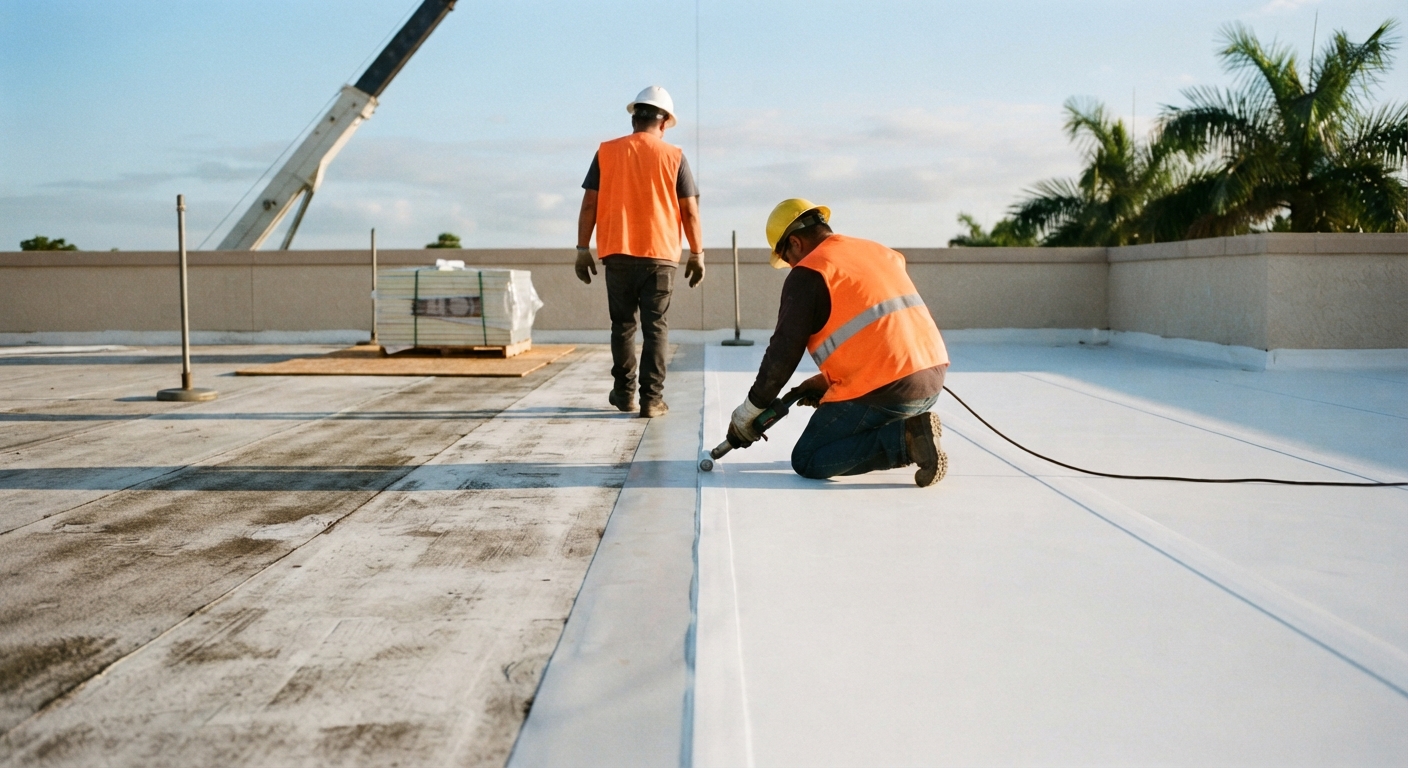
Repairs on an occupied building need their own discipline. Every leak call should end with a photo record of the cause, the repair and its location on a roof plan, because that record later supports either decision in front of a board or an underwriter. Advanced Roofing’s repair service page states that its work is time-stamped and photo documented, and its roof management program keeps inspection reports and repair history in one place. In Miami-Dade and Broward, the High-Velocity Hurricane Zone sections of the Florida Building Code govern the roof assembly and its products, so the scope of any section replacement there is confirmed with the building official before pricing.
Which code, condo and timing dates belong in the decision file?
As of October 6, 2026, four dated items affect the repair-or-replace decision.
- Florida Building Code, 9th Edition, effective December 31, 2026. The permit application date generally decides which edition governs a replacement. Confirm the adopted Section 706 text with the building official before relying on any change.
- The 12-month window in Section 706.1.1. Last season’s storm repairs still count against a section’s 25 percent limit, so their dates belong in this season’s scope review.
- Condominium reserves. Section 718.112(2)(g), Florida Statutes, lists the roof first among the items a structural integrity reserve study covers for buildings three habitable stories or higher, and sets December 31, 2026 as the latest completion date for existing associations that pair the study with a milestone inspection. Boards take both options to their engineer, reserve professional and attorney; the guide to condo milestone inspection roof findings explains what the forms record.
- Hurricane season and insurance. The Atlantic season runs through November 30, so open seams and loose edge metal are repaired before any replacement procurement. Owners whose carrier is requiring a new roof should read the guide to insurance requiring roof replacement and get the underwriter’s position in writing through their agent.
Decision checklist: who does what before money is committed?
- Property or facility manager: compile three to five years of repair records with date, location, cause and cost, and pull the roof’s permit record.
- Roofing contractor or roof consultant: map the roof sections as the code defines them, mark every repair on that plan, and total the repaired area per section for the trailing 12 months.
- Moisture survey provider: survey under ASTM C1153 or an equivalent method and confirm the findings with cores; a commercial drone survey gives the consultant a base map.
- Building official: confirm how Section 706.1.1 and the 553.844(5) exception apply to the planned scope, which code edition the permit date triggers and, in Miami-Dade and Broward, the product approval required.
- Manufacturer: confirm in writing which repairs keep the warranty in force and how a section replacement affects coverage.
- Tax advisor: classify the planned work as repair or capital improvement before the budget is set.
- Owner, asset manager or board: compare a priced repair scope, a section replacement and a full replacement against the same survey. A large statewide contractor built for occupied buildings may not be the lowest bid on a small, simple repair.
- Operations: keep a commercial roof maintenance schedule of two inspections a year plus post-storm checks so the next decision starts with data.
Frequently Asked Questions
When should a commercial roof be replaced instead of repaired?
Replace a commercial roof when the failure is systemic: leaks recurring in new places, seams failing across the field, wet insulation over large areas, or a deteriorating deck. NRCA guidance points to replacement when repair spending becomes excessive or damage reaches the structure or interior. A moisture survey confirmed by cores documents the finding.
What is the 25 percent rule for roof repairs in Florida?
Florida Building Code, Existing Building Section 706.1.1 limits repair, replacement or recovering to 25 percent of a roof area or roof section in any 12-month period unless that roof or section is replaced to current code. Section 553.844(5), Florida Statutes, relaxes the rule for roofs built under the 2007 code or later.
Does tie-in work count toward the 25 percent roof rule?
Under the Florida Building Commission’s answer to Declaratory Statement DS 2021-007, removing and reinstalling undamaged components only to connect a repaired area to the existing roof does not count toward the 25 percent threshold. The answer was issued under the 7th Edition (2020), so confirm its current application with the building official.
Can you replace just one section of a commercial roof?
Yes, where the roof is divided into sections as the Florida Building Code defines them, such as by expansion joints, parapet walls or changes in elevation. The failed section is torn off and replaced, and the new system is tied into the existing roof at the boundary. It suits buildings where the other sections are dry.
Is a roof repair deductible while a roof replacement is capitalized?
Under the IRS tangible property regulations, costs that keep a building in ordinarily efficient operating condition are generally deductible, while costs that restore it, including replacing a major component or substantial structural part, generally must be capitalized. The owner’s tax advisor should classify a specific roof project before the budget is set.
How often should a commercial roof be inspected to catch problems early?
FEMA P-2181 recommends inspecting low-slope roofs at least twice a year, ideally in spring and fall, and after high-wind events, with repairs completed quickly. In Florida that schedule brackets hurricane season. Recording each finding on a roof plan lets repairs and section totals be tracked from year to year.
Fund the roof the evidence describes
Commercial roof repair vs replacement comes down to whether a roof’s problems are local or systemic and, in Florida, whether the repairs inside one roof section are approaching the code’s limit. A repair log mapped to roof sections, a moisture survey confirmed by cores, the permit record and the warranty terms answer both questions. A roof with isolated defects and dry insulation earns a repair. A roof with migrating leaks, wet insulation across a section or a climbing repair bill earns a section or full replacement, scheduled before the next storm season forces it. With the 9th Edition taking effect December 31, 2026, the permit date belongs in the same file.
Written by The Technical Team at Advanced Roofing. Founded in 1983, Advanced Roofing is 100% employee-owned and was ranked the #13 largest roofing contractor in the U.S. on Roofing Contractor magazine’s 2026 Top 100 list.
To map your roof sections, review the repair history and get a repair-or-replace assessment, request a free commercial roofing quote or call (800) 638-6869. For an active leak, see emergency flat roof repair service.