At a glance: Whether to repair or replace a South Florida commercial roof depends on where the defect sits, whether the insulation under it is dry, and how much of the roof section has been repaired in the past 12 months. This article lists the warning signs that separate a leak from a failing roof, compares six repair scopes and their limits, explains Florida’s 25 percent repair rule and its 2007-code exception, covers repairs on occupied buildings in the High-Velocity Hurricane Zone, and closes with a decision checklist assigned by role.
Commercial roof repair vs replacement in South Florida is decided by the roof’s repair record and the moisture under the membrane more than by the age printed on the permit. A repair is the right call when the failure is local, the insulation beneath it is dry, and the work keeps the roof section inside the Florida Building Code limit on how much roof can be repaired in a 12-month period; when repairs cluster in one section and recur at the same details, the owner is buying a replacement in installments while still carrying a failing roof into hurricane season. Misjudging it costs either a re-roof forced on someone else’s schedule by a storm, an insurer, or the code, or a sound roof torn off years before it needed to be. This article does not argue that older roofs should be replaced, and it does not decide the code path, insurance outcome, or reserve treatment for any specific building.
Why is the repair decision different for a South Florida commercial roof?
A South Florida commercial roof is repaired under rules that most published repair-or-replace advice never mentions. Florida Building Code, Existing Building Section 706.1.1 limits repair, replacement, or recovering to 25 percent of the total roof area or roof section in any 12-month period unless the entire roofing system or section is replaced to current code, as the section is quoted in the Florida Building Commission’s declaratory statement staff analysis DS 2021-007. Section 553.844(5), Florida Statutes, creates an exception: on a roof system or section built, repaired, or replaced under the 2007 Florida Building Code or a later edition, only the repaired portion must meet the code in effect, even when the work reaches 25 percent or more.
The same staff analysis concluded that undamaged material removed and reinstalled only to tie a repair into the existing roof does not count toward the 25 percent threshold. The repair area is the damaged area. A roof section also has a code definition: an area divided by expansion joints, parapet walls, flashing, changes in elevation, or roof type. Each section carries its own 12-month count, and the count is cumulative across separate repairs.
Weather sets the calendar. The Atlantic hurricane season runs from June 1 to November 30, according to NOAA’s National Hurricane Center climatology, so a repair deferred in October is a repair carried through the next season. In Miami-Dade and Broward, roofs sit in the High-Velocity Hurricane Zone, where Florida Building Code Sections 1512 through 1525 govern the roofing assembly and Miami-Dade Notices of Acceptance apply to roofing products. The 9th Edition of the Florida Building Code takes effect on December 31, 2026, according to the Florida Building Commission, and FRSA’s summary of the approved Section 706.3 modifications shows how the recover and replacement rules change for permits after that date.
What warning signs show a commercial roof is failing and not just leaking?
A commercial roof leak and a commercial roof failure look the same from the ceiling, and the difference sits on the roof and inside the assembly. A leak is one entry point, such as a split pipe boot or a cracked pitch pan, that a repair closes. A failure is a condition spreading across the roof, such as seams opening along their length, membrane shrinking away from walls, or insulation holding water, and a repair only interrupts it.
Water moves sideways before it moves down. Rain that enters at an open lap travels through the insulation until it finds a deck joint or a fastener, so the stain in a tenant’s ceiling can appear well away from the defect. Wet insulation loses thermal value, adds dead load, and corrodes steel deck fasteners, and the membrane above it loses adhesion. FEMA’s low-slope roof systems fact sheet (FEMA P-2181, March 2022) identifies roof edges as a frequent starting point of wind failure, where lifted edge flashing, coping, or gutters allow the membrane to peel progressively. A roof can be dry inside and still be failing at its perimeter.
The signs below separate the two conditions. Interior signs tell the owner to look; rooftop signs and moisture data tell the owner what to do.
| Warning sign | Where it shows | Usually points toward | How it is confirmed |
|---|---|---|---|
| One ceiling stain after wind-driven rain | Interior, below a penetration or curb | Repair | Rooftop check of the nearest penetrations and curbs |
| Stains that return after a repair or move between bays | Interior, several areas | Wet insulation; assess before repairing again | Moisture survey verified by cores |
| Open or fishmouthed seams along long runs | Membrane laps | Replacement if widespread; repair if isolated | Seam probing |
| Membrane pulling away at walls and curbs | Base flashings | End-of-life trend on aged single-ply | Hands-on flashing check |
| Blistering, alligatoring, or granule loss | Modified bitumen cap sheet | Repair if local; evaluate the system if widespread | Visual survey and test cut |
| Lifted or loose edge metal and coping | Perimeter | Repair and refasten before the next storm | Hands-on perimeter check |
| Ponding that stays long after rain | Low areas and drains | Drain repair; recurring ponding signals slope or deck issues | Post-rain observation |
| Soft or spongy areas underfoot | Field of the roof | Wet insulation or deck damage | Cores and underside inspection |
| Rust staining or corrosion on the deck underside | Deck, from below | Replacement scope | Underside inspection and cores |
A commercial drone survey maps where these signs cluster, and the cluster often says more than any single sign. ASTM C1153 sets the standard practice for locating wet roof insulation with nighttime infrared imaging and calls for verification with invasive tests, which on a roof means cores cut through the assembly.
What repair options exist, and where does each one fall short?
Commercial roof repair covers a range of scopes, from an emergency patch to cutting out and replacing a wet section, and each scope has a defined job. The table matches each option to the condition it fixes and the limit that applies to it.
| Repair option | What it fixes | Where it fits | Where it falls short |
|---|---|---|---|
| Emergency temporary repair | Active water entry during or after a storm | Stops interior damage until permanent work | Temporary by definition; must be followed by a permanent repair with approved materials |
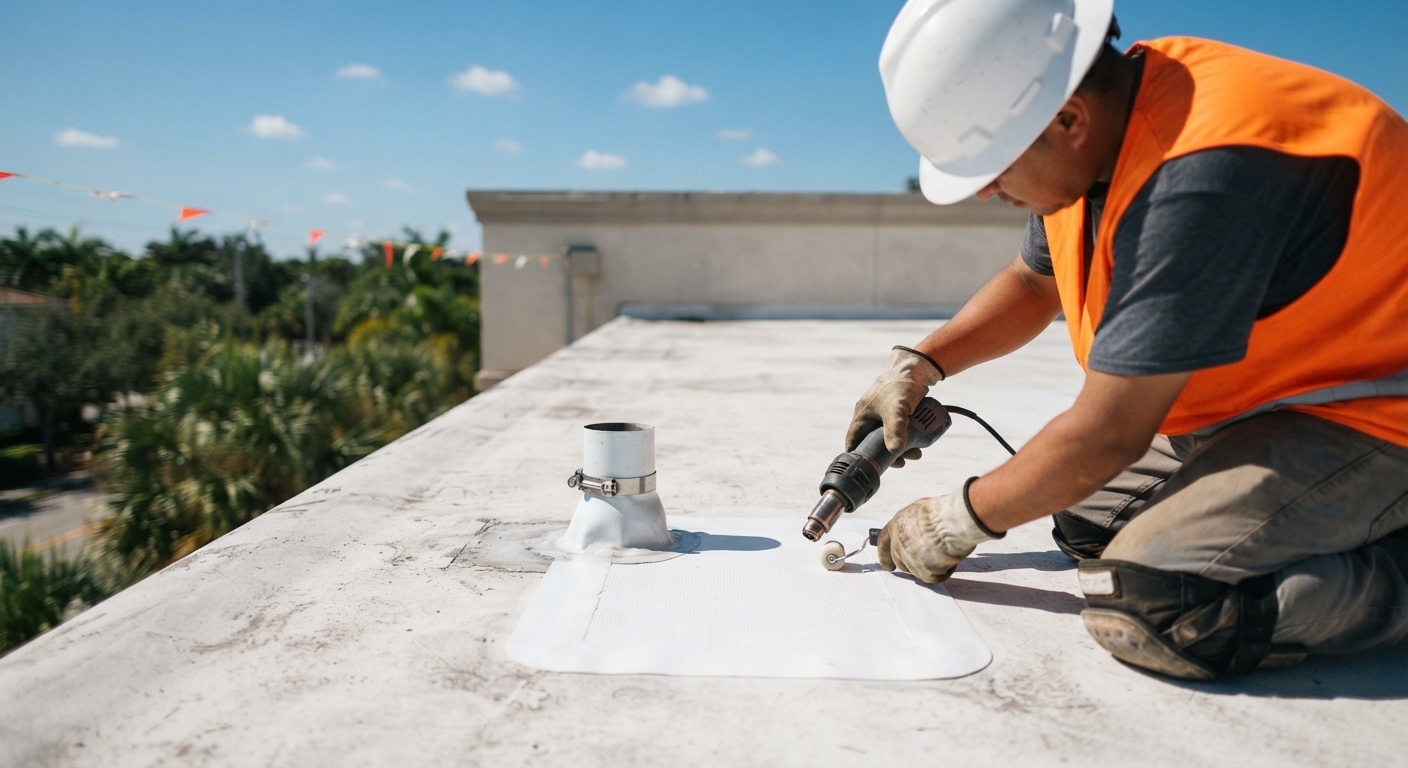
| Detail repair at flashings, boots, pitch pans, curbs | Water entry at penetrations | Dry roof with a local defect | Does not address field aging; repeat failures at one detail signal an equipment or design problem |
| Seam repair | Open laps on single-ply or modified bitumen | Isolated seams on a membrane that still welds or bonds | Aged membrane may not weld reliably; widespread open seams point to end of service life |
| Perimeter and edge metal repair | Lifted coping, edge flashing, gutters | Wind damage or loose fasteners at the edge | Restores attachment only; metal that cannot be reattached properly is replaced |
| Drain and scupper repair | Ponding and backed-up water | Clogged strainers, failed sumps, damaged drains | Does not correct insufficient slope or deck deflection |
| Wet-area cut-out and replacement | Localized saturated insulation | Wet area small relative to the roof section | Counts toward the 25 percent repair area; large wet areas make replacement the rational scope |
Two rules apply across every option. A repair on a warranted roof should be performed by an applicator the manufacturer authorizes, so confirm the terms in the warranty document before any trade cuts into the membrane. Each repair should also be recorded with its location, photographs, area in square feet, and date, because that record is what the next decision rests on. Advanced Roofing’s commercial roof repair service time-stamps and photo-documents its work, and its emergency flat roof repair crews respond around the clock to active leaks.
Coatings and restoration systems are a separate path with their own conditions, covered in the guide to commercial roof restoration vs replacement. That path depends on the same moisture data a repair decision does.
What drives the cost and timing of commercial roof repairs?
Advanced Roofing does not publish pricing, and a repair price quoted without a site visit is a guess. The variables that move a repair budget can be named. Material inputs come first: the Associated General Contractors of America’s September 11, 2026 Data DIGest reports that input prices for new nonresidential construction rose 8.9 percent from August 2025 to August 2026, based on Bureau of Labor Statistics producer price data. Those inputs include the asphalt behind modified bitumen and the metals behind edge flashing, coping, and fasteners.
| Driver | Effect on the repair | Source or basis |
|---|---|---|
| Material input prices | Liquid asphalt up 16%, aluminum mill shapes up 27%, steel mill products up 23% year over year, August 2025 to August 2026 | AGC Data DIGest, Sept. 11, 2026 (BLS producer price indexes) |
| Wet insulation found during repair | Adds cut-out area and counts toward the section’s 25 percent limit | FBC, Existing Building Section 706.1.1 |
| HVHZ location (Miami-Dade, Broward) | Approved products and assemblies required on permanent repairs | FBC, Building Sections 1512 to 1525 |
| Roof installed before the 2007 FBC | Repairs past 25 percent of a section can force section replacement | Section 553.844(5), Florida Statutes |
| Emergency or scheduled response | After-hours work and temporary protection add cost; a permanent repair still follows | Contract terms |
| Access and occupancy | Lifts, night work, and tenant notices add time | Site conditions |
Weather drives the schedule. Afternoon storms during the wet season limit how much membrane a crew can open in a day, so a repair that requires cutting out material is sized to be closed and watertight before the rain arrives.
What changes when the repair is on an occupied South Florida building?
On an occupied building, a repair is planned around the tenants as much as the roof. The property manager receives the date, access point, and affected areas in advance. Work near rooftop air intakes is timed so adhesive and primer odors stay out of occupied space, and any membrane opened during the day is dried in before the crew leaves.
Interior protection matters more on a repair than on a re-roof, because the water is usually already inside. Ceiling tiles, inventory, and equipment under the defect are protected before the roof is opened, and the tenant gets one contact for the work. Crews stay behind warning lines or guardrails set back from the roof edge. When a repair involves rooftop units, curbs, or materials that must be lifted, Advanced Roofing’s in-house crane division schedules picks outside business hours where the site allows. Founded in 1983, Advanced Roofing is 100% employee-owned, and repair and re-roofing work on occupied buildings is its core business.
South Florida adds three local conditions. Salt air corrodes fasteners, edge metal, and equipment supports faster on coastal roofs; FEMA P-2181, citing NFIP Technical Bulletin 8, recommends hot-dipped galvanized or stainless steel for exposed roof connectors and fasteners within 3,000 feet of the coastline. Buildings in Miami-Dade and Broward follow HVHZ requirements on every permanent repair. Local crews work from the Miami commercial roofing, Fort Lauderdale commercial roofing, and Palm Beach commercial roofing offices.
Which code, condo, and insurance dates affect a repair decision?
As of October 6, 2026, four items belong in the repair file, and each should be re-checked on the day a decision is made.
- Florida Building Code, 9th Edition, effective December 31, 2026. The permit application date generally determines which edition governs a repair permit. The building official confirms it.
- The 25 percent rule and the 2007-code exception. Section 706.1.1 sets the 12-month limit; Section 553.844(5) exempts roofs built under the 2007 code or later, and the statute bars local governments from amending that exception by ordinance.
- Condominium reserves. Section 718.112(2)(g), Florida Statutes, lists the roof among the components of a structural integrity reserve study. Repeated repairs or a replacement decision change the remaining useful life a reserve professional assigns, so boards take both to their engineer, reserve professional, and association attorney.
- Insurance. Section 489.147, Florida Statutes, bars contractors from interpreting policy provisions, advising on coverage, or adjusting a claim without a public adjuster license. Coverage questions about storm repairs go to the insurer, the agent, a licensed public adjuster, or an attorney. Owners facing an underwriting demand can read the guide to insurance requiring roof replacement.
Commercial roof repair vs replacement: a decision checklist for when repair still pays
Repair a South Florida commercial roof when the defect is local, cores show dry insulation, the roof section’s 12-month repair area stays under the Florida Building Code’s 25 percent limit or the roof qualifies for the 2007-code exception, and the repair log shows defects are not recurring. When those tests fail, price replacement before approving the next repair.
- Facility or property manager: keep a repair log for each roof section with date, location, area in square feet, cause, and cost, and total the area for the trailing 12 months before approving the next repair.
- Roofing contractor: report whether each defect is new or a repeat and whether the insulation was dry, and order a moisture survey with cores when stains return or move.
- Building official: confirm whether the roof qualifies under Section 553.844(5) and which code edition the permit date triggers.
- Owner or asset manager: compare the trailing repair spend for each section against the replacement estimate for that section; rising spend at the same details means the roof is being replaced in installments.
- Warranty holder: confirm that every repair was made by an authorized applicator and that the records the warranty requires are on file.
- Board or CAM: take the repair log and the moisture survey to the association’s engineer and reserve professional before voting on either option.
- Procurement: a large statewide contractor built for occupied buildings may not be the lowest bid on a single small repair, so compare scope and documentation as well as price.
Advanced Roofing’s roof management program stores inspection reports, photographs, and repair history in its Advanced Access portal, and scheduled commercial roof maintenance visits add to that record twice a year, as the commercial roof maintenance schedule for Florida buildings explains. If water is already inside, the roof leak action steps come first and the decision comes after.
Frequently Asked Questions
When should a commercial roof be replaced instead of repaired?
Replacement is usually the better scope when moisture surveys and cores find wet insulation across large areas, when seams or flashings fail across the roof instead of at one location, when the deck shows corrosion or rot, or when repairs in one roof section approach the Florida Building Code’s 25 percent limit in a 12-month period.
What is the 25 percent roof repair rule in Florida?
Florida Building Code, Existing Building Section 706.1.1 says no more than 25 percent of a roof’s total area or a roof section may be repaired, replaced, or recovered in any 12-month period unless the entire system or section is replaced to current code. The count is cumulative, so several small repairs in one section within a year add together. The building official applies the rule to a specific permit.
Does the 25 percent rule apply to every commercial roof?
No. Section 553.844(5), Florida Statutes, provides that when a roof system or section was built, repaired, or replaced under the 2007 Florida Building Code or a later edition, only the repaired portion must meet the current code, even if the work reaches 25 percent or more. Roofs installed before the 2007 code remain under the 25 percent limit, so the permit history matters.
How do I know if my commercial roof has wet insulation?
A moisture survey finds it. ASTM C1153 describes locating wet roof insulation with nighttime infrared imaging, and electrical impedance scanners are another survey method. Both should be verified with core samples cut through the roof assembly. Returning stains and soft areas underfoot are common reasons to order one.
Can a roof repair void a commercial roof warranty?
It can. Many manufacturer warranties require repairs on a warranted roof to be made by an authorized applicator using compatible materials, and unauthorized work can affect coverage for the area involved. Read the warranty before any repair and keep dated photographs of every repair.
Should I repair my commercial roof before hurricane season?
Yes, when the roof has known defects at edges, seams, flashings, or drains. The Atlantic hurricane season runs from June 1 to November 30, and FEMA guidance identifies lifted edge metal and coping as a common starting point for wind failure on low-slope roofs. Repairs completed before June leave the roof section’s condition and records clear going into the season.
Let the repair record decide the roof
Commercial roof repair vs replacement in South Florida comes down to evidence the owner can collect: where defects occur, whether they recur, whether the insulation is dry, and how much of each roof section has been repaired in the past 12 months. A local defect on a dry roof is a repair. Recurring failures, spreading moisture, or a section approaching the 25 percent limit on a pre-2007 roof mean the replacement is already underway in installments.
Written by The Technical Team at Advanced Roofing. Founded in 1983, Advanced Roofing is 100% employee-owned and was ranked the #13 largest roofing contractor in the U.S. on Roofing Contractor magazine’s 2026 Top 100 list.
To schedule a roof condition assessment and repair-or-replace review, request a free commercial roofing quote or call Advanced Roofing at (800) 638-6869.