At a glance: TPO roof repair on a South Florida commercial building turns on two tests: whether the existing membrane still takes a hot-air weld and whether the insulation below is dry. This guide covers how TPO fails at seams, flashings, edges, and fasteners; which repairs hold, including underside patches on aged sheets; what drives cost and schedule; how repairs run on occupied buildings; the 25 percent rule, its 2007-code exception, and the December 31, 2026 code change; and a repair-or-replace checklist by role.
TPO roof repair South Florida owners can rely on starts with a test the leak itself never shows: whether the membrane around the damage will still take a hot-air weld, and whether the insulation under it is dry. A patch welded to sound, clean thermoplastic restores the sheet; a patch caulked onto oxidized membrane over wet insulation leaves the water in the roof. Getting the call wrong means paying twice, months before the Florida Building Code changes on December 31, 2026. This article covers how TPO roofs fail on South Florida commercial buildings, which repair methods hold, and which findings point to replacement. It does not set a repair-or-replace rule for any specific roof; the roof consultant, engineer of record, and building official make those determinations.
Why does a TPO repair decision in South Florida carry more weight in late 2026?
A TPO repair decision in South Florida now sits between a code change, a statute, and the end of hurricane season. FRSA’s February 2026 summary of the approved 9th Edition changes to Existing Building Section 706 confirms the new Florida Building Code takes effect December 31, 2026, and the Florida Building Commission publishes the adopted code. The permit application date generally decides which edition governs, so a repair that grows into a replacement late in the year can land under a new code.
The repair limit comes from Existing Building Section 706.1.1, which has long capped repair, replacement, or recover work at 25 percent of a roof or roof section in any 12-month period unless the whole section is brought up to the current code. Section 553.844(5), Florida Statutes, changes that for roofs built, repaired, or replaced under the 2007 Florida Building Code or a later edition: when 25 percent or more of such a roof is repaired, only the repaired portion must meet the code in effect, and local governments may not amend the exception by ordinance. A TPO roof permitted before the 2007 code applied does not get that exception, so the permit record belongs in the repair scope.
The Insurance Institute for Business & Home Safety’s assessment of roof performance in Hurricane Ian found damage on more than half of the low-slope commercial roofs it reviewed, with most damaged roofs showing flashing or coping failures, including buildings built after newer code provisions.
How do TPO roofs fail on South Florida commercial buildings?
A TPO sheet is two layers of thermoplastic, a weathering cap on top and a core below, laminated around a polyester reinforcing scrim. The cap carries the ultraviolet and heat stabilizers, and seams are made by melting two sheets together with hot air. The IIBEC paper on aged TPO membrane performance, written by GAF’s building science staff for the 2020 IIBEC convention, notes that single-ply systems have no inherent redundancy, so watertightness depends on the sheet, the welded seams, and the polymer’s resistance to weathering.
| Failure | Where it starts | What drives it in South Florida | What it means for the repair |
|---|---|---|---|
| Open or cold-welded seam | Field laps and T-joints where three sheets meet | A weld that never fully fused at installation; daily heat cycling and wind flutter load the lap edge | Probe the full seam run; one open lap can signal a welder set-up problem across the roof |
| Puncture or tear | Paths to rooftop units, debris landing zones | Service traffic, dropped tools, storm-blown debris | Clean-and-weld patch if the sheet around it is sound |
| Flashing failure | Curbs, pipe boots, drains, parapet base | Movement between equipment and deck; aging sealant at terminations | Replace the flashing detail, not just the sealant |
| Edge and coping failure | Perimeter metal, parapet caps, corners | Uplift is highest at edges and corners; fasteners corrode near the coast | Re-secure or replace edge metal; patching the membrane alone leaves the weak point |
| Fastener back-out | Mechanically attached sheets | Repeated wind flutter works fasteners loose and wears the sheet at plates | Back-outs across the roof point to a system-level problem |
| Cap erosion toward the scrim | Field areas, spots beside reflective walls | UV and heat; dark debris left on the sheet | Exposed scrim no longer sheds water; replace that area |
| Wet insulation | Below any of the above | Water travels laterally from the entry point | Cut out and replace wet board before patching over it |
Water rarely stays where it enters. On a mechanically attached TPO roof, wind lifts the sheet between fastener rows and pulls it back down hundreds of times in a storm, which works on seams and fasteners and can pump moisture across the insulation. That lateral travel is why the stain on the ceiling tile is rarely under the hole, and why a repair that seals only the visible defect can leave a wet section behind it. FEMA’s low-slope roof fact sheet in its Hurricane and Flood Mitigation Handbook (FEMA P-2181, March 2022) reports that low-slope membrane roofs often fail at the edges when wind lifts and peels edge flashings, copings, and fascia covers, so the perimeter belongs in every TPO repair inspection, leak or no leak.
Which repair methods hold up in TPO roof repair South Florida contractors perform?
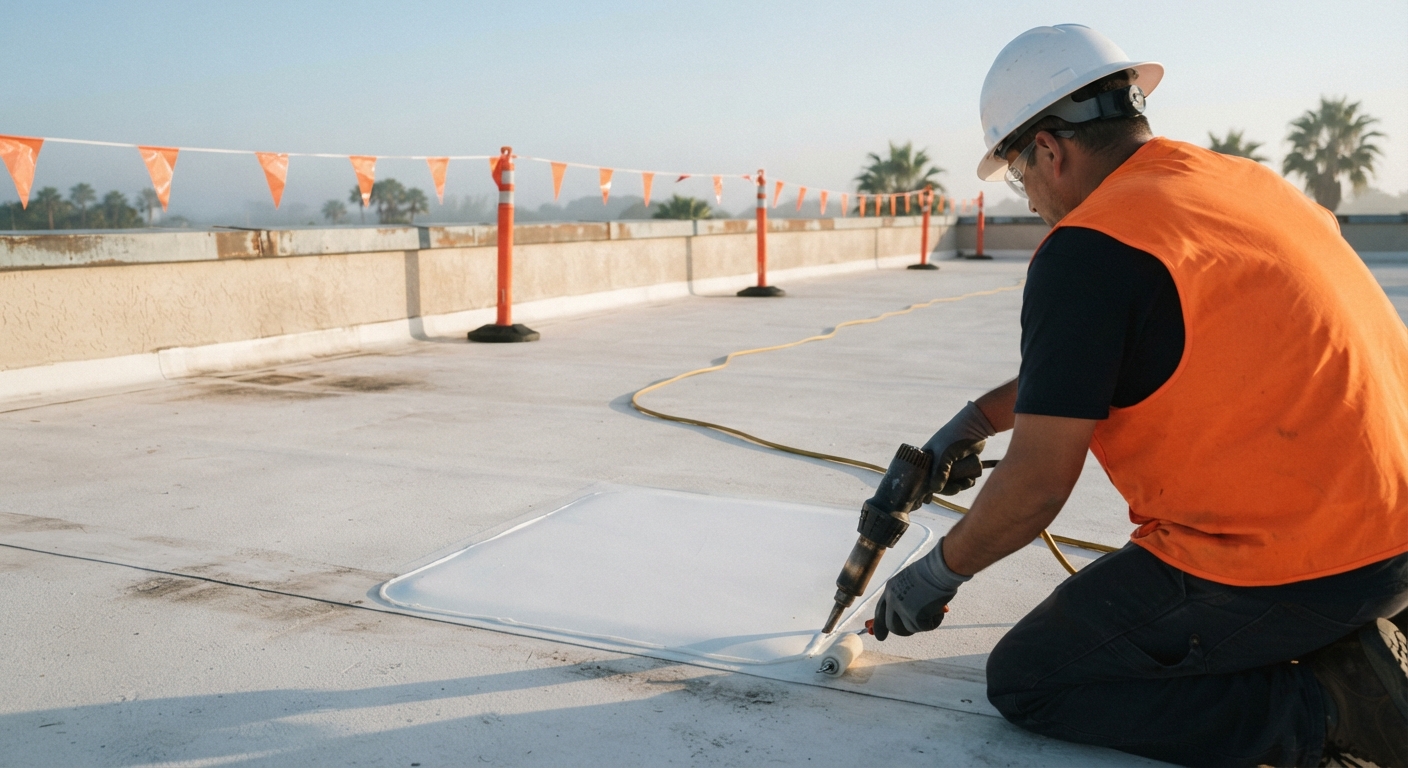
A durable TPO repair is a heat weld between new membrane and clean, weldable existing membrane, made with the manufacturer’s materials and verified by probing. Every method below is a variation of that weld or a stopgap until it can be made, and Advanced Roofing’s commercial roof repair service holds every low-slope system to the same standard.
Preparation decides whether the weld holds, because in-service TPO collects dirt and an oxidized surface layer. NRCA’s Professional Roofing reported in 2011 that the Western States Roofing Contractors Association’s TPO roof membrane repair and maintenance guidelines add a scrub with an abrasive pad and the manufacturer’s solvent on older membranes to restore weldability, and describe underside patches welded to the back of the existing sheet where the top surface will no longer take a weld.
In the IIBEC paper, new membrane welded to the cap of TPO roofs aged 12 years or more averaged 43 to 47 pounds per inch of peel strength, and new membrane welded to the aged core averaged 53 to 57 pounds per inch, both above the 40 pounds per inch the authors cite as the average for new welds. The study covered 20 roofs from a single manufacturer, so it describes properly made repairs on those membranes, not every TPO roof.
| Repair method | When it fits | Where it falls short |
|---|---|---|
| Clean-and-weld cover patch | Puncture, tear, or short open seam on membrane that passes a test weld | Fails on membrane that will not fuse; does nothing for wet insulation below |
| Seam re-weld or cover strip | Open laps and T-joints found by probing | Many open laps can mean a systemic welding defect that spot repairs cannot chase down economically |
| Underside (core) patch | Aged, mechanically attached sheet whose top surface will not take a weld | Not practical on adhered membrane, where adhesive and facer remnants cover the underside |
| Flashing replacement | Failed curb, pipe, drain, or parapet flashing | Must tie into weldable field membrane; old sealant left in place can trap water |
| Edge metal re-securement or replacement | Lifted coping, loose drip edge, corroded fasteners | Needs fabricated metal and wind-rated attachment; approved components in the HVHZ |
| Sealant, mastic, or repair tape | Emergency dry-in during a storm or before a crew can weld | Temporary; does not fuse with TPO and should be replaced with a welded repair |
Verification is part of the repair. Carlisle SynTec’s guidance on test welds and seam probing calls for a test weld at the start of each morning and afternoon, a continuous weld at least 1½ inches wide on the peeled sample, and probing only after welded seams have cooled for at least 30 minutes. Those figures are Carlisle’s; other manufacturers publish their own. The same 2011 NRCA column notes that manufacturers generally require their own repair products to keep a warranty in force. Carlisle SynTec Systems gave Advanced Roofing its 2020 Excellence in Single-Ply Award, and the company’s announcement reports more than 9.8 million square feet of Carlisle single-ply installed and warranted that year.
What drives the cost and schedule of a TPO repair?
Advanced Roofing does not publish repair pricing, and a price quoted before anyone has probed seams and checked the insulation describes the visible defect, not the repair.
| Driver | How it moves budget or schedule | Who confirms it |
|---|---|---|
| Weldability of the existing membrane | Extra cleaning, abrasion, or underside patches add labor; failed test welds push the area toward replacement | Roofing contractor, manufacturer |
| Wet insulation found by survey and cores | Each wet area is cut out and replaced before patching | Roofing contractor, roof consultant |
| Open seams and failed details | Labor scales with linear feet of seam and the count of curbs, drains, and penetrations | Roofing contractor |
| Edge metal condition | Fabricated coping or drip edge and new fasteners add material and lead time | Roofing contractor, sheet metal shop |
| Warranty status | Active warranties can require approved materials, notice, and manufacturer inspection | Manufacturer, owner |
| Permit and HVHZ requirements | Permitted repairs add review time and require approved products | Building official |
| Access and weather | Roof hatch or crane access, and afternoon storms, set how much can be opened per day | Roofing contractor, property manager |
Moisture data is the honest way to size the job. ASTM D7954/D7954M sets the practice for nondestructive electrical impedance moisture surveys on insulated low-slope roofs and notes that a survey locates moisture without determining how it got in; cores confirm the readings. A commercial drone survey adds an overhead map for the record, and Advanced Roofing’s in-house sheet metal fabrication shop shortens the wait when edge metal is part of the repair.
What changes when the TPO repair is over an occupied South Florida building?
On an occupied building, the first visit often splits into two jobs: stop the water now, then fix the roof correctly. Advanced Roofing’s emergency flat roof repair service handles the first with temporary dry-in that holds until a weld crew returns in dry weather. TPO repairs use hot-air welders rather than open flame, which keeps a torch off the roof above occupied space, but cleaners and primers carry solvent odor, so crews coordinate with the property manager before working near the fresh-air intakes of rooftop units.
The sequence on a working building follows the tenants. Interior protection goes down under active leaks, walk pads protect the membrane along routes crews and HVAC technicians use, and work areas are closed and sealed before afternoon storms. Advanced Roofing’s commercial roof repair team in Miami records repairs in the company’s Advanced Access cloud portal, and its roof management program keeps inspection and repair history for owners with several buildings.
Advanced Roofing serves South Florida from its Fort Lauderdale headquarters, its Miami branch, and its West Palm Beach and Jupiter office.
Which code dates and approvals apply to a TPO repair as of October 2026?
- Florida Building Code, 9th Edition, effective December 31, 2026. The permit application date generally decides the governing edition. FRSA’s published modification to Section 706.3 adds an exception for removing an upper roof system while keeping an adequate substrate; confirm the adopted text with the building official before relying on it.
- Section 706.1.1 and Section 553.844(5), Florida Statutes. Repairs above 25 percent of a roof section in 12 months trigger code compliance for the whole section unless the roof was built, repaired, or replaced under the 2007 code or later.
- Section 706.3 recover limits. A new covering may not go over a water-soaked or deteriorated roof or over two existing coverings, so a repair plan that turns into a recover inherits those tests.
- High-Velocity Hurricane Zone. In Miami-Dade and Broward, Sections 1512 through 1525 govern roofing, and repair materials need the product approvals the building official accepts.
Insurance is a separate question. Advanced Roofing is not an insurer or public adjuster, and the carrier decides coverage for storm-related repairs; owners facing an underwriting demand can start with the guide to insurance requiring roof replacement.
How do you decide between TPO repair and replacement?
A TPO roof should be replaced rather than repaired when the existing membrane will not take a test weld after proper cleaning, when cap erosion has exposed the scrim across large areas, when moisture surveys show widespread wet insulation, or when seams and fasteners are failing across the roof instead of at isolated points.
A roof that passes those tests and has localized damage is a repair candidate. Assign each item below before anyone prices either option.
- Property or facility manager: pull the permit history showing the installation date and code edition, and log every leak location and date since the last repair.
- Roofing contractor: make test welds on the existing membrane in several areas, probe every seam in the affected sections, and report the results with photographs.
- Roofing contractor: run a moisture survey under ASTM D7954 or infrared imaging, confirm it with cores, and map wet areas by roof section.
- Roof consultant or engineer of record: compare the wet and failed area with the 25 percent threshold, the 553.844(5) exception, and the Section 706.3 conditions.
- Warranty holder: confirm whether the warranty is active and which repair materials and inspection it requires.
- Building official: confirm whether the repair needs a permit and, in the HVHZ, which product approvals apply.
- Owner, asset manager, or board: compare the repair scope with a replacement estimate built on the same survey, and count how many repair cycles the roof has already absorbed.
FEMA’s fact sheet also states that mechanically attached single-ply membranes are prone to degradation after debris impact and does not recommend them for hurricane-prone regions, a point to raise if a replacement would reuse that attachment method. Replacement on a working building runs through commercial re-roofing for occupied buildings; owners weighing a coating can read the commercial roof restoration vs replacement guide, and the comparison of TPO, PVC, and modified bitumen covers the membrane choice. A large statewide contractor may not be the lowest bid on a single small patch.
Frequently Asked Questions
Can an old TPO roof be repaired?
Yes, when the existing membrane still accepts a weld after proper cleaning. In a study of TPO roofs in service 12 years or more, presented at the 2020 IIBEC convention, new membrane welded to the aged sheet met or exceeded the average peel strength the authors cite for new welds. A test weld on the actual roof decides it; where the top surface will not fuse, an underside patch may work on a mechanically attached roof.
How do you repair an open seam on a TPO roof?
The crew cleans the seam area with the manufacturer’s weathered-membrane cleaner, probes to find the full length of the opening, and re-welds the lap with a hand-held hot-air welder or welds a cover strip over it. After the weld cools, the repaired seam is probed again. Several open laps across one roof can point to a welding problem from the original installation.
Is caulk or roof tape a permanent fix for a TPO leak?
No. Sealants and repair tapes stick to the surface but do not fuse with the TPO sheet the way a hot-air weld does, and they age quickly in South Florida sun. They are useful as emergency dry-in during a storm or until a crew can weld, and they should be replaced with a welded repair made with the manufacturer’s materials.
Does a TPO roof repair need a permit in Miami-Dade or Broward?
It depends on the scope and the jurisdiction, and the building official decides. Miami-Dade and Broward are in the High-Velocity Hurricane Zone, where Sections 1512 through 1525 of the Florida Building Code govern roofing and repair materials need the product approvals the official accepts. Larger repairs can also reach the 25 percent threshold in Existing Building Section 706.1.1.
Will a TPO repair void the manufacturer’s warranty?
A repair made with the manufacturer’s approved materials and procedures, and reported as the warranty requires, generally keeps the warranty in force; one made with incompatible products can put it at risk. Read the warranty’s repair and notice terms before any work starts, and ask the contractor to confirm in writing that the repair follows them.
How long does a TPO roof last in South Florida?
No single number applies. Service life depends on sheet thickness, attachment, drainage, installation quality, and maintenance. In the IIBEC study, samples from roofs in service 12 years or more, including an Orlando roof exposed for more than 17 years, still met current ASTM D6878 thickness requirements for new membrane. The warranty term for the specific assembly is the figure an owner can hold a contractor to.
Let the weld test and the moisture map choose the scope
A TPO repair in South Florida is only as good as the membrane and insulation it ties into. Where the sheet still welds, seams fail at isolated points, and the insulation is dry, a welded repair with probing and photographs restores the roof and defers a replacement the building does not yet need. Where test welds fail, the scrim shows, or wet insulation spreads, more patches only move the cost into next year. With the 9th Edition arriving December 31, 2026, the permit history belongs in the same file as the survey. Settling those facts first lets an owner defend either choice.
Written by The Technical Team at Advanced Roofing. Founded in 1983, Advanced Roofing is 100% employee-owned and was ranked the #13 largest roofing contractor in the U.S. on Roofing Contractor magazine’s 2026 Top 100 list.
To schedule a TPO repair assessment with test welds and a moisture survey, request a free commercial roofing quote or call (800) 638-6869.