
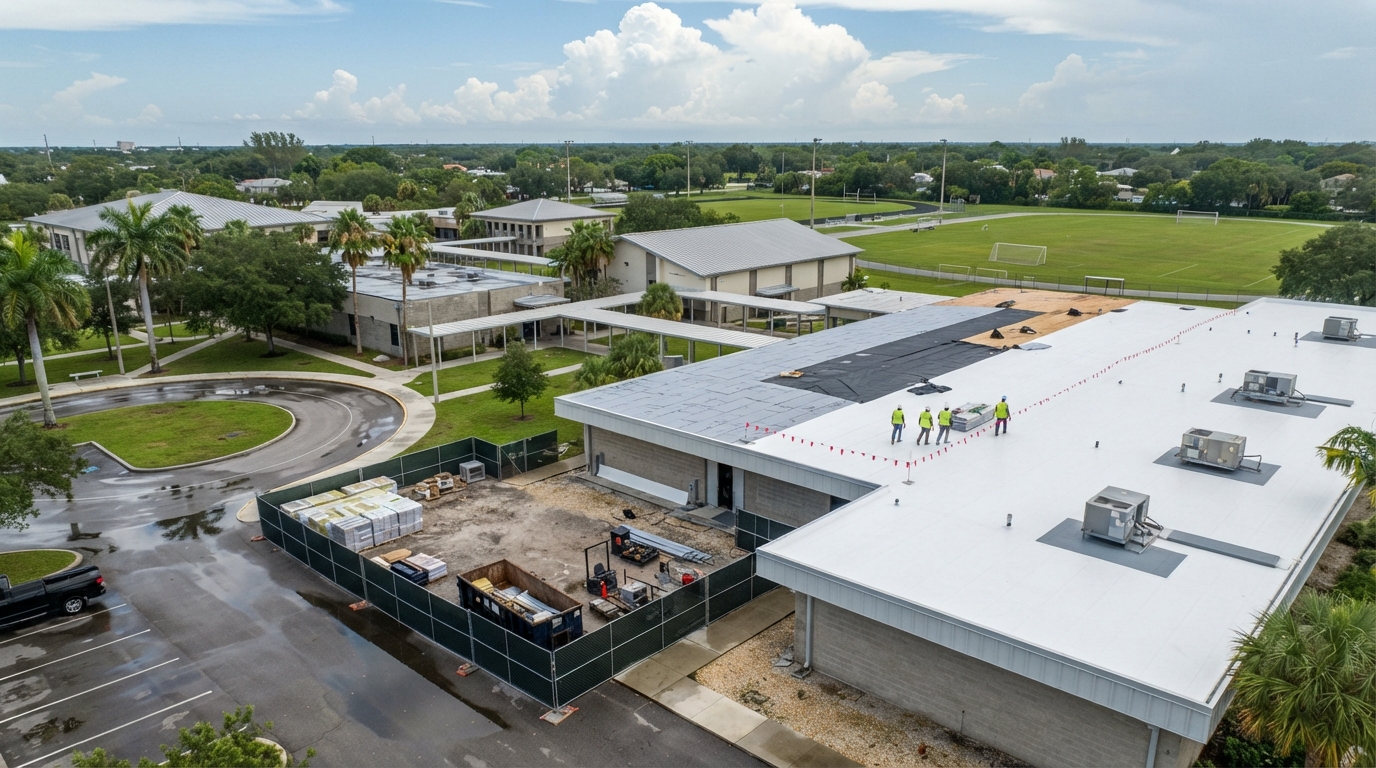
At a glance: A Florida school reroof has a short summer window: a statutory opening date no earlier than August 10, a rainy season that starts in mid to late May, and a hurricane season that opens June 1. This article explains why the project is won during design and bidding the fall before, how wet decks and rooftop equipment set the schedule, when to phase or reroof during the school year, what background screening and asbestos rules require, and which statutes govern bidding. It ends with a role-by-role checklist and answers to common district questions.
A school roof replacement Florida districts plan for summer break succeeds or fails months before the last bell, during design, bidding, submittals, and contractor screening. The working window between the last student day and an opening date that Florida law sets no earlier than August 10 overlaps the rainy season and the first months of hurricane season, so a reroof awarded late or scoped too large for one summer leaves open roofs and classrooms that are not ready in August. This article sets out how to size, bid, and stage the work to fit. It does not argue that every school roof belongs in a summer window; occupied-campus reroofing and multi-summer phasing are often the better answer.
Why is the summer window for a school roof replacement in Florida so short?
The summer window for a Florida school reroof is the stretch between the last day students are on campus and the day teachers and staff need their rooms back. Section 1001.42(4)(f), Florida Statutes, bars a district from opening schools earlier than August 10, and each district’s adopted calendar sets the last student day, teacher pre-planning, and summer programs inside that frame. Subtract summer school, camps, athletics, and the days custodians need to reset rooms, and the true roofing window on many campuses is measured in weeks.
Weather takes another share. The National Weather Service office in Tampa Bay places the rainy season at May 15 to October 15 for Southwest Florida and May 25 to October 10 for the rest of West Central Florida, with frequent lightning from late May onward. The National Hurricane Center’s climatology puts hurricane season at June 1 to November 30. The plan has to absorb afternoon storms, lightning stand-downs, and the chance of securing the site mid-project.
Code timing adds a third constraint. Miami-Dade County’s permitting notice states that the Florida Building Code, 9th Edition, becomes effective December 31, 2026, and that applications submitted on or after that date must comply with it (as of November 24, 2026). Documents drafted this fall against the 8th Edition for summer 2027 work should be rechecked by the design professional. Public schools also follow the State Requirements for Educational Facilities, which the Florida Department of Education publishes as part of the Florida Building Code; a proposed amendment to Rule 6A-2.0010 was noticed September 23, 2026.
A summer school roof replacement in Florida needs construction documents, board award, submittals, material orders, and contractor background screening finished before students leave. Size each summer’s scope to what crews can tear off, dry in, and complete before teachers return, and phase the remaining buildings into the next summer or schedule them as occupied work.
What fails on Florida school roofs, and how does it set the schedule?
Most Florida school roofs that reach replacement are low-slope assemblies, often modified bitumen or built-up roofing over insulation board, lightweight insulating concrete, structural concrete, or steel deck. Water that enters through a failed seam, a split at a curb, or a clogged drain travels laterally through insulation and lightweight concrete before it shows up as a stained ceiling tile, so the wet area is usually larger than the leak map suggests. Wet insulation comes off, and wet lightweight concrete may need drying or replacement, which is the usual reason a tear-off overruns its schedule.
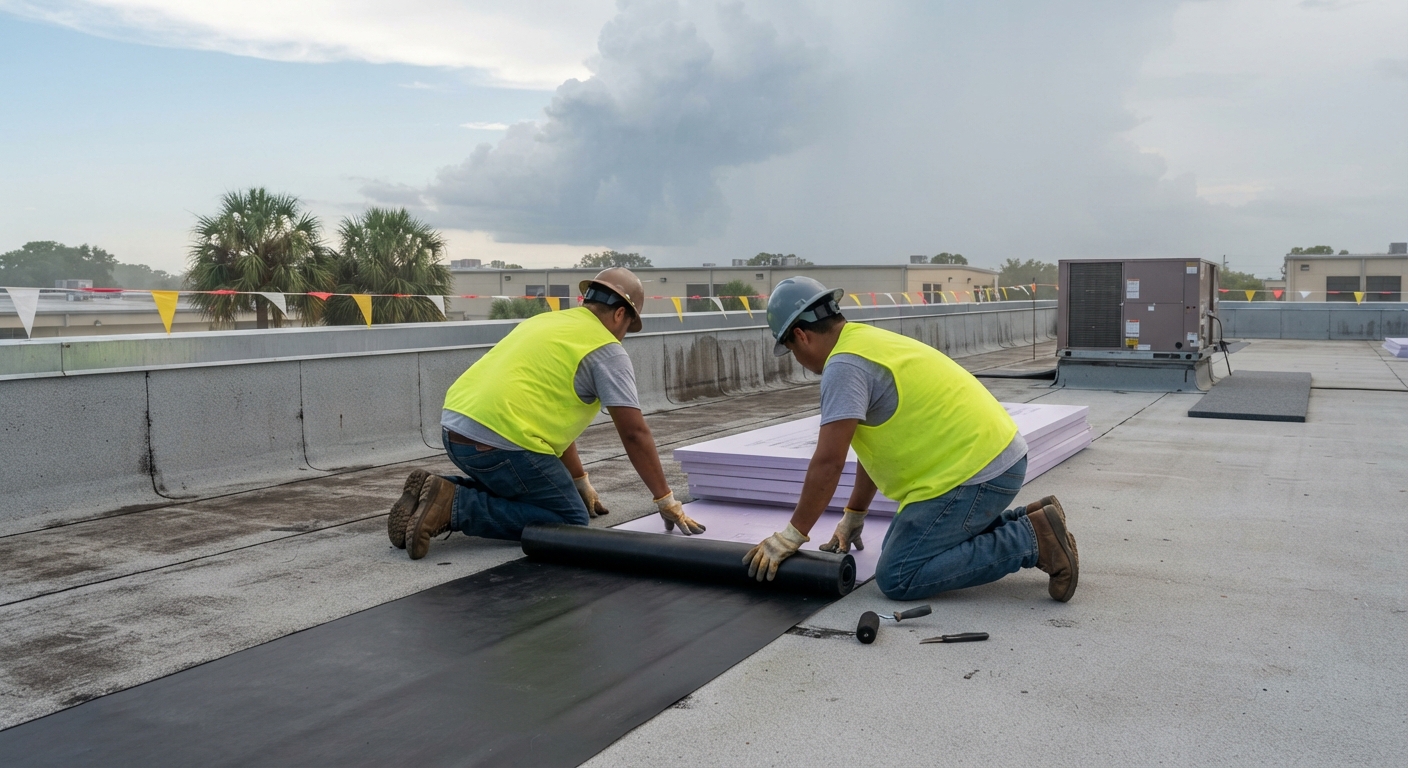
The same physics set the daily rhythm. Crews remove only what they can make watertight that day, using a temporary roof or base ply as the dry-in, because an afternoon storm can arrive before quitting time. On Advanced Roofing’s project at Barbara Hawkins Elementary School for Miami-Dade County Public Schools, the scope was a complete tear-off with a temporary roof, then new tapered lightweight concrete sloped at 1/4 inch per foot over the structural deck, then a torch-applied modified bitumen system. Each layer has its own cure sequence, and any commercial re-roofing schedule on a school has to carry them.
Rooftop equipment, lightning protection, and drainage sit on the same critical path. Units are lifted and reset on new curbs, lightning protection is detached and recertified, and drains move when tapered insulation changes the low points. Bidding those items inside the roofing scope removes the handoffs that stall a summer job. Our guide to lightning protection during a reroof covers the detach-and-recertify sequence.
Table 1. Roof conditions found before bidding and what each means for a summer schedule
| Condition found | Effect on the summer schedule | Who confirms it |
|---|---|---|
| Dry insulation, single existing covering | Shortest path; tear-off, or recover where the Florida Building Code allows it | Roof consultant or design professional |
| Wet insulation over steel or concrete deck | Tear-off to the deck; more debris and more dry-in days | Roof consultant, with cores and a moisture survey |
| Wet or deteriorated lightweight insulating concrete | Possible deck removal and new LWIC, with cure time before the membrane | Design professional and LWIC manufacturer |
| Suspect asbestos in roofing felts, mastic, or flashing | Sampling and abatement sequenced before tear-off | District AHERA designated person and licensed asbestos consultant |
| Rooftop units near end of service life | Replace during the reroof so the new roof is not cut later | Mechanical engineer |
| Existing lightning protection system | Detach, store, reinstall, and recertify | Lightning protection installer |
Summer tear-off, phased, or occupied: which school reroofing approach fits?
Districts choose among three schedules based on roof area, building count, deck condition, and summer occupancy. A single-summer tear-off suits a compact campus whose scope fits with weather margin. Phasing across two or more summers suits large campuses and complex decks. School-year reroofing suits campuses that cannot wait and can accept occupied-work controls.
Occupied reroofing is a proven path on Florida schools, and it is how much of Advanced Roofing’s school and education roofing work has been delivered. The Barbara Hawkins reroof, about 50,000 square feet, was completed safely while classes were in session, within three months, with hot asphalt limited to weekends and safety workers holding class movement at critical times. At Sheridan Technical Center in Hollywood, a multi-building Broward campus, the reroof took about four months with attendance undisrupted.
Table 2. School reroofing schedules compared
| Approach | Best fit | Where it falls short |
|---|---|---|
| Single-summer full tear-off | Compact campus; scope sized to the window with weather margin | No float for rain, storms, or late materials; a late award compresses every step |
| Multi-summer phasing | Large campuses, many buildings, complex decks | Unphased roofs keep leaking in the interim; two mobilizations; price escalation between bid years |
| Occupied school-year reroof | Urgent failures; campuses with zones that can be closed in sequence | Fencing, controlled hours, odor and noise controls, and screening for every worker; slower daily production |
| Coating or recover, where code permits | Dry, adhered, single-covering roofs with service life left | No fix for wet insulation or a deteriorated deck; recover is prohibited in listed conditions; a coating warranty is a different product from a new-roof warranty |
No schedule removes weather risk, and no roof system makes a campus hurricane-proof. A new roof is designed and tested to rated pressures, storms can exceed them, and warranties carry wind-speed limits and exclusions. A large statewide contractor is also not always the lowest bid on a small single building, where a local roofer can be the better fit.
What drives the cost and timeline of a summer school reroof?
Advanced Roofing does not publish pricing, and a cost-per-square-foot figure quoted without the deck type, assembly, and scope is a sales number. The most reliable local cost reference for a district is its own bid tabulations and those of neighboring districts, which are public records. The drivers below move both the budget and the number of summer weeks a project consumes.
Table 3. Cost and schedule drivers for a summer school reroof
| Driver | Effect on budget and schedule | Source or basis (accessed Nov. 24, 2026) |
|---|---|---|
| Roof area (square feet) and building count | Sets crew size and whether the scope fits one summer | Barbara Hawkins: about 50,000 sq ft within three months, occupied (Advanced Roofing project page) |
| Deck type and moisture | Wet LWIC or insulation adds removal, drying, and replacement days | Cores and moisture survey by the roof consultant |
| Rooftop mechanical scope | Crane picks, curb work, disconnects, and startup | Barbara Hawkins: six 27,000-pound units set with stick cranes (project page) |
| Asbestos in roofing materials | Abatement before tear-off by accredited workers | EPA, Asbestos and School Buildings |
| HVHZ products and approvals | Miami-Dade and Broward HVHZ product rules; submittal review time | Florida Building Code; design professional |
| Weather days | Rainy season and hurricane season overlap the window | NWS Tampa Bay; National Hurricane Center |
| Payment and performance bonds | Bond premium carried in every bid | Section 255.05, Florida Statutes |
Two variables move the decision most: the share of deck that turns out wet, and the award date. A late-winter award leaves time for submittals, approvals, and material orders before students leave. A May award starts the summer with crews waiting on materials.
What changes on an occupied Florida school campus during a reroof?
A school in summer is rarely empty. Summer school, camps, athletics, and administrative staff keep parts of most campuses in use, and that brings in Florida’s background screening law. Section 1012.467, Florida Statutes, requires fingerprint-based screening for noninstructional contractors on school grounds when students are present, including employees and subcontractors, and screened workers wear a statewide badge. Confirm which workers need badges and how long processing takes well before mobilization.
Site logistics separate the work from the people. At McNab Elementary School in Pompano Beach, a Broward SMART Bond project done while school was in session, Advanced Roofing fenced the site with chain-link and mesh, built a gravel access road, covered the basketball court with 3/4-inch plywood, and limited hours around drop-off and pickup. When a hurricane warning arrived, crews secured all materials on the ground and later remobilized. Lifts and unit picks are easier to hold outside occupied hours, and away from open air intakes, when the roofer’s own crane division controls the calendar.
Worker safety rules apply whether or not students are present. OSHA’s construction standard at 29 CFR 1926.501 requires roofers on low-slope roofs with unprotected edges 6 feet or more above lower levels to be protected by guardrails, safety nets, personal fall arrest, or a warning-line combination. OSHA’s heat illness guidance lists roofing among jobs where workers have suffered heat-related illness and recommends water, rest, shade, and shorter shifts for workers not yet acclimatized, which lowers daily production in a Florida July.
Older Florida schools can contain asbestos in roofing felts, mastics, or flashing cement. EPA’s Asbestos and School Buildings guidance requires an asbestos management plan at each school, and removal during renovation falls under the asbestos NESHAP. Confirm sampling with the district’s AHERA designated person before the bid so abatement is sequenced ahead of tear-off, as it had to be in several areas at McNab.
Which Florida statutes and code dates govern bidding a school reroof?
District school boards choose a delivery method under Section 1013.45, Florida Statutes, which lists competitive bids, design-build, and construction management among the permitted procedures. Section 1013.46 requires boards to prequalify bidders for construction contracts and to award competitively bid contracts to the lowest responsible bidder; a contractor not prequalified by the deadline cannot bid. Section 255.05 requires a payment and performance bond on public construction contracts and lets the awarding board exempt contracts of $200,000 or less.
Some districts, along with private and charter schools, also buy through cooperative contracts. Advanced Roofing holds an Equalis Group cooperative contract and describes its government and public procurement roofing options on its site. Whether a given school board may use a cooperative contract for a roofing project is decided by the board’s purchasing rules and its counsel.
Re-check three dates before advertising: the code edition in force on the permit application date, the status of the SREF amendment, and the district’s adopted calendar. Which code path, procurement method, or bond requirement applies to a project is for the district’s design professional, building official, purchasing department, and attorney to decide.
Summer school reroof checklist for facility directors and procurement officers
- Facility director, early fall: rank roofs using cores and moisture surveys; pick this summer’s buildings and next summer’s.
- Design professional, late fall: draw documents to the code edition that will govern the permit date, including drains, curbs, and lightning protection.
- AHERA designated person, before the bid: confirm asbestos sampling and put abatement in the documents.
- Procurement officer, winter: set prequalification deadlines, delivery method, and bonds, and weigh bidders against criteria for selecting a roofing contractor beyond price.
- School board, late winter: award in time for submittals and material orders before the last student day.
- Contractor and district security: badge every worker, including subcontractors, before mobilization.
- Principal and summer program staff: publish building, entrance, and parking closures, and move programs out of buildings under the roof.
- Superintendent: submit a daily dry-in plan, lightning stand-down procedure, and hurricane securing plan.
- Mechanical engineer: decide which rooftop units are replaced and which air intakes close during odorous work.
- Facility director, close-out: collect warranty registration, as-builts, lightning recertification, and the maintenance plan.
Frequently Asked Questions
When should a Florida school district bid a summer roof replacement?
Bid in late fall or winter for work the following summer. That timing leaves room for prequalification, board award, submittals, product approvals, material orders, and contractor background screening before students leave. Construction documents should be complete before advertising, and for summer 2027 work they should be checked against the Florida Building Code, 9th Edition, which takes effect December 31, 2026. A spring award usually means crews start the summer waiting on materials.
Can a school roof be replaced while classes are in session?
Yes, with controls. Occupied reroofing uses fenced work zones, restricted hours around arrival and dismissal, odorous or hot work scheduled when buildings are empty, monitored edges, and screened workers. Advanced Roofing has reroofed Florida schools while occupied, including Barbara Hawkins Elementary for Miami-Dade County Public Schools, completed within three months. Daily production is slower than in an empty summer campus, so the schedule runs longer.
Do roofing crews need background checks to work on Florida schools?
When students are present, generally yes. Section 1012.467, Florida Statutes, requires fingerprint-based screening for noninstructional contractors permitted on school grounds when students are present, including employees and subcontractors, and screened workers wear a statewide badge. Summer programs mean students are often on campus during summer work. The district decides how the law applies to each worker and site, so confirm requirements and processing time early.
How long does a school roof replacement take?
Duration depends on roof area, building count, deck moisture, rooftop equipment, and weather. On Advanced Roofing’s Florida school projects, a roughly 50,000-square-foot reroof at Barbara Hawkins Elementary took about three months while occupied, and the multi-building Sheridan Technical Center reroof took about four months. Summer work on an empty campus moves faster per day, but the window between the last student day and an August opening is short.
What happens if a hurricane threatens during a school reroof?
The contractor follows the hurricane securing plan in the contract: finish the day’s dry-in, secure or remove loose materials and equipment from the roof, and protect open areas. During the McNab Elementary reroof in Pompano Beach, a hurricane warning led crews to offload and secure all equipment and materials on the ground before remobilizing. Write that procedure, and who pays for remobilization, into the contract before work starts.
Does the Florida Building Code 9th Edition affect summer 2027 school roofs?
Most likely. Miami-Dade County’s permitting notice states the 9th Edition becomes effective December 31, 2026, and that permit applications submitted on or after that date must comply with it. Summer 2027 school roofs permitted in 2027 will fall under the new edition. Ask the design professional and the building code official which edition governs your permit application date before construction documents are bid.
Win the summer reroof in the fall before it
A Florida school roof can be replaced over summer without delaying the opening of school when the calendar is treated as the hardest constraint on the project. An August 10 opening floor, a rainy season that begins in May, and a hurricane season that begins June 1 leave a short window, and wet decks, rooftop equipment, asbestos, and screening all compete for it. Districts that award before spring, size each summer to what can be dried in daily, and phase or reroof occupied buildings when a campus is too large give themselves the margin weather will take.
Written by The Technical Team at Advanced Roofing. Founded in 1983, Advanced Roofing is 100% employee-owned, has supported the Florida Educational Facilities Planners Association for more than two decades, and ranked #13 on Roofing Contractor magazine’s 2026 Top 100 Roofing Contractors list (see the 2026 ranking).
To plan a summer, phased, or occupied reroof for a school campus, request a free quote or call (800) 638-6869.