
At a glance: A reroof takes the top of the lightning protection system apart. Air terminals, conductors, and bonds come off before tear-off and must be reset, interconnected, flashed, and re-inspected before the building is protected and certified again. This article covers what fails when that work is treated as a punch-list item, four ways to handle an existing system, what drives the scope, how UL and LPI certificates are affected, the new attachment rule in the 2026 Florida Building Code, and a checklist that assigns each step to a named role.
Lightning protection during a reroof is a separate scope of work with its own installation standard, its own third-party certificate, and, for Florida permits issued under the 2026 code, its own attachment design requirement. Every air terminal, conductor, and bond on the roof has to come off before the old membrane can be removed and must go back on, interconnected and flashed, before the building has a complete path to ground, so an owner who leaves it to the roofing punch list can end up with a new roof, an invalid certificate, and a system that only looks complete. This article explains how to detach, reset, and recertify an existing system and who owns each step; it does not replace the lightning protection designer, the engineer of record, or the building official.
Why Does the 2026 Florida Building Code Matter for Lightning Protection on a Reroof?
The 9th Edition (2026) Florida Building Code, which takes effect December 31, 2026, adds a section that applies directly to rooftop lightning protection. The Florida Building Commission’s Analysis of Changes for the 9th Edition Florida Building Code, Building lists new Section 1510.8.6, which covers lightning protection components attached directly to or through metal edge systems, gutters, or roof coverings, and requires the attachment methods to be designed by a registered design professional to resist design wind loads. FRSA’s summary of additional 2026 Florida Building Code changes, published March 2, 2026, adds that flashing for those components must follow the roof covering manufacturer’s installation instructions and Sections 1503.2 and 1507, and notes that the language was still pending final publication when the summary was written.
The Florida section traces to the 2024 International Building Code. A white paper by SPRI and the Lightning Protection Institute describes the IBC language: compatible brackets, fasteners, or adhesives on tested edge metal and gutters, installation to the roof covering manufacturer’s instructions, and a registered design professional’s direction where the manufacturer is unknown. The same language points installation to NFPA 780, Standard for the Installation of Lightning Protection Systems, now in its 2026 edition, or to UL 96A.
Florida gives the issue more weight than most states. The National Weather Service office in Melbourne reports 70 to 100 thunderstorm days a year across central Florida and ranks Florida first among states for lightning deaths in its 1959 to 2007 record. A reroof that leaves sections without a complete system through part of a summer is a real exposure.
What Happens to Lightning Protection During a Reroof?
A lightning protection system works as one continuous network. Air terminals intercept the strike, roof conductors and down conductors carry the current, bonds tie in metal bodies such as rooftop units and vents, and grounding electrodes dissipate the current into the earth. The system protects the building only while that path is complete, and a reroof interrupts it at the top, because nearly everything above the deck has to be lifted, cut free, or unbolted before tear-off. The concealed parts usually stay; the Lightning Protection Institute’s reroofing specification directs that grounding and down-conductor materials that meet the design remain in place during reroofing and be interconnected with the new rooftop elements.
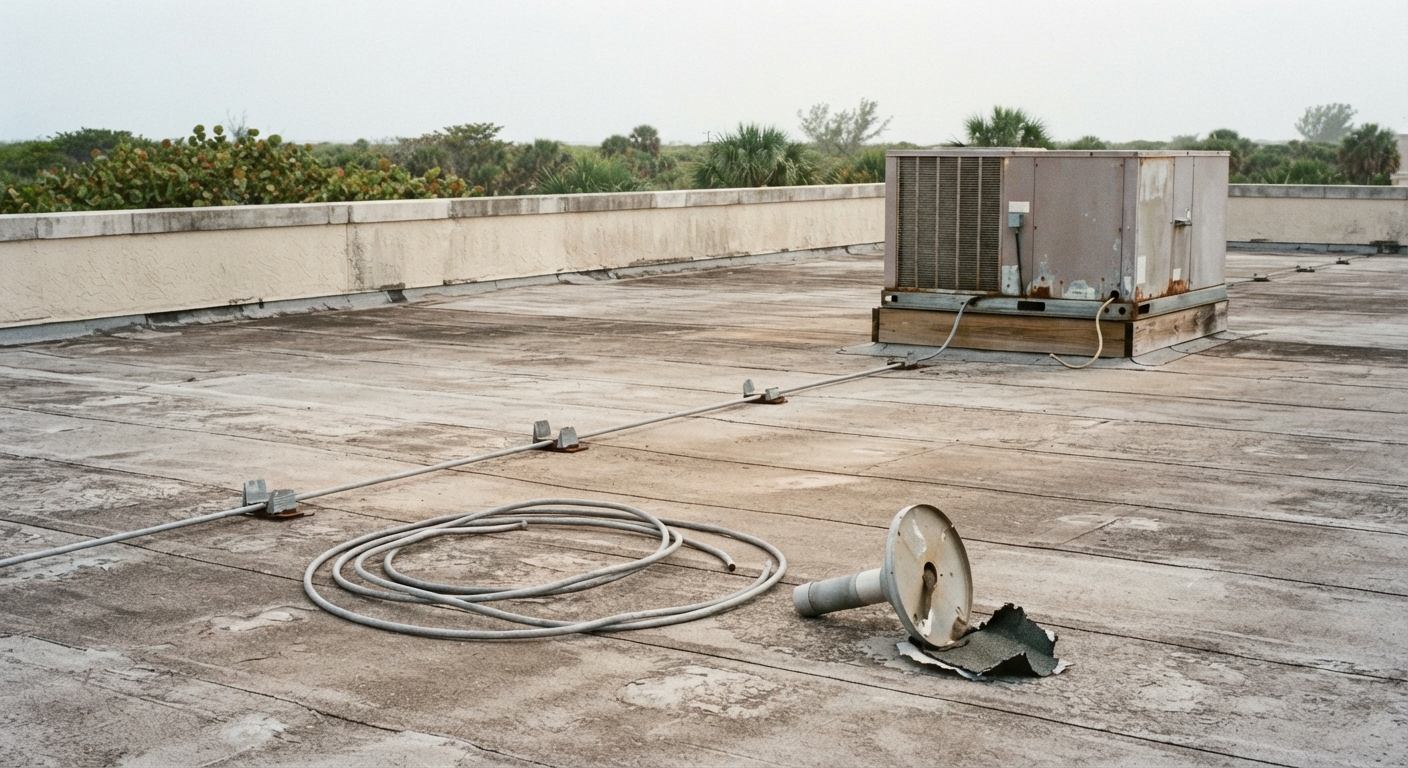
Most reroof failures in a lightning protection system are mechanical. Air terminal bases adhered to the old membrane come off with a layer of the old roof stuck to them and cannot go onto a new single-ply sheet without a membrane-compatible adhesive or attachment. Conductors pulled up and coiled for staging pick up kinks, and the LPI specification limits bends to no sharper than 90 degrees and no tighter than an 8-inch radius, with conductors secured at 3-foot intervals. Bonds to rooftop units are lost when equipment is replaced and nobody reconnects the new unit. Copper and aluminum parts get mixed when replacement pieces come from a different supply, and the same specification prohibits copper in contact with aluminum because the pairing corrodes.
| Component | What the reroof does to it | What to check at reset |
|---|---|---|
| Air terminals and bases | Lifted with the old membrane or cut free before tear-off | New bases attached by a method the membrane manufacturer accepts; terminals at least 10 in. tall and within 2 ft of exposed corners and edges (LPI reroof spec) |
| Roof conductors and cable holders | Detached, coiled, and staged during tear-off | Bends no sharper than 90 degrees or 8 in. radius; secured at 3 ft intervals; same metal as the original (LPI reroof spec) |
| Bonds to rooftop units, vents, and metal bodies | Disconnected when equipment is removed, raised, or replaced | Every new or reset unit reconnected as the design requires before the unit is started |
| Edge metal and coping connections | Removed with the old coping or gutter | Compatible brackets per the edge-metal manufacturer; attachment designed by a registered design professional under FBC 2026 Section 1510.8.6 |
| Through-roof penetrations and down conductors | Usually stay; exposed to damage during tear-off | Marked and protected before tear-off; flashed to the roof manufacturer’s instructions |
| Grounding electrodes | Stay in place below grade | Interconnected with the new rooftop system; condition verified only where documented or tested |
Reset, Replace, or Redesign: Which Approach Fits the Existing System?
An existing system can be handled four ways, depending on its age, its documentation, and how much of the rooftop is changing. NRCA’s Professional Roofing column on rooftop lightning protection systems advises that an owner whose system holds a UL Master Label Certificate or an LPI Master Installation Certificate tell the roofing contractor before work starts, and says the owner’s lightning protection contractor must be involved to keep the certificate valid. For noncertified systems, the column suggests an evaluation by a lightning protection contractor before roofing begins, documented through a UL Letter of Findings or an LPI Limited Scope Inspection.
| Approach | When it fits | Certificate outcome | Where it falls short |
|---|---|---|---|
| 1. Reset existing components | Recent, documented system in good condition; rooftop layout unchanged | Re-inspection; LPI’s reroof spec calls for a Reconditioned Master Certificate when an LPI-IP Master Certificate or UL Master Label is on file | Old parts may not fit the new membrane or the 2026 attachment rule; careful removal adds labor |
| 2. Replace rooftop components, keep down conductors and grounds | Aging rooftop parts over a sound concealed system | Reconditioned certificate where documentation exists; Limited Scope Certification where concealed work and grounding are undocumented (LPI reroof spec) | A rooftop scope does not verify concealed grounding; the certificate may cover the roof area only |
| 3. Full redesign | New rooftop equipment or solar, no documentation, or a system that predates the current standard | New full-system certificate possible if the whole system complies | Highest cost; may need access to concealed down conductors through occupied space |
| 4. Remove and do not reinstall | Owner decision after a risk review | No certificate | Building left without protection; any insurer, lender, or tenant requirement for a certified system must be confirmed with that party first |
No option makes a building lightning-proof. A lightning protection system gives the current a preferred path to ground; it does not prevent strikes, and the IBC language summarized by SPRI and LPI pairs installed systems with surge protective devices because the rooftop network alone does not protect the building’s electrical equipment. Where the owner’s existing lightning protection contractor holds the current certificate, keeping that contractor on the reset is often the shortest path to recertification, even though Advanced Roofing lists removal and replacement, UL Master Label work, and testing and recertification among its commercial lightning protection services.
What Drives the Cost and Schedule of the Lightning Protection Scope?
No primary source publishes a reliable per-square-foot or per-terminal price for resetting a commercial lightning protection system, and Advanced Roofing does not publish pricing. The budget follows the quantities below, and a bid that omits them cannot be compared line for line, the same discipline owners use to compare commercial roofing bids.
- Perimeter and corners. The LPI reroofing specification places air terminals within 2 feet of exposed corners and roof edges, so long perimeters, parapet breaks, and stepped roof levels add terminals and bases.
- Conductor length. Conductors are secured at 3-foot intervals under the same specification, so linear feet of conductor sets the count of cable holders and attachment points on the new membrane.
- Metal bodies to bond. Each rooftop unit, fan, vent, and edge-metal run in the design adds a connection to reset.
- Material class. The specification calls for Class I materials on structures up to 75 feet tall and Class II materials above 75 feet, which changes conductor size and component cost.
- Attachment engineering. For 9th Edition permits, Section 1510.8.6 adds a registered design professional’s attachment design to resist design wind loads, coordinated with the roof and edge-metal manufacturers.
- Documentation on file. An existing certificate supports a reconditioned certificate; missing records push the project toward a limited-scope inspection.
- Mobilizations. Each roofing phase can require a separate lightning protection visit.
What Changes on an Occupied Florida Building?
On an occupied building, the lightning protection sequence is built into the roofing phases. LPI’s guidance on reroofing projects and trade coordination recommends planning removal and reinstallation by phase to maximize time under protection. Each section’s terminals and conductors come off just ahead of tear-off on that section and are reset once it is dried in and ready for bases. The schedule should show the lightning protection crew’s visits beside the roofing phases, and the property manager should know which areas are unprotected on which days, the same way tenants hear about noise and work hours on occupied-building re-roofing projects.
Florida’s thunderstorm calendar sharpens that schedule. The National Weather Service office in Melbourne estimates that monthly lightning strikes in Brevard County peak from June through August. A roof replaced between November and April spends less of its open period in that window; a summer reroof needs smaller phases and a written limit on how long any section stays disconnected.
Rooftop equipment work adds a bonding step. When a new rooftop unit is set on a new curb, the bond to the lightning protection system has to be reconnected, and LPI lists unbonded rooftop additions and careless disconnection by other trades among the common failures. Advanced Roofing performs re-roofing, custom sheet metal and coping fabrication, and rooftop air-conditioning work in-house, which keeps the curb, coping, unit, and bond on one schedule; with separate contractors, the bond should be a named line item.
In Miami-Dade and Broward, roof coverings and their attachments fall under the Florida Building Code’s High-Velocity Hurricane Zone sections and product approval requirements. Whether a given air terminal base or edge-metal bracket satisfies those requirements on a specific roof is a determination for the registered design professional and the building official. The submittal should carry the roof manufacturer’s acceptance of the attachment method, and the perimeter brackets follow the same design pressures that govern commercial roof wind uplift ratings.
Which Code Edition and Certificate Rules Apply to Your Reroof?
As of November 18, 2026, the 8th Edition (2023) Florida Building Code is in effect and the 9th Edition takes effect December 31, 2026. The permit application date generally determines which edition governs, so a reroof permitted after that date should carry Section 1510.8.6 in its scope. The building official makes the final call, and the adopted text on the Florida Building Commission site should be read against the summaries cited here. The same edition change affects the recover rules covered in commercial roof recover vs. tear-off in Florida.
Certificates run on their own clock. UL’s Master Label program overview states that a certificate remains valid unless the structure or system is modified, the system is damaged, or the certificate expires. UL’s 2009 lightning protection services description sets expiration at five years from the inspection date and lists changes to a roofing or coping system among the modifications that end a certificate early. The same UL document says a Letter of Findings has no expiration and is not published to UL’s online directory. The LPI Inspection Program brochure recommends recertifying a system every three years.
Lightning Protection Reroof Checklist for Owners and Facility Managers
- Facility or property manager: find the existing UL Master Label, LPI-IP certificate, or Letter of Findings, plus the original installer’s name, before bids go out.
- Owner: give the certificate and any as-built drawings to every bidder and require the lightning protection scope as a separately priced line item.
- Roof consultant or designer: show lightning protection components and their interface details on the construction documents, as the NRCA column recommends.
- Roofing contractor: mark every through-roof penetration and down conductor before tear-off and photograph the layout section by section.
- Lightning protection contractor: confirm each base and bracket attachment with the membrane and edge-metal manufacturers and, for 9th Edition permits, obtain the registered design professional’s attachment design.
- Mechanical contractor: reconnect the bond on every new or reset rooftop unit before start-up.
- Owner: schedule the third-party close-out inspection through UL or LPI-IP and hold retainage until the certificate or letter is issued.
- Facility manager: add the lightning protection system to the commercial roof maintenance walk, since LPI recommends annual inspection as part of facility maintenance.
Frequently Asked Questions
Does a roofing contractor need to remove the lightning protection system before a reroof?
Yes, the rooftop portion has to come off before the old membrane can be removed, while down conductors and grounding usually stay in place. NRCA’s Professional Roofing column says lightning protection work is generally beyond most roofing contractors’ expertise, so removal should be coordinated with, or performed by, a qualified lightning protection contractor.
Does a reroof void a UL Master Label certificate?
It can. UL’s program documents state that a Master Label certificate stops being valid when the structure or system is modified or damaged, and UL’s 2009 services description lists changes to a roofing or coping system among those modifications. Plan for a re-inspection at close-out and confirm current rules with UL or the certifying installer.
What is a Reconditioned Master Certificate?
It is the certificate the Lightning Protection Institute’s reroofing specification calls for when an existing LPI-IP Master Certificate or UL Master Label is on file and the system is reset after reroofing. Without documentation for the concealed work and grounding, the specification calls for a Limited Scope Certification. The certifying program makes the final decision.
Who should reinstall lightning protection after a roof replacement?
A lightning protection contractor qualified under NFPA 780, UL 96A, or LPI 175, working to the roof manufacturer’s attachment and flashing instructions. Where the owner’s existing contractor holds the current certificate, keeping that contractor involved is often the simplest route to recertification. The roofing contractor sequences the work and flashes penetrations.
Does the 2026 Florida Building Code require lightning protection on commercial buildings?
New Section 1510.8.6 governs how lightning protection components are attached to edge metal, gutters, and roof coverings where a system is installed, including attachment designed by a registered design professional for design wind loads. Whether a specific building must have a system is a separate question for its design professional, building official, and any insurer or tenant with a requirement.
Can old lightning protection parts be reused on a new roof?
Sometimes. Parts in good condition that match the original metal can go back in their original locations on a simple project, but adhered bases usually need replacement, and old components may not fit the new membrane or the 2026 attachment rule. The lightning protection contractor decides part by part, and the certifier checks the result.
Put the Lightning Protection System in the Reroof Scope From the Start
A reroof takes the top of the lightning protection system apart, and the system is only as good as its reset. LPI and NRCA treat removal, reinstallation, and re-inspection as coordinated work by a qualified lightning protection contractor. UL ties certificate validity to changes in the roofing and coping system, and the 2026 Florida Building Code adds an engineered attachment design for components on edge metal, gutters, and roof coverings. An owner who finds the certificate before bidding, prices the scope as its own line, phases the work, and holds retainage until the certificate is reissued ends the project with a new roof and a complete path to ground.
Written by The Technical Team at Advanced Roofing. Founded in 1983, Advanced Roofing is 100% employee-owned and was ranked the #13 largest roofing contractor in the U.S. on Roofing Contractor magazine’s 2026 Top 100 list (2026 Top 100 ranking announcement).
To scope lightning protection as part of a reroof, request a commercial reroofing quote or call Advanced Roofing at (800) 638-6869.