
At a glance: Reflective roof membranes and coatings do lower cooling energy on Florida commercial buildings, but measured results range from about 11% to 25% of air-conditioning energy on average, with individual spaces from 13% to 48%. This article explains why: insulation, duct location, aged reflectance, and operating hours. It covers the Florida Building Code reflectance values in effect now and on December 31, 2026, compares white TPO, PVC, coatings, and cap sheets with their limits, addresses occupied-building work, and ends with a checklist for owners and boards.
A reflective membrane does cut cooling energy on a Florida commercial building, and measured Florida studies show it. Before choosing a cool roof, Florida commercial owners should treat the savings as a range set by the building rather than a fixed percentage, because insulation, duct location, surface soiling, and cooling hours decide whether the reduction is small or large. Getting this wrong means budgeting a reroof around savings that never appear on the utility bill. This article does not argue for tearing off a sound roof to change its color, which the U.S. Department of Energy says is rarely economical.
The figures below come from Florida Solar Energy Center and Lawrence Berkeley National Laboratory field studies, the Florida Building Code, and federal guidance, each dated and linked. The checklist near the end is written to be forwarded to an owner, asset manager, or board.
What Do the Florida Energy Code and Federal Research Say About Cool Roofs?
Florida already regulates roof reflectance on new commercial construction. Section C402.3 of the 2023 Florida Building Code, Energy Conservation requires low-sloped roofs over cooled space to meet a three-year-aged solar reflectance of 0.55 with a thermal emittance of 0.75, or a three-year-aged Solar Reflectance Index (SRI) of 64. According to the Cool Roof Rating Council’s summary of Florida code requirements, Climate Zone 1A, which includes Miami-Dade, Broward, and Monroe, requires 0.63 or an SRI of 75. Roof areas under solar arrays, rooftop equipment, skylights, and walkways are excepted.
The 9th Edition (2026) Florida Building Code takes effect December 31, 2026, and as of November 3, 2026 the Florida Building Commission’s Analysis of Changes for the 9th Edition energy code shows the reflectance table carried forward with updated test-standard references rather than new minimums. The permit application date generally determines which edition governs. Whether the section applies to a particular reroof is a determination for the building official and the design professional of record.
Product labeling has changed too. The ENERGY STAR certification program for roof products ended on June 1, 2022, so a product sheet that still cites an ENERGY STAR roof label is out of date; the Cool Roof Rating Council’s Rated Roof Products Directory is now the public source for tested aged values. On savings, the U.S. Department of Energy’s Energy Saver guidance on cool roofs says results depend on climate, insulation, roof type, and HVAC efficiency, which is the frame this article uses.
How Does a Reflective Roof Membrane Reduce a Florida Building’s Cooling Load?
A reflective roof membrane reduces cooling load by keeping the roof surface cooler, which shrinks the temperature difference that drives heat down into conditioned space. Solar reflectance is the share of sunlight the surface sends back; thermal emittance is how readily it sheds absorbed heat as infrared radiation. White TPO or PVC rates high on both, while a dark cap sheet or bare EPDM rates low on reflectance.
The surface temperature difference is large. DOE’s Energy Saver page states that a conventional roof can exceed 150°F on a sunny summer afternoon, while a reflective roof under the same conditions can stay more than 50°F cooler. Lawrence Berkeley National Laboratory measured a large retail store in Austin, Texas and recorded the average daily maximum roof surface temperature falling from 168°F to 126°F after a black rubber membrane was replaced with white thermoplastic.
What sits below the membrane decides how much of that difference reaches the utility bill. Thick above-deck insulation slows heat flow whatever the color; ducts and air handlers in a hot plenum gain roof heat directly. The Florida Solar Energy Center’s field and laboratory research found cooling reductions depended on insulation level, reflectance, duct location, and air conditioner sizing, and noted that Florida’s humidity and warm nights make near elimination of cooling energy very unlikely, because moisture removal and internal heat are untouched by roof color.
| Rated property | What it tells the owner | FBC 8th Ed. minimum, Climate Zone 2 | FBC 8th Ed. minimum, Climate Zone 1A | Where to verify |
|---|---|---|---|---|
| Three-year-aged solar reflectance | Share of sunlight reflected after weathering and soiling | 0.55 | 0.63 | CRRC Rated Roof Products Directory |
| Three-year-aged thermal emittance | How readily the surface radiates absorbed heat | 0.75 | 0.75 | CRRC Rated Roof Products Directory |
| Three-year-aged SRI (alternative path) | Single index combining reflectance and emittance | 64 | 75 | Manufacturer data calculated per ASTM E1980 |
| Initial solar reflectance | Value when new; not the compliance value | No minimum | No minimum | CRRC directory, initial column |
White TPO, PVC, Coating, or Cap Sheet: Which Cool Roof Path Fits the Building?
The right cool roof path depends on the condition of the roof already there. A new white TPO or PVC membrane goes on during a replacement or a code-permitted recover. A reflective coating goes over a roof that is dry, adhered, and sound. A modified bitumen system can take a white cap sheet. Insulation added during a replacement is the fourth lever, and it works whatever the surface color.
Advanced Roofing’s article on extending roof service life with a commercial roof coating explains where coatings fit. A coating is not a fix for wet insulation, widespread loss of adhesion, or a deteriorated deck, and a coating warranty is not a new-roof warranty, so a core sample and moisture survey come before any coating bid. Owners comparing paths can review Advanced Roofing’s commercial roof coating services alongside its overview of TPO commercial roofing systems in Florida.
Timing matters as much as product. DOE’s Energy Saver page notes that cool products usually cost no more than conventional ones on replacement roofs, and DOE’s 2011 Guide to Cool Roofs says it is rarely economical to replace a sound roof just to raise its reflectance. The cheapest moment for a cool roof is the replacement the building already needs, which is also the moment to bring insulation to code, as Advanced Roofing’s page on sustainable roofing in Florida describes.
| Option | Best fit | What it changes | Where it falls short |
|---|---|---|---|
| New white TPO or PVC membrane | Roof at or near the end of its service life; tear-off or code-permitted recover | High-reflectance, high-emittance surface plus the chance to add insulation | Highest first cost of the four; reflectance drops as the surface soils; seams and flashings still need maintenance |
| Reflective coating over the existing roof | Dry, adhered, single-covering roof with years of service left | Raises surface reflectance without tear-off and with limited disruption | Not for wet insulation or failed adhesion; needs recoating on a cycle; coating warranty is not a new-roof warranty; adds no insulation |
| White cap sheet on modified bitumen | Owners who want a multi-ply system | Lighter surface on a redundant assembly | Aged reflectance varies widely by product; check the CRRC rating before specifying |
| Insulation upgrade at replacement | Any reroof where insulation is removed | Cuts heat flow day and night regardless of color | Raises roof height at curbs, drains, and parapets; does not lower membrane surface temperature |
How Much Does the Cool Roof Florida Commercial Owners Install Actually Save?
Measured field studies of commercial buildings show reflective roofs cutting air-conditioning energy by roughly 11% to 25% on average, with individual tenant spaces in one Florida strip mall ranging from 13% to 48%. The largest reductions appear on single-story buildings with modest insulation and ducts above the ceiling. The smallest appear on well-insulated buildings and on spaces kept very cold.
| Study | Building | Change | Measured result | Source |
|---|---|---|---|---|
| Florida Solar Energy Center, 1997 | 12,500 sq ft metal-roof strip mall, Cocoa, FL; R-11 batts; air handlers in roof plenum | Bare metal (about 29% reflectance) coated with white acrylic (about 75–77%) | Summer cooling energy down 25.3% on average (13–48% by shop); utility peak-hour AC demand down 40% | FSEC-CR-964-97 |
| Florida Solar Energy Center, 1996 | 10,000 sq ft elementary school, Cocoa Beach, FL | Gray modified bitumen (23% reflectance) coated with white acrylic elastomeric (68%) | Reflectance measured at 63% after one year of exposure; staff reported improved comfort | FSEC, Our Savior’s School |
| Lawrence Berkeley National Laboratory, 2001 | 100,000 sq ft retail store, Austin, TX | Black rubber membrane replaced with white thermoplastic | AC energy down 11%; peak AC demand down 14%; about $7,200 per year at 2001 rates ($0.072 per sq ft) | LBNL-47149 |
| U.S. Department of Energy, 2011 | Commercial buildings in general (guidance, not a field study) | White roof | Annual energy savings worth up to $0.20 per sq ft; greatest in hot climates | DOE Guide to Cool Roofs |
The 1997 Florida Solar Energy Center study of a Cocoa strip mall is the closest match to a Florida retail building: one story, R-11 insulation, and air handlers in the plenum. Shops kept coldest saved the least in percentage terms. In FSEC’s 1996 study of a Cocoa Beach elementary school, the coating held most of its reflectance through the first year. Neither building had the above-deck insulation a current replacement would add, so neither result transfers directly to a newly insulated roof.
- Insulation. EPA’s ENERGY STAR cool roof guidance says cool roofs save the most on buildings with low roof insulation. A study commissioned by the EPDM Roofing Association found only marginal reductions at typical insulation levels; that group represents dark-membrane makers.
- Duct location. Ductwork and air handlers in a hot plenum pick up roof heat directly.
- Aged reflectance. Three-year-aged ratings, not initial values, predict long-term results.
- Operating hours, setpoint, and tariff. Long cooling hours and demand charges raise the value of a cooler roof.
- Roof share of load. The roof dominates a single-story building’s solar exposure and covers only the top floor of a taller one.
Read the table conservatively: the strip mall figure is a seven-shop average, the LBNL dollars reflect 2001 Texas rates, and the DOE figure is a ceiling. Oak Ridge National Laboratory’s Cool Roof Calculator lets a mechanical engineer test the building before a savings figure enters a proposal. Advanced Roofing’s post on the energy efficiency of TPO commercial roofing describes the membrane itself.
What Changes When the Building Stays Open During a Cool Roof Project?
On an occupied building, the reflective surface is the simple part of the scope. A replacement means tear-off in sections dried in the same day, protected staging, and crane picks outside business hours where the site allows. Rooftop units are flashed into the new membrane, so roofing and mechanical schedules are set together, the phasing Advanced Roofing’s commercial re-roofing for occupied buildings is organized around.
Coatings need cleaning and repairs first, and some chemistries carry odor, so nearby rooftop-unit intakes may need to be managed with the mechanical contractor. Where rooftop solar is planned, the area under the array is exempt from the reflectance values, and both schedules should be coordinated so the roof is disturbed once.
In Miami-Dade and Broward Counties, the High-Velocity Hurricane Zone sections of the Florida Building Code govern the roof assembly, and the system must carry the applicable product approval, including a Miami-Dade Notice of Acceptance where required. Color does not change wind design; attachment, fastening, and perimeter details do, and the engineer of record confirms them. No roof is immune to storm damage, since rated pressures can be exceeded and warranties carry wind-speed limits.
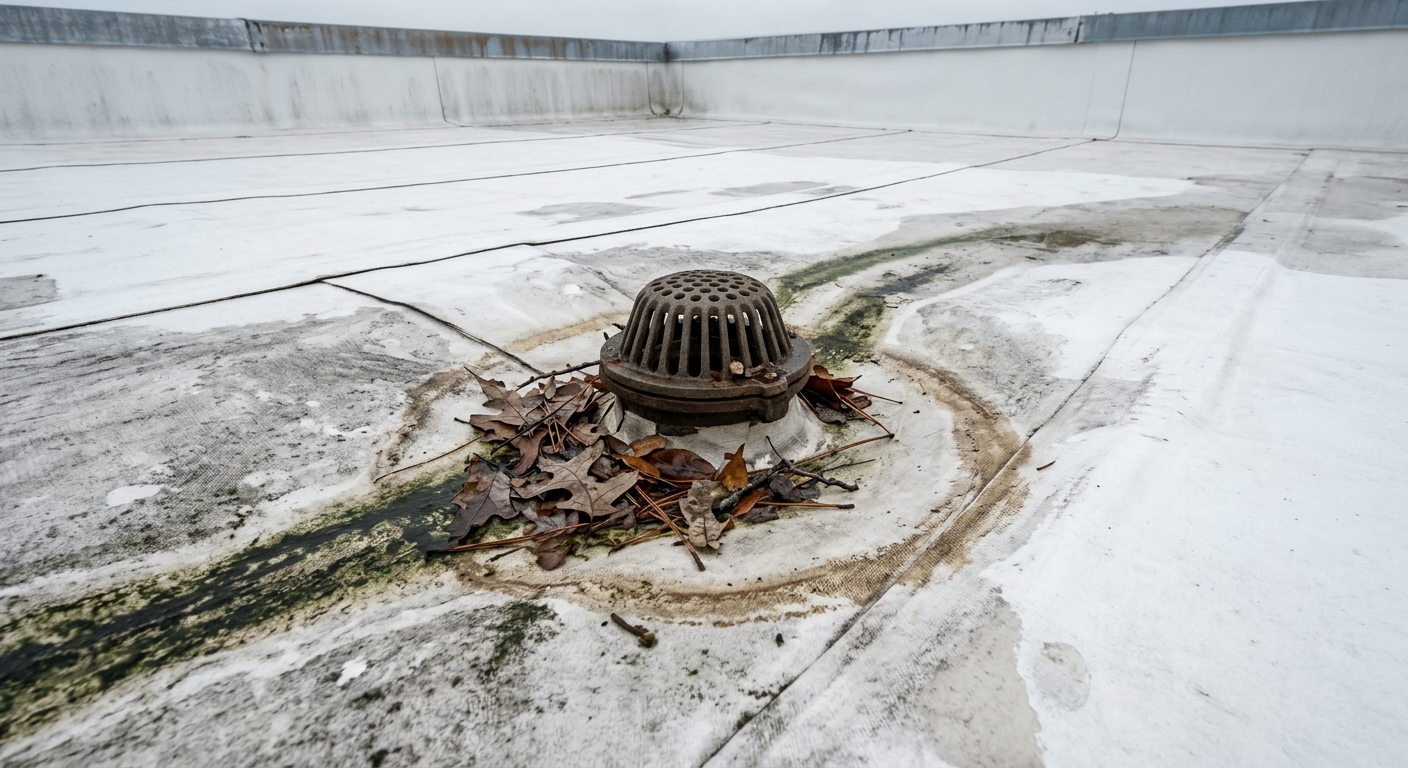
Keeping the surface reflective is maintenance work in Florida. At FSEC’s test facility, a coated sample’s reflectance fell from 0.71 to 0.59 within a year, mostly from algae and dirt, while the commercial roofs above lost far less. A commercial roof maintenance program should include drain clearing and cleaning that follows the manufacturer’s written instructions, since unapproved methods can affect the warranty.
Which Code Edition, Test Standard, and Utility Programs Apply in 2026 and 2027?
For a project in late 2026 or 2027, the 8th Edition (2023) Florida Building Code applies until the 9th Edition takes effect on December 31, 2026, with the permit application date generally deciding which governs. The ENERGY STAR roof label has not been valid since June 1, 2022. Aged ratings now come through the CRRC, and Lawrence Berkeley National Laboratory’s Heat Island Group documented how the aging practice ASTM D7897 reproduces three-year-aged reflectance using soiling mixtures that include one modeled on Miami.
Some Florida utilities have offered reflective-roof incentives; FSEC published a 2019 evaluation of the Orlando Utilities Commission’s commercial cool roof rebate program. Each utility sets its own terms, which change and may still reference ENERGY STAR, so confirm them in writing before a rebate appears in a budget. The utility, not Advanced Roofing, determines eligibility.
Cool Roof Decision Checklist for Florida Property and Facility Managers
Each item has an owner, and the list can be forwarded to an asset manager or board as written. Determinations assigned to the engineer, building official, or utility are theirs to make.
- Facility manager: pull 24 months of utility bills, including demand charges, as the post-project baseline.
- Roof consultant or contractor: core the roof and run a moisture survey; wet insulation rules out a coating.
- Roof consultant: record insulation type and thickness and where ducts and air handlers sit.
- Mechanical engineer: model the roof’s share of cooling load before a savings figure enters the proposal.
- Design professional and building official: confirm the governing code edition and whether Section C402.3 applies to the reroof.
- Specifier: require CRRC three-year-aged values on the submittal, not initial values or an ENERGY STAR mark.
- Property manager: plan tenant notices, intake management, and crane-pick windows with the contractor.
- Asset manager: ask the utility in writing about current incentives and product requirements.
- Maintenance lead: set inspection and cleaning intervals that match the warranty terms.
Frequently Asked Questions
Does a white TPO roof lower cooling costs in Florida?
Yes, in most cases, by an amount that depends on the building. White TPO reflects far more sunlight than a dark membrane. Lawrence Berkeley National Laboratory measured an 11% cut in air-conditioning energy after white thermoplastic replaced black rubber on a large Texas store. Insulation, duct location, and soiling set the Florida result.
How much does a cool roof save on a Florida commercial building?
Measured results range widely. In a 1997 Florida Solar Energy Center study of a Cocoa strip mall, a white coating cut summer cooling energy by about 25% on average, from 13% to 48% by shop. DOE’s 2011 guide puts commercial savings at up to $0.20 per square foot per year.
Do reflective roofs lose reflectivity in Florida’s humidity?
Yes, some reflectance is lost as dirt and biological growth build up. That is why the Florida energy code uses three-year-aged values and why Lawrence Berkeley National Laboratory’s aging method includes a soiling mixture modeled on Miami. Manufacturer-approved cleaning helps hold rated performance.
Is a cool roof required by the Florida Building Code?
For new low-sloped roofs over cooled space, Section C402.3 of the 8th Edition Florida Building Code, Energy Conservation, sets minimum aged reflectance and emittance or SRI values, higher in Climate Zone 1A, with exceptions for areas under solar arrays and equipment. Whether it applies to a reroof, and how the 9th Edition reads after December 31, 2026, is for the building official to confirm.
Is a reflective roof coating as effective as a new white membrane?
A coating can match a white membrane’s surface reflectance when the products’ CRRC aged ratings are similar. The difference is the roof underneath. A coating suits only a dry, adhered roof with service life left, and it adds no insulation. On a roof near the end of its life, a new membrane with code-level insulation is usually the stronger energy decision.
Does a cool roof still help if the roof is well insulated?
It helps less. EPA’s ENERGY STAR guidance says cool roofs save the most on buildings with low roof insulation, and an EPDM Roofing Association study found only marginal reductions at typical insulation levels. A well-insulated building can still benefit where ducts sit above the ceiling or demand charges are high.
What a Reflective Membrane Can and Cannot Do for a Florida Cooling Bill
The evidence supports the opening claim. Reflective membranes and coatings lower roof surface temperature by tens of degrees, and measured commercial studies in Florida and Texas show air-conditioning energy reductions of about 11% to 25% on average. The same studies show why no single percentage applies: insulation, duct location, aged reflectance, operating hours, and tariff set the result, and Florida’s humidity caps what any roof can remove.
For most owners the practical answer is to make the roof reflective when it is replaced anyway, add insulation to code, choose products by CRRC aged ratings, and keep the surface clean. A coating fits only a dry, sound roof, and an engineer’s model belongs in the proposal that goes to the board.
Written by The Technical Team at Advanced Roofing. Founded in 1983, Advanced Roofing is 100% employee-owned and was ranked the #13 largest roofing contractor in the U.S. on Roofing Contractor magazine’s 2026 Top 100 list.
To have a Florida low-slope roof cored, surveyed, and evaluated for a reflective membrane or coating, request a quote from Advanced Roofing or call (800) 638-6869.