
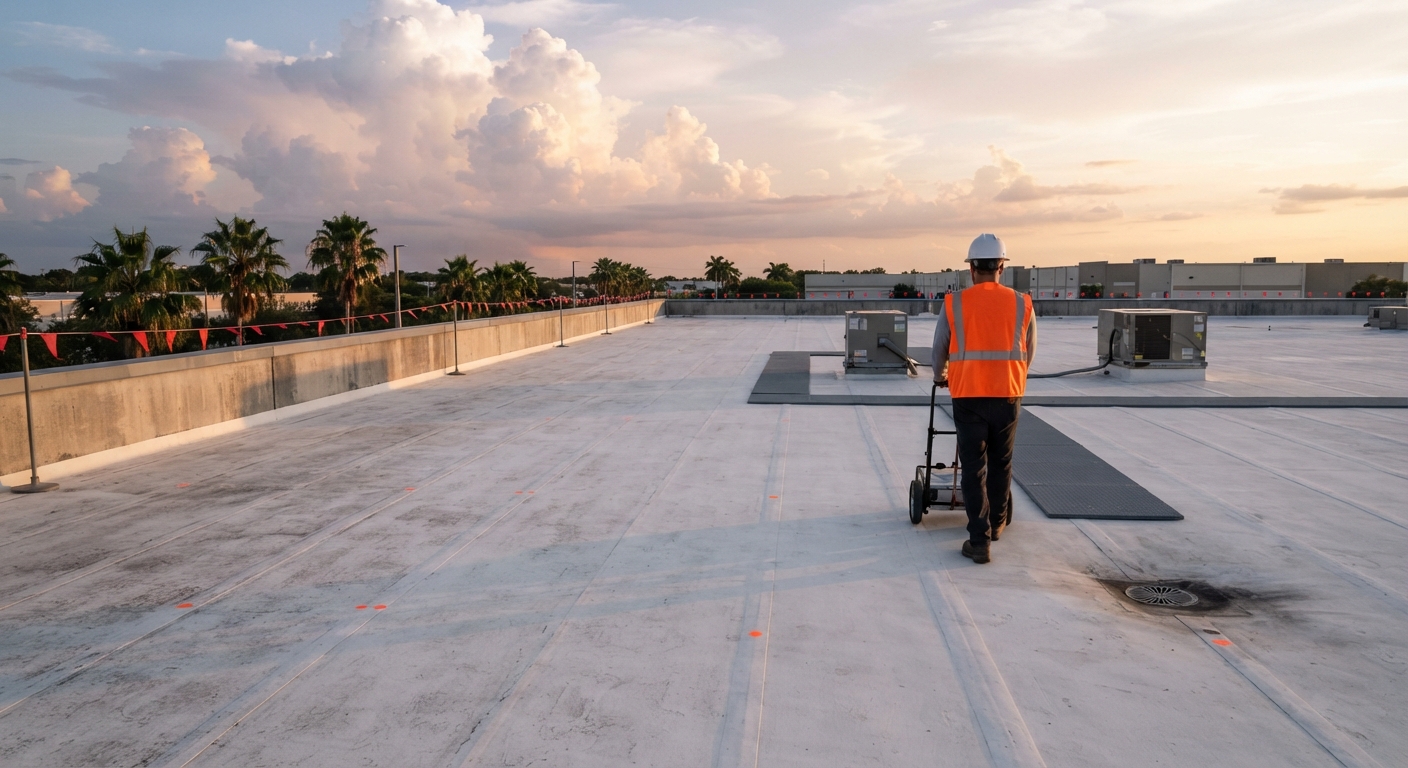
At a glance: A per-square-foot price for a Florida commercial reroof is a total project cost divided by roof area, and most of what moves it is invisible from the ground: the share of wet insulation, deck condition, the number of existing coverings, the insulation level the energy code requires, wind attachment at the perimeter, and how the crew works around an occupied building. This article explains each driver, compares repair, coating, recover, and replacement scopes, covers the December 31, 2026 code change, and closes with a bid checklist. It quotes no prices.
The commercial roof replacement cost in Florida that matters to an owner is the price per square foot of a specific assembly on a specific deck, and that number is set by conditions most cost guides never measure: how much of the insulation is wet, how many roofs are already on the building, what the wind zone requires at the perimeter, and how the crew reaches and works around an occupied building. Budgets built from a published average tend to find the gap after tear-off, when wet insulation or a corroded deck becomes a change order. This article explains what moves the per-square-foot price on a low-slope commercial re-roofing project and how to test a bid against those drivers. It quotes no prices, because a defensible figure for one building comes from cores, a moisture survey, and a written scope.
Why is a Florida commercial reroof harder to price heading into 2027?
A reroof permitted after the code change is priced against different rules. The Florida Building Code, 9th Edition (2026) takes effect December 31, 2026, and the Miami-Dade County Permitting and Inspection Center’s notice on the 9th Edition states that applications submitted through its online portal after 4 p.m. on December 30, 2026 must comply with the new edition (as of November 24, 2026). Other jurisdictions set their own cutoff mechanics, so the permitting building department decides which edition applies.
The reroofing rules change in the new edition. The Florida Building Commission’s Analysis of Changes for the 9th Edition Existing Building code lists a revised Section 706.3 exception that allows only the upper roof covering or system to be removed on a building with two coverings, provided the remaining substrate is adequate for the new roof. The Florida Roofing and Sheet Metal Contractors Association’s summary of the 9th Edition changes explains that the same exception can let adequate original insulation or lightweight insulating concrete stay in place, and that buildings in the High-Velocity Hurricane Zone still follow Sections 1512 through 1525. For some two-roof buildings, that difference changes the removal, disposal, and insulation quantities in the bid.
Market pricing also moves on its own. The U.S. Bureau of Labor Statistics publishes a monthly producer price index for roofing contractors’ nonresidential building work, available through the Federal Reserve Bank of St. Louis FRED database. An owner holding a bid that is several months old can use that index to ask whether the pricing still reflects the market before carrying it into a capital plan. The index is national and prices no individual project.
What is inside a per-square-foot price for a low-slope commercial roof?
A per-square-foot price on a commercial reroof is a total project cost divided by roof area, and the total is built from components that do not scale evenly with area. Field membrane and insulation scale with square footage. Edge metal, coping, curbs, drains, and penetration flashings scale with linear feet and counts, so a small roof crowded with penetrations carries a higher price per square foot than a large, open roof with the same membrane. Mobilization, permitting, engineering, crane time, and safety setup behave partly as fixed costs, which is why the per-square-foot figure generally falls as roof area rises.
| Component | What it covers | Why it varies between buildings |
|---|---|---|
| Removal and disposal | Tear-off of existing coverings and wet insulation; haul-off and dumpster fees | Number of existing coverings, ballast or gravel weight, disposal distance |
| Deck repair | Replacement of corroded steel, deteriorated wood, or failed lightweight concrete | Unknown until cores and tear-off; normally carried as a unit-price allowance |
| Insulation and slope | Above-deck board, tapered insulation, crickets, cover board | Energy-code R-value, drainage slope needed, how much existing insulation is reusable |
| Membrane system | TPO, PVC, modified bitumen, or another assembly | System type, number of plies, attachment method, warranty requirements |
| Perimeter and flashings | Edge metal, coping, curbs, drains, penetrations | Linear feet of edge; count of penetrations and rooftop units |
| Wind attachment | Fasteners, plates, adhesives, enhanced perimeter and corner zones | Wind zone, building height, exposure, HVHZ requirements |
| General conditions | Permits, engineering, crane, fall protection, supervision, temporary protection | Site access, occupancy, schedule constraints |
Wet insulation is the component that most often separates a budget from a final cost. Water entering through a failed seam or flashing travels laterally through the insulation layer, so the leak visible inside the building can sit well away from the wet area on the roof. Wet board loses thermal resistance, adds weight, can corrode a steel deck, and cannot stay under a new membrane, so every wet square foot is removed and replaced. A core sample shows what is under the membrane at one point, and a moisture survey shows how far the problem extends across the roof.
Repair, coat, recover, or replace: which scope does the per-square-foot price buy?
Four scopes appear in commercial reroof proposals, and their per-square-foot prices are comparable only when the scope is identical. Commercial roof repair addresses discrete defects. A coating renews the surface of a sound, dry roof, the work described on the roof coatings service page. A recover installs a new covering over the existing roof where the code allows it. A replacement removes the existing covering to the deck and installs a new assembly. Each fits a different condition and has limits.
| Scope | Condition it fits | What the price usually includes | Where it falls short |
|---|---|---|---|
| Repair | Isolated seam, flashing, or penetration failures on a roof with service life left | Labor and materials at the defect; sometimes a leak investigation | Repeated repairs on a roof past its service life cost more over time than replacement; wet insulation outside the repair stays |
| Coating | Dry, adhered roof with surface wear | Cleaning, substrate repairs, coating application | Not a fix for wet insulation, loss of adhesion, or a deteriorated deck; a coating warranty is not a new-roof warranty |
| Recover | One existing covering, dry insulation, adequate substrate, code path confirmed | Cover board or insulation and new membrane over the existing roof | Prohibited in conditions the code lists; can trap moisture if the survey is incomplete; HVHZ follows separate sections |
| Full replacement | Wet insulation, deck damage, two coverings, or end of service life | Tear-off to deck, deck allowance, new insulation, membrane, flashings | Highest initial cost and longest weather exposure during work; still subject to wind-speed limits and warranty exclusions |
No scope makes a roof hurricane-proof. Every assembly is tested to rated pressures, storms can exceed them, and manufacturer warranties carry wind-speed limits and exclusions. A repair remains the right answer for a roof with dry insulation and years of service left. For the full budget picture, including repair and recover scenarios, see the commercial roofing cost in Florida budget guide; this article stays on what moves the replacement price per square foot.
Which factors move commercial roof replacement cost in Florida the most?
Commercial roof replacement cost in Florida per square foot is driven by six conditions: the share of wet insulation, deck condition, the number of existing coverings, the insulation level the energy code requires, wind attachment at the perimeter and corners, and site access and occupancy. Roof area, membrane type, and the permit’s code edition then adjust the total.
- Wet insulation share. Measured by cores and a moisture survey; a commercial drone survey adds a roof-wide view of conditions before anyone prices the job.
- Deck condition. Confirmed at tear-off, which is why the deck line should be a unit price agreed in advance.
- Existing coverings. Two or more generally require removal to the deck today; the 9th Edition exception described above may change that for some buildings.
- Energy-code insulation. The International Code Council explains that under IECC Section C503.3.1, a roof replacement with insulation entirely above the deck must meet the insulation requirement for new construction; the designer confirms how the Florida energy code applies to the permit edition.
- Wind attachment. Perimeter and corner zones need denser attachment, and products need Florida Product Approval or, in the HVHZ, a Miami-Dade NOA. Buildings served from the Miami commercial roofing office and the Fort Lauderdale office fall in the HVHZ.
- Access, height, and occupancy. Crane picks, street closures, night work, and phasing add labor and general conditions.
The commercial roof replacement planner on this site turns those inputs into a preliminary budget range and timeline: roof area, roof system, layers to remove, HVHZ location, building height, site access, occupancy, and target permit date. It suits the capital-plan stage; a bid-ready number still needs cores, a moisture survey, and a written scope.
What changes the price on an occupied Florida building?
Many Florida commercial reroofs happen over tenants, patients, students, or guests, and occupancy changes the method, which changes the price. Advanced Roofing’s re-roofing service page describes work scheduled around business hours, with night and weekend installation where needed. Night work, smaller daily areas, and temporary protection add labor hours a vacant building does not need, and a large contractor set up for that work is not always the lowest bid on a small, simple, unoccupied building.
Florida’s afternoon thunderstorms set the daily rhythm. Each day’s tear-off is limited to what the crew can dry in before weather arrives, so a building with sensitive interiors gets smaller daily sections and more mobilizations per roof, as the guides to data center roof replacement in Florida and reroofing occupied hospitals describe. Smaller sections cost more and keep interiors dry.
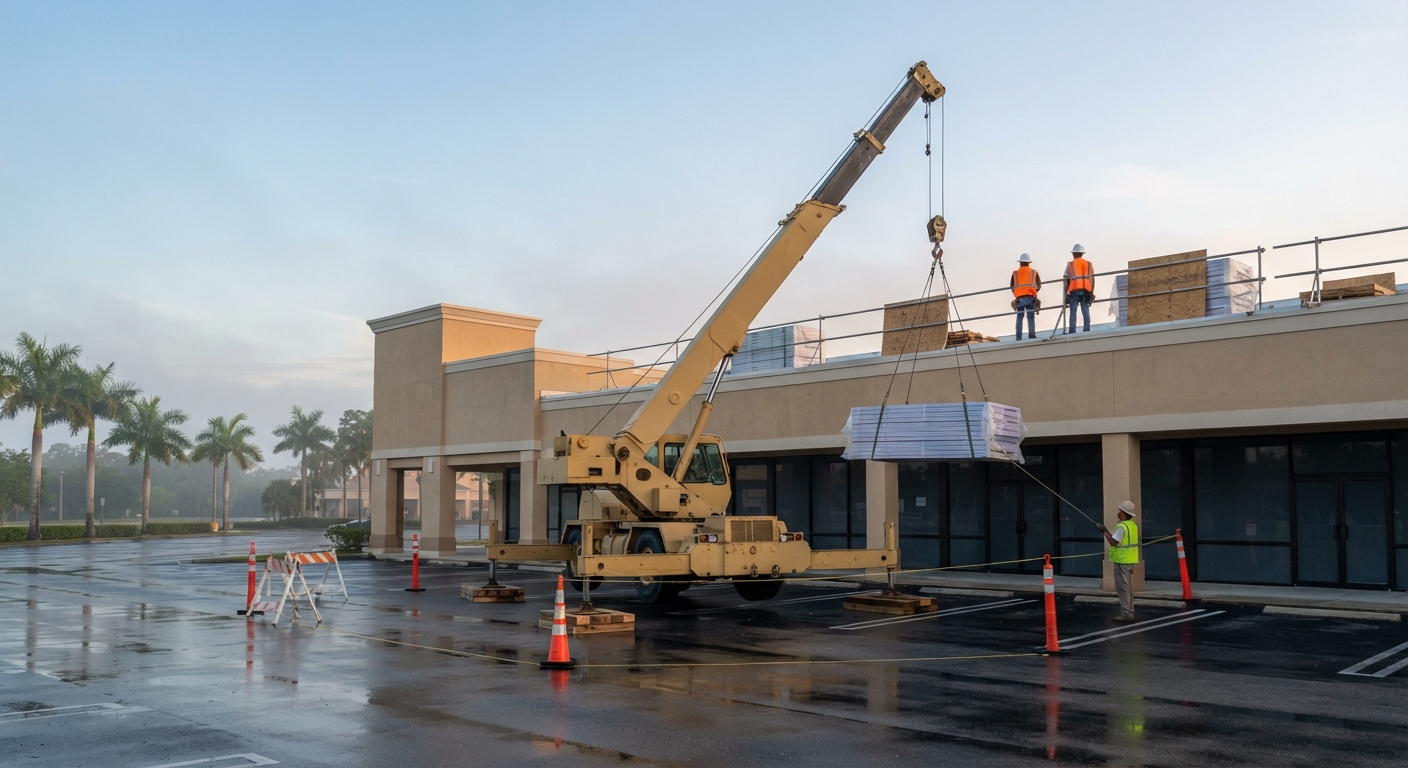
Material movement is the second occupancy cost. On an occupied site, crane picks of insulation, membrane, and debris are scheduled outside business hours where the site allows, with drop zones closed to the public. Advanced Roofing runs its own crane division, which shortens the coordination chain on picks; urban and zero-lot-line sites can still require a lane or street closure.
Fall protection is a fixed requirement with a variable cost. OSHA’s construction standard 29 CFR 1926.501(b)(10) requires employees doing roofing work on low-slope roofs with unprotected sides and edges 6 feet or more above a lower level to be protected by guardrails, safety nets, personal fall arrest, or a warning-line system combined with one of those methods or a safety monitoring system. Long open perimeters, skylights, and multiple levels add setup time that appears in general conditions.
Rooftop HVAC units sit on curbs the new roof must flash, and some curbs must be raised to clear the new insulation height. Units are disconnected in a sequence the building engineer approves, with notice to the property manager before every shutdown.
Which code and permit dates affect a commercial reroof budget?
The permit application date generally determines which edition of the Florida Building Code governs a reroof, and the 9th Edition takes effect December 31, 2026 (as of November 24, 2026). An owner holding a bid priced under the 8th Edition should ask whether a later permit would change its insulation, attachment, or product requirements, and have the designer confirm each product’s approval for the permit’s edition.
Condominium associations work to a second calendar. The roof is a required component of the structural integrity reserve study under Florida Statute 718.112(2)(g), and the study’s findings shape the reserve and assessment discussion around a reroof. Advanced Roofing is not an engineer of record, insurer, or legal advisor; questions about what the statute requires of a specific building go to the board’s engineer, reserve study professional, and association attorney.
Commercial reroof budget checklist: who owns each step?
- Facility or property manager: collect roof age, leak history, repair invoices, and warranty documents.
- Roofing contractor: take cores, run a roof-wide moisture survey, and map wet areas by square footage.
- Roofing contractor: state recover or full replacement, coverings removed, and insulation R-value and tapered design.
- Owner and contractor: agree on unit prices for deck replacement and for wet insulation beyond the surveyed quantity, so concealed conditions are priced before the contract.
- Design professional or engineer of record: confirm wind design pressures, perimeter and corner attachment, and the code edition the permit will fall under.
- Property manager: put occupancy constraints (work hours, crane windows, HVAC shutdown limits) in writing so every bidder prices the same method.
- Asset manager or CFO: compare bids by scope line before price per square foot.
- Condo board or CAM: route reserve, statutory, and insurance questions to the engineer, attorney, and insurer.
The qualification side of the same comparison, including licensing, insurance, and safety record, is covered in the guide on how to select a roofing contractor.
Frequently Asked Questions
How much does a commercial roof replacement cost per square foot in Florida?
The price per square foot for a specific Florida building depends on the wet insulation share, deck condition, number of existing coverings, required insulation, wind zone, access, and occupancy, so a published average says little about one roof. The commercial roof replacement planner gives a preliminary range from your building’s inputs. A bid-ready figure comes from cores, a moisture survey, and a written scope.
Why do two commercial roofing bids for the same roof differ so much per square foot?
Bids usually differ because they price different scopes. One proposal may assume a recover while another assumes full tear-off; one may carry a deck allowance and another may exclude it; insulation thickness, tapered design, perimeter attachment, and work hours often vary. Line the proposals up by scope item first. A price far below the field usually means something on the list is missing.
Does a second existing roof layer raise the cost of a commercial reroof?
Yes. A second covering adds removal labor, disposal weight, and time, and under the current Florida Building Code two or more existing coverings generally require removal to the deck. The 9th Edition, effective December 31, 2026, adds an exception that can allow removal of only the upper covering where the remaining substrate is adequate. Your design professional and building department confirm which path applies.
Is flat roof replacement more expensive in Miami-Dade and Broward counties?
Projects in Miami-Dade and Broward follow the High-Velocity Hurricane Zone sections of the Florida Building Code, which carry their own requirements for roof assemblies, attachment, and product approvals, including Miami-Dade Notices of Acceptance. Those requirements can change materials, fastening density, and inspection steps compared with the same roof elsewhere in Florida. The engineer of record determines the wind design for each building.
Will the 2026 Florida Building Code change my commercial reroof budget?
It can. The permit application date generally determines which edition governs, and the 9th Edition takes effect December 31, 2026. Changes to the recovering-versus-replacement rules can alter tear-off quantities on two-roof buildings, and product approvals must match the permit’s edition. Ask your contractor and design professional to state which edition the bid assumes and what changes if the permit date moves.
Can a commercial building stay open during a roof replacement?
In most cases, yes. Occupied reroofs are phased so each day’s tear-off area is dried in before weather arrives, crane picks are scheduled outside business hours where the site allows, and tenants receive notice of noisy work and HVAC shutdown windows. Those methods add labor and general conditions to the price, and they are the reason interiors and operations stay protected.
Why the roof assembly, not an average, sets the price per square foot
A Florida commercial reroof is priced from the assembly up. The membrane is the visible part of the number, while wet insulation, deck repair, existing coverings, energy-code insulation, wind attachment, and the method needed to work over an occupied building account for most of the difference between one roof and the next. The code edition change on December 31, 2026 adds one more variable to budgets being set now. An owner who measures those conditions before bidding, fixes unit prices for concealed work, and compares proposals by scope can defend the per-square-foot figure to a board or an asset manager before the roof is open.
Written by The Technical Team at Advanced Roofing. Founded in 1983, Advanced Roofing is 100% employee-owned and ranked #13 on Roofing Contractor magazine’s 2026 Top 100 Roofing Contractors list, as documented in the company’s Top 100 ranking announcement.
Plan your project. Build a preliminary range in the commercial roof replacement planner, or request a free commercial roofing quote for cores, a moisture survey, and a written scope. Call (800) 638-6869.