At a glance: A commercial roof replacement in South Florida is scheduled against three calendars: the National Weather Service wet season, the Atlantic hurricane season, and the Florida Building Code edition that takes effect December 31, 2026. This article explains how long low-slope roofs last and what ends their service life, compares repair, recover and replacement by remaining life, lists what moves budget and schedule, covers occupied-building work and HVHZ rules, and closes with the code and condo dates and a checklist each decision-maker can own.
A commercial roof replacement South Florida owners intend to build in 2027 is largely decided in the fourth quarter of 2026. The window is set by three calendars, the National Weather Service’s South Florida wet season, the Atlantic hurricane season, and the Florida Building Code edition a permit application falls under once the 9th Edition takes effect on December 31, 2026. An owner who waits for the next leak can end up opening a roof during July thunderstorms, under a code edition the bids did not assume, after the condominium reserve statute has already counted the roof as a funded component. This article covers timing, service life and planning for occupied buildings in Miami-Dade, Broward and Palm Beach counties, and it does not price a specific roof, decide a code path, or tell a board what the law requires of its building.
Why is late 2026 a deadline for commercial roof replacement South Florida projects?
The Florida Building Code changes editions on a fixed date, and the permit application date generally decides which edition governs a reroof. The Florida Building Commission’s 9th Edition (2026) code takes effect statewide on December 31, 2026, replacing the 8th Edition (2023). Miami-Dade County’s Permitting and Inspection Center has published a notice on the 9th Edition code change stating that applications submitted on or after December 31, 2026 must comply with the new edition, and that anything filed through its online portal after 4 p.m. on December 30, 2026 falls under the 2026 code. Broward and Palm Beach County cutoffs should be confirmed with the local building official.
The edition matters for reroofing because the rules on when a new roof may go over an existing one are changing. The Florida Roofing and Sheet Metal Contractors Association (FRSA) has published the approved 9th Edition modification to Existing Building Section 706.3, which adds an exception allowing an adequate existing substrate, such as sound insulation, to remain when an upper roof system is removed. FRSA describes the language as pending until the code is final, and the Commission was still taking glitch-amendment comments in October 2026.
Weather sets the other boundary. The National Weather Service office in Miami defines the South Florida wet season as May 15 through October 15 and attributes 60 to 70 percent of average yearly rainfall to it. The National Hurricane Center lists the Atlantic hurricane season as June 1 through November 30, with activity peaking around September 10. Low-slope tear-off work runs most predictably in the months outside both windows, so a project not designed, bid and permitted by early in the year runs into the afternoon storm cycle.
How long does a low-slope commercial roof last in South Florida, and what ends its service life?
A low-slope roof reaches the end of its service life when the assembly under the membrane can no longer be kept dry, which is often earlier than the membrane’s age suggests. Published service-life figures are averages for capital planning, not predictions for a specific roof. Fannie Mae’s Estimated Useful Life tables for multifamily property condition assessments list 20 years for built-up, EPDM and TPO roofs, 40 years for metal roofs and 25 years for parapet caps and copings, and the same document states that the assessor’s judgment about maintenance, environment and geography governs the remaining life of an actual roof.
In South Florida, the mechanisms that shorten that life are physical and specific. Ultraviolet exposure and surface heat age membranes and sealants year-round. Water that enters through an open seam or failed flashing travels laterally through the insulation, well past the visible leak, and saturated board loses thermal value, adds dead load and corrodes fasteners in steel deck. Ponding near clogged or undersized drains keeps the membrane wet for days after each storm. Perimeter edge metal and coping carry the highest wind pressures on the roof, so an open coping joint is a wind problem too.
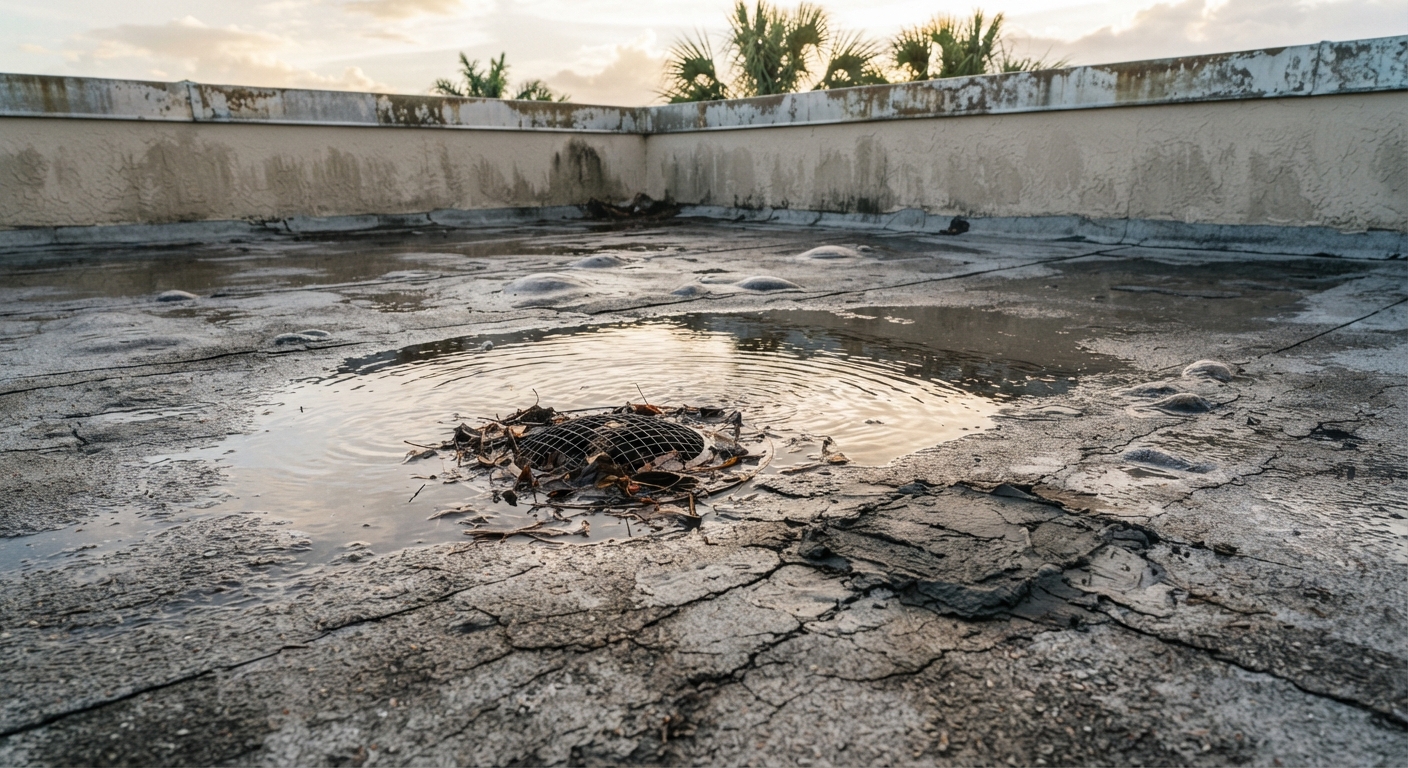
Remaining life is measured, not inferred from the install date. Core samples and a nondestructive moisture survey show how much insulation is wet and where, and a commercial drone survey can map the roof for the consultant before anyone walks it. The National Roofing Contractors Association recommends roof system inspections at least twice a year, preferably in spring and fall, plus inspections after severe weather such as hurricanes. A file of dated inspection photos turns a replacement decision from an argument about age into a record of condition.
| Component | Fannie Mae EUL (years) | What shortens it in South Florida | What to measure |
|---|---|---|---|
| Built-up, EPDM or TPO membrane | 20 | UV and heat aging, ponding, open seams | Seam integrity, cores, moisture survey |
| Metal roof | 40 | Salt-air corrosion at fasteners and laps | Fastener and lap corrosion, panel attachment |
| Parapet caps and copings | 25 | Wind uplift at joints, sealant failure | Joint condition, attachment, sealant |
| Interior roof drains (covers) | 30 | Debris and clogging that cause ponding | Ponding area and hours after rain |
| Roof structure | 50+ | Wet insulation corroding deck and fasteners | Deck condition at cores and soft spots |
Repair, recover or replace: which scope fits the roof’s remaining life?
The right scope follows from how much of the assembly is still dry and attached, and each option has conditions under which it is the wrong answer. A roof with years left and a few localized failures is a repair candidate, and commercial roof repair on that roof is the economical call. Repeated repairs on a roof past its service life cost more over time than replacement, because each patch addresses one entry point while water keeps moving through insulation the patch never touches.
Coatings and recovers sit between the two. A commercial roof coating can extend the surface life of a dry, adhered membrane, but it does not fix wet insulation, lost adhesion or a deteriorated deck, and a coating warranty is not a new-roof warranty. Existing Building Section 706.3 prohibits a recover over a water-soaked or deteriorated covering or over two existing coverings, and buildings in the High-Velocity Hurricane Zone follow Sections 1512 through 1525 of the Florida Building Code, Building, instead. A recover installed without cores can trap moisture under the new roof.
| Scope | Where it fits | Planning horizon | Where it falls short |
|---|---|---|---|
| Targeted repair | Localized failures, dry insulation, years of service left | Bridges to a planned replacement date | Does not stop water moving through wet insulation; repeated repairs on an end-of-life roof cost more over time |
| Coating or restoration | Dry, adhered, stable membrane confirmed by cores | Extends surface life as scheduled maintenance | Not a fix for wet insulation, lost adhesion or deck damage; a coating warranty is not a new-roof warranty |
| Recover (new roof over existing) | Single covering that is dry and adequate as a base | Fewer weather-exposed days, less disruption | Prohibited over water-soaked coverings or two existing coverings; HVHZ follows separate sections; traps moisture if cores are skipped |
| Full tear-off and replacement | Wet insulation, deck damage, two coverings, end of service life | Resets the service-life clock and warranty | Highest first cost; opens the building to weather during tear-off; most tenant disruption |
The contractor should fit the job as well. A statewide contractor built for occupied commercial buildings may not be the lowest bid on a small, simple roof.
What moves the budget and the schedule on a South Florida replacement?
Budget and schedule move with the same few variables, and each one can be priced or scheduled before a contract is signed. Advanced Roofing’s guide to commercial roofing cost in Florida for 2026 works through installed cost by assembly; the table below lists the drivers that matter for timing and planning, with the unit to require in every bid.
| Driver | How it moves budget or schedule | Unit to ask for in bids | Source and date |
|---|---|---|---|
| Wet insulation found in cores | Turns a recover into a tear-off; adds insulation and disposal | Price per square foot of wet insulation replaced | FRSA, FBC Existing Building §706.3 (Feb. 2026) |
| Permit application date | Sets the code edition the design must meet | Code edition stated in the proposal | Miami-Dade notice; 9th Edition effective Dec. 31, 2026 |
| Wet-season rainfall | Reduces productive tear-off days from May 15 to Oct. 15 | Weather allowance in working days | NWS Miami: wet-season normals 44.84 in. Miami, 37.49 in. Fort Lauderdale, 36.30 in. West Palm Beach (1991–2020) |
| Remaining useful life | Decides whether a repair can bridge to a later date | Years of remaining life stated by the assessor | Fannie Mae Form 4099.F (Aug. 2019) |
| Condominium reserve status | Sets the funding source and approval path | Roof line in the structural integrity reserve study | F.S. 718.112(2)(g) (2026) |
Deck replacement, rooftop equipment disconnect and reset, and tapered insulation are the lines most often missing from early budgets. Requiring unit prices for them in every proposal keeps bids comparable and keeps hidden conditions from becoming change orders.
What changes when the building stays open during the replacement?
On an occupied building, the schedule is built around the tenants. Tear-off sections are sized so each area is dried in the same day, which caps how much roof a crew opens before the afternoon thunderstorm cycle. Adhesive and hot-asphalt work is scheduled away from rooftop air intakes, crane picks over entrances move to early mornings or weekends where the site allows, and the property manager receives notice of every shutdown window before it starts.
Rooftop equipment is the most common coordination failure. Curbs, penetrations and condensate lines have to be raised, reflashed or relocated in step with the new insulation height, and a packaged rooftop unit may need to be lifted and reset. A single-source contractor with an in-house crane division and commercial air conditioning service removes one handoff between trades. Founded in 1983, Advanced Roofing is 100% employee-owned, and commercial re-roofing of occupied buildings is its core work.
Location changes the code path. Miami-Dade and Broward counties sit in the High-Velocity Hurricane Zone, where roofing follows Florida Building Code Sections 1512 through 1525 and products carry Miami-Dade Notices of Acceptance, while Palm Beach County buildings follow the statewide high-wind provisions. Local planning runs through our commercial re-roofing in Miami, Fort Lauderdale commercial roofing and West Palm Beach commercial roofing offices, and the wind design for a specific building remains the engineer’s determination.
Perimeter warning lines or guardrails, controlled roof access, interior protection under open areas and daily fastener sweeps are scope items of their own. They belong in the bid, along with a named site contact for tenants.
Which code, condo and insurance dates belong in the replacement plan?
As of October 6, 2026, these dated items affect a South Florida replacement plan and should be re-checked when a budget or contract is approved.
- Florida Building Code, 9th Edition, effective December 31, 2026. In Miami-Dade, online applications filed after 4 p.m. on December 30, 2026 fall under the new edition. The Section 706.3 exception for retaining an adequate substrate is pending final text.
- Milestone inspections. F.S. 553.899 requires condominium and cooperative buildings three or more habitable stories tall to have a milestone inspection by December 31 of the year the building turns 30 and every 10 years after; local agencies may set 25 years for buildings near salt water.
- Structural integrity reserve studies. F.S. 718.112(2)(g) lists the roof first among the components a study must cover and requires the study at least every 10 years. For associations existing on or before July 1, 2022 that pair it with a milestone inspection, December 31, 2026 is the outside completion date, and budgets adopted on or after December 31, 2024 cannot waive or reduce reserves for those components.
- Insurance. Underwriting decisions about roof age and condition belong to the carrier and the owner’s agent; our article on an insurer requiring roof replacement lists the questions to ask. A contractor does not interpret coverage.
Boards should take these items to their engineer, reserve professional and association attorney, who decide what applies to a specific building.
Commercial roof replacement planning checklist: who owns each step?
- Facility or property manager: order core samples and a moisture survey this quarter and keep dated inspection records in one file.
- Roof consultant or engineer: write one scope naming the assembly, insulation target, attachment, product approvals and the code edition the design assumes.
- Owner or asset manager: decide before year-end whether the permit will be filed under the 8th or 9th Edition, and approve the budget on that basis.
- Board or community association manager: confirm where the roof sits in the milestone inspection and reserve study schedule, including its stated remaining useful life.
- Procurement: require unit prices for wet insulation, deck replacement and equipment reset, and compare bids line by line using our guide on how to select a roofing contractor.
- Property manager and contractor: agree on tenant notices, shutdown windows, crane-pick dates and a single site contact before mobilization, and review the commercial roof hurricane season guide if work will run past June 1.
- Energy or sustainability lead: if a rooftop array is planned within the new roof’s life, bring Advanced Green Technologies’ rooftop solar team into design so attachments are flashed into the new system during installation.
- Operations: fund a commercial roof maintenance program and the warranty-required inspections after close-out.
Frequently Asked Questions
When is the best time of year to replace a commercial roof in South Florida?
The most predictable window for low-slope tear-off work is mid-October through mid-May, outside the wet season the National Weather Service defines as May 15 to October 15 and largely outside the June 1 to November 30 hurricane season. Work can proceed in summer with same-day dry-in, but weather allowances grow. Design, bidding and permitting usually need to finish before that window opens.
How long does a commercial flat roof last in Florida?
Fannie Mae’s Estimated Useful Life tables list 20 years for built-up, EPDM and TPO roofs and 40 years for metal roofs as planning averages. An actual roof’s remaining life depends on maintenance, drainage, exposure and installation quality, so core samples and a moisture survey are a better guide than the install date.
Does the 2026 Florida Building Code change affect my roof replacement?
It can. The 9th Edition takes effect December 31, 2026, and the permit application date generally decides which edition applies. Miami-Dade’s notice states that online applications filed after 4 p.m. on December 30, 2026 must meet the new edition, and FRSA reports an approved, pending change to Section 706.3 on retaining existing substrate. Confirm the edition with the building official.
Should I repair or replace my commercial roof?
Repair fits a roof with years of service left, dry insulation and localized failures. Replacement fits a roof with widespread wet insulation, deck damage, two existing coverings or repeated leaks past its service life. Core samples settle the question, and repeated repairs on an end-of-life roof usually cost more over time than replacement.
Can a business stay open during a commercial roof replacement?
Most occupied buildings stay open. The work is phased so each section is dried in the same day, noisy and odorous tasks are scheduled around operations and air intakes, crane picks move outside business hours where possible, and tenants receive notice of each shutdown window. The schedule and notice plan should be written into the contract.
Is a condo roof replacement covered by the structural integrity reserve study?
The roof is the first component listed in Florida’s structural integrity reserve study requirement, F.S. 718.112(2)(g), for condominium buildings three or more habitable stories tall. The study states the roof’s remaining useful life and replacement cost and sets the reserve schedule. How a specific building’s roof is funded is a question for the association’s engineer, reserve professional and attorney.
Put the roof on the calendar before the calendar decides
A South Florida roof replacement is planned against dates that do not move. The dry season opens in mid-October, the 9th Edition of the Florida Building Code arrives on December 31, 2026, and condominium reserve rules already treat the roof as a funded component. The scope an owner defends to a board, whether repair, recover or replacement, follows from remaining life measured in cores. Owners who measure the roof this quarter, name the code edition in the scope, and sequence the work around tenants and weather turn a replacement into a capital project with a date the board approved in advance.
Written by The Technical Team at Advanced Roofing. Advanced Roofing Inc. was ranked the #13 largest roofing contractor in the United States on Roofing Contractor magazine’s Top 100 list, announced in August 2026 (read the ranking announcement).
To plan a 2027 replacement, request a free quote from Advanced Roofing or call (800) 638-6869 to schedule core samples and a roof condition assessment.