At a glance: A Florida insurer that requires a new roof on a commercial building is judging wind and water risk from roof age and condition, so a roof that has never leaked can still fail its underwriting guidelines. This guide explains what underwriters look for, why the homeowners’ 15-year roof law generally does not cover commercial policies, how much notice the statutes require, and how to choose between documentation, repair, coating, replacement, or a different carrier. It closes with a 30-day action checklist assigned by role.
An insurance requiring roof replacement notice on a Florida commercial building is an underwriting judgment about how the roof will perform in the next windstorm, and a dry ceiling does not answer it. The owner who argues about leaks spends the notice period on the wrong question, while the owner who answers with a documented condition and remaining-useful-life report gives the underwriter something to accept or reject on the record. Getting this wrong costs a lapse in property coverage, a rushed replacement priced during hurricane season, or a roof bought years early. This article does not claim that insurers are wrong to require replacement or that an inspection will always save the roof; sometimes the inspection confirms what the underwriter suspected, and a well-planned replacement is the right answer.
Why is an insurance company requiring a new roof when the roof doesn’t leak?
Commercial property underwriters price the next hurricane, and roof age and roof condition are the two facts they can read from a file. A roof that has kept water out for twenty years has shown that it sheds rain. It has not shown that its perimeter metal, fasteners, and membrane attachment will hold at design wind pressures after two decades of ultraviolet exposure and salt air.
Florida’s insurer of last resort publishes its own version of this rule. In a June 2024 commercial lines bulletin, Citizens Property Insurance Corporation announced that Commercial Lines Rule 103.11, effective August 1, 2024, allows a one-time remaining-useful-life exception beyond its stated roof age when a Florida-licensed roofing or general contractor documents the roof’s condition, and that Citizens keeps the final decision on insurability. Private carriers set their own guidelines, and Citizens describes its bulletins as historical, so confirm the current rule with your agent.
Many owners have heard that Florida insurers cannot refuse a roof under 15 years old. That protection, in section 627.7011(5), Florida Statutes, applies to homeowners’ policies on residential structures, and subsection (6)(a) of the same section states that it does not apply to policies not considered homeowners’ policies. An office building, retail center, warehouse, or association master policy is generally written on a commercial form. Ask your agent or attorney how your policy is classified before assuming the 15-year rule protects it.
What does an underwriter see on a commercial roof that has never leaked?
A low-slope roof fails in wind from the outside in, which is why a dry interior tells an underwriter so little. FEMA’s Hurricane and Flood Mitigation Handbook for Public Facilities (FEMA P-2181, March 2022) states that low-slope membrane roofs often fail at the edges when wind lifts and peels metal edge flashings, copings, or fascia covers, and that a lifted gutter can pull the edge flashing with it and start a progressive peel of the membrane. None of that produces a ceiling stain until the storm arrives.
Water can also be present long before anyone sees it. A small breach at a seam or penetration lets water into the insulation, where it spreads laterally under an intact membrane. The wet boards lose thermal value, the membrane loses adhesion over the wet area, and fasteners in a steel deck begin to corrode. The first interior sign can appear years later and far from the entry point, and a moisture survey confirmed by core samples finds that water where a walk across the roof does not.
The inspection report an insurer reviews typically records the conditions in the table below. Each one describes wind or water exposure, and several can be corrected without a full replacement.
| Condition recorded | Why it matters for wind or water risk | How it is verified |
|---|---|---|
| Roof age | Carrier guidelines set acceptable ages by system; age runs from the last full replacement | Permit record, prior contract, warranty certificate |
| Perimeter edge metal and coping | FEMA P-2181 identifies edges as the common starting point of low-slope wind failure | Hands-on check of attachment, fastener spacing, and cleats |
| Membrane surface and seams | Crazing, alligatoring, and open seams mark UV aging and water entry points | Visual survey and seam probing |
| Wet insulation | Water under an intact membrane reduces adhesion and corrodes deck fasteners | Infrared or impedance moisture survey confirmed by core samples |
| Patch density | Many repairs suggest a system near the end of its service life | Photographs and repair history |
| Drains and ponding | Standing water adds load and accelerates membrane aging | Post-rain observation and drain inspection |
| Rooftop equipment | Loose panels and units become debris that punctures membranes | Curb, flashing, and tie-down inspection |
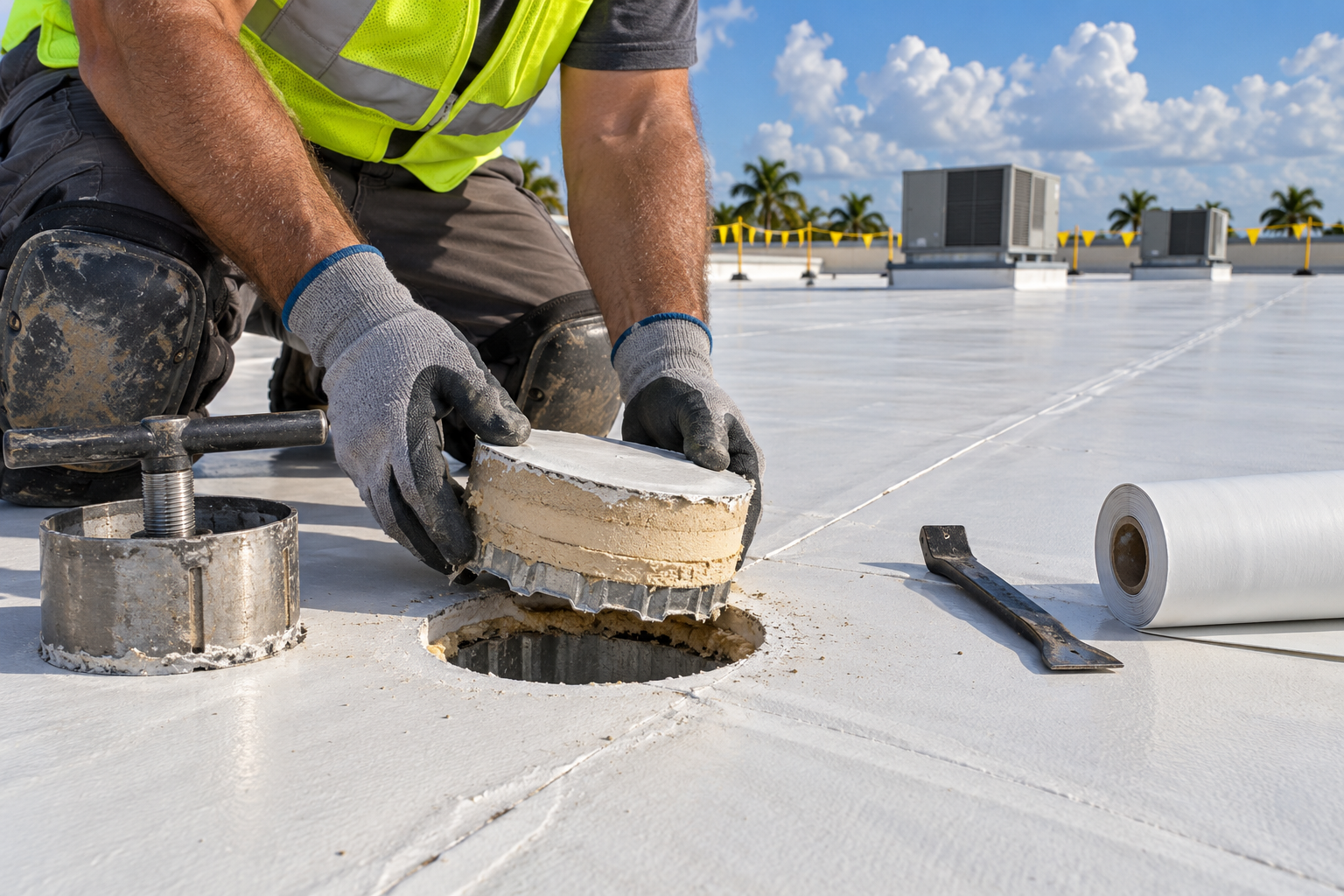
Rooftop equipment belongs in the same review. FEMA’s handbook describes access panels blown off rooftop HVAC units becoming wind-borne debris that punctures membranes, and it recommends equipment attachment designed for local wind requirements. A commercial drone survey gives the agent a current overhead record of the membrane, edges, and equipment.
Replace, repair, or document: which answer to an insurance requiring roof replacement notice fits your roof?
The owner has five realistic responses, and the inspection decides which ones are open. Each response must satisfy two audiences, the underwriter who reads the report and the building official who permits any work, and the table below shows where each one falls short.
| Response | When it fits | What the underwriter needs | Where it falls short |
|---|---|---|---|
| Condition and remaining-useful-life report | Dry, adhered roof within its service life | Signed report with cores, moisture survey, photographs, and a stated opinion | Carrier can still decline; Citizens grants its exception only once |
| Targeted repairs and re-inspection | Discrete defects at coping, seams, flashings, or drains | Invoices, before-and-after photographs, updated report | Roof age in the file does not change |
| Restoration coating | Sound, dry substrate with years of life left | Carrier’s written acceptance before the work | Does not fix wet insulation or deck damage; may not count as replacement |
| Full replacement | Widespread wet insulation, deteriorated deck, or a system past its service life | Permit, final inspection record, completion date | Highest cost; schedule pressure inside the notice window |
| Different carrier | The current carrier’s age rule is the only obstacle | The new carrier’s own inspection | Premium and terms may differ; the request can return at the next renewal |
Documentation is the least expensive answer and the one to try first when the roof is dry, adhered, and within its expected service life. A condition report from a licensed roofing contractor, with core results, a moisture survey, perimeter photographs, and a written remaining-useful-life opinion, gives the underwriter something specific to accept. Advanced Roofing’s roof management program keeps inspection reports, repair history, and warranty records in its Advanced Access portal.
Targeted commercial roof repairs work when the report lists discrete defects such as loose coping, open seams, failed pitch pans, or clogged drains. Restoration coatings extend service life on a sound, dry roof, and Advanced Roofing’s roof coating guidance is explicit that a coating does not fix wet insulation, widespread adhesion loss, or a deteriorated deck, and that a coating warranty is not a new-roof warranty. Before buying either, get the carrier’s written answer on whether that work satisfies the requirement, because some underwriting guidelines do not count a coating as a replacement.
Replacement resets the roof age in the carrier’s file. It is the right answer when cores find widespread wet insulation, a deteriorated deck, or a system past its service life, and commercial re-roofing on occupied buildings is the core of Advanced Roofing’s work. Shopping the policy through your agent is also legitimate. Another carrier’s guidelines may accept the current roof, though the premium and terms may differ and the next renewal may bring the same request.
What drives the cost and calendar of an insurer-required roof replacement?
Advanced Roofing does not publish pricing, and a cost range quoted without a roof survey is a guess. The budget for an insurer-driven replacement moves on the same variables as any Florida re-roof, which the 2026 commercial roofing cost guide walks through assembly by assembly.
| Driver | Effect on budget or schedule | Who confirms it |
|---|---|---|
| Share of wet insulation found in cores | Decides recover eligibility and tear-off quantity | Roofing contractor, roof consultant |
| Deck condition | Deck repair found at tear-off adds cost and days | Roofing contractor, structural engineer |
| HVHZ location (Miami-Dade, Broward) | Requires HVHZ assemblies and Notice of Acceptance products | Building official |
| Permit date relative to December 31, 2026 | Decides which Florida Building Code edition governs | Building official |
| Number of rooftop units | Curbs, disconnects, and crane picks add trade coordination | Contractor, mechanical engineer |
| Occupancy constraints | Night, weekend, or phased work extends duration | Property manager, contractor |
| Material lead times and season | Product availability and storm weather move start dates | Roofing contractor |
Schedule is usually the tighter constraint. Forty-five days leaves little room for inspection, permitting, and lead times, so a realistic goal may be a signed contract and start date for the underwriter to review. Ask your agent whether the carrier accepts a contract and schedule as evidence of intent; guidelines differ, and only the carrier can answer.
How do you replace a roof on an occupied Florida building without shutting down tenants?
Occupied-building work is sequenced around the tenants. Advanced Roofing re-roofs occupied commercial buildings around business hours, including night and weekend installation when a building requires it.
- A pre-construction meeting with the property manager sets staging areas, crane pick times, access routes, and tenant notice windows.
- Tear-off is limited to the area that can be dried in the same day, with temporary protection staged for afternoon storms.
- Material and rooftop equipment lifts by Advanced Roofing’s in-house crane division are scheduled outside business hours where the site allows.
- Daily cleanup and photo progress reports let the property manager answer tenants and the insurer from the same record.
- Close-out delivers the permit final inspection, product approval numbers, manufacturer warranty registration, and the maintenance schedule the warranty requires.
Florida adds its own constraints. Buildings in Miami-Dade and Broward fall in the High-Velocity Hurricane Zone, where roofing products need Miami-Dade Notices of Acceptance and the code’s HVHZ sections govern the assembly; the building official decides what the permit requires. Hurricane season runs June 1 through November 30, and Advanced Roofing’s late-season commercial roof hurricane plan covers how to secure an open roof when a storm threatens.
The insurer needs the same close-out file the owner keeps. Send your agent the permit number, the final inspection record, and the completion date as soon as they exist. Advanced Roofing’s semiannual roof maintenance inspections keep that record current, as most commercial roof warranty terms require.
Which Florida rules and deadlines control your response?
The notice period is set by statute and depends on the policy type. As of September 26, 2026, section 627.4133, Florida Statutes, requires at least 45 days’ advance written notice of nonrenewal, with the reasons stated, for most commercial property policies, and at least 120 days’ notice for personal lines and commercial residential policies, including condominium association and apartment building policies. Read the notice for its effective date and stated reason; whether a particular notice was given correctly is a question for your agent or attorney.
A renewal can also arrive with changed terms instead of a nonrenewal. Section 627.43141 requires the insurer to summarize any change in policy terms in a notice titled Notice of Change in Policy Terms, and it treats payment of the renewal premium as acceptance of the new terms. A change in how roof losses are settled would appear in that notice, so read it before paying.
Code rules decide how much of a roof can be repaired. Under section 553.844(5), Florida Statutes, a roof built, repaired, or replaced under the 2007 Florida Building Code or later needs only the repaired portion brought to current code, even when the work exceeds 25 percent; older roofs remain under the Existing Building code’s 25 percent provision. The 9th Edition Florida Building Code takes effect December 31, 2026, and FRSA has published an approved modification to Section 706.3 on recovering versus replacement. Confirm the adopted text, and which edition governs your permit date, with the building official. Condominium boards should also coordinate any replacement with the roof component of the association’s structural integrity reserve study under section 718.112(2)(g) and with the association’s engineer and attorney.
What should the owner do in the first 30 days after the notice?
Assign each of the following steps to a named person on the day the notice arrives.
- Property manager: record the effective date, the stated reason, and the days remaining, and request the underwriter’s inspection report and photographs through the agent.
- Insurance agent or broker: confirm in writing what the carrier will accept (condition report, remaining-useful-life opinion, a specific form, or a signed contract) and the submission deadline, and ask whether other markets will write the building with the current roof.
- Roofing contractor: perform a condition inspection with cores, a moisture survey, perimeter and equipment attachment review, and photographs, and state a remaining-useful-life opinion in writing.
- Owner or asset manager: price three scenarios (documentation only, targeted repairs, replacement) and fund the one the report supports.
- Attorney: review lender and lease obligations tied to continuous property coverage, and review the notice itself if its timing or reasons look deficient.
- Condominium board: bring in the association’s engineer, reserve professional, and attorney before committing reserve funds.
- Everyone: hold any replacement contract until the inspection report is in hand.
Frequently Asked Questions
Can an insurance company make me replace a commercial roof that doesn’t leak?
An insurer can decline to renew a commercial property policy when the roof no longer meets its underwriting guidelines, whether or not the roof leaks, provided it gives the notice Florida law requires. The insurer cannot order the work. The owner decides whether to replace, repair, document the roof’s condition, or seek coverage elsewhere, so ask your agent what evidence the carrier will accept before choosing.
Does Florida’s 15-year roof law apply to commercial buildings?
Section 627.7011(5), Florida Statutes, limits refusals based solely on roof age for homeowners’ policies on residential structures, and subsection (6)(a) states that the section does not apply to policies not considered homeowners’ policies. Office, retail, industrial, and most association master policies are written on commercial forms. Your agent or attorney can confirm how your specific policy is classified.
How much notice must an insurer give before nonrenewing a commercial property policy in Florida?
As of September 26, 2026, section 627.4133 requires at least 45 days’ advance written notice of nonrenewal, with the reasons stated, for most commercial property policies. Commercial residential policies, including condominium association and apartment building coverage, require at least 120 days. If the required notice is not given, the statute extends coverage for a defined period, and your agent or attorney can confirm which rule applies.
Will a roof coating satisfy an insurance company’s roof replacement requirement?
A coating satisfies the requirement only if the carrier says so in writing. A restoration coating can extend the life of a dry, well-adhered roof, yet it does not correct wet insulation, a deteriorated deck, or failed perimeter attachment, and some underwriting guidelines do not count a coating as a replacement. Get the underwriter’s written answer through your agent before contracting for coating work.
What is a roof remaining useful life inspection?
A remaining useful life inspection is a documented assessment, by a licensed roofing contractor or another qualified professional, of how many more years a roof can perform as intended. A credible report includes core samples, a moisture survey, perimeter and equipment attachment findings, photographs, and a stated opinion. Citizens’ Commercial Lines Rule 103.11 allows a one-time roof age exception based on this kind of documentation, subject to underwriting approval.
Should my roofing contractor negotiate with my insurance company?
A roofing contractor should inspect the roof, document its condition, and state a remaining-useful-life opinion, and stop there. Coverage questions belong to your agent, your insurer, a licensed public adjuster, or an attorney. Advanced Roofing provides the documentation and the construction plan, and the policy conversation stays between you and the professionals licensed to have it.
Answer the underwriter with evidence before the renewal date
Florida’s 15-year roof protection is written for homeowners’ policies, and the statutory notice period on a commercial policy is often 45 days, so the response has to start the week the notice arrives. A documented inspection with cores, a moisture survey, and a remaining-useful-life opinion either earns the roof more time or confirms that replacement is due, and in both cases the owner decides on the building’s facts. Where replacement is the answer, planning it around tenants, hurricane season, and the December 31, 2026 code change keeps the deadline from setting the terms.
Written by The Technical Team at Advanced Roofing. Founded in 1983, Advanced Roofing is 100% employee-owned and was ranked the #13 largest roofing contractor in the U.S. on Roofing Contractor magazine’s 2026 Top 100 list.
To schedule an inspection before your renewal date, request a roof condition inspection online or call (800) 638-6869.