At a glance: A lightning protection certificate describes a system only as it stood on the inspection date. This guide explains how NFPA 780, UL Solutions, and the Lightning Protection Institute Inspection Program handle inspection intervals and certificate terms, what an inspection checks on a Florida roof, how the documentation options compare, what drives scope and schedule, how reroofing an occupied building affects certification, and what the 9th Edition Florida Building Code adds on December 31, 2026. It closes with a role-by-role checklist and answers to common owner questions.
Lightning protection inspection and recertification is how a Florida building owner confirms that a rooftop lightning protection system still matches the design that was certified, because a certificate describes the system only as it stood on the inspection date. Every reroof, rooftop unit change-out, coping repair, and storm after that date can sever a conductor or break a bond without leaving damage visible from the parking lot, and the owner usually finds out after a strike, through fire damage, failed electronics, or a certificate that lapsed before the loss. This article explains what NFPA 780, UL Solutions, and the Lightning Protection Institute Inspection Program each require or recommend, how reroofing an occupied building interacts with certification, and what the 9th Edition Florida Building Code changes on December 31, 2026. It does not argue that every building needs a lightning protection system, and it makes no code, insurance, or engineering determination for any specific property.
Why does a lightning protection system need regular inspection in Florida?
Florida’s lightning exposure is documented in federal data. The National Weather Service lightning fatality data show a U.S. average of about 20 deaths per year for 2016 through 2025, and as of the September 22, 2026 update, Florida led all states with six deaths in 2026. Those figures count people struck outdoors and say nothing directly about building losses. They do reflect how often the state sees cloud-to-ground lightning, and each strike a rooftop system carries can damage the conductor where it attaches.
NFPA 780, Standard for the Installation of Lightning Protection Systems, is the U.S. installation standard, now in its 2026 edition. It addresses periodic inspection in its administrative chapter and ties the interval to the authority having jurisdiction. Its informational annex, which carries no mandatory force, has long recommended an annual visual inspection, a complete inspection on a multi-year cycle, and one to three years for critical systems. Confirm the wording in whichever edition a specification or insurer names.
Third-party certification sits on top of the standard. UL Solutions’ Master Label Certificate program certifies a complete, fully compliant structure and states that the certificate is valid for five years from issuance. The Lightning Protection Institute Inspection Program (LPI-IP) recommends recertification every three years. Advanced Roofing’s commercial lightning protection services include new installations, repairs, and recertification.
What does a lightning protection inspection actually check?
A lightning protection inspection verifies that the system still provides a continuous path from every air terminal on the roof to the grounding electrodes, and that the building’s other metal systems remain bonded to it. The chain has five parts: air terminals, main conductors across the roof and down the building, bonds to rooftop metal, grounding electrodes, and surge protective devices at the service entrances. A break anywhere leaves strike current to find another route through steel, conduit, piping, or wiring, where side-flash can ignite combustibles or destroy electronics.
Florida conditions attack the chain at its connections. Salt air and humidity corrode fittings where dissimilar metals meet, such as copper conductor clamped to aluminum coping without a listed bimetallic connector. Wind and foot traffic loosen fasteners, and adhesive cable holders release as membranes move with heat, so conductors lift and get cut during later roof work. Earth resistance changes with soil moisture, which is why NFPA 780’s annex has advised staggering ground tests across wet and dry seasons.
A commercial lightning protection inspection in Florida typically covers five things: a rooftop visual check of air terminals, conductors, and bonds; a review of rooftop changes since the last certificate; continuity testing of conductor runs; earth resistance testing of the grounding electrodes; and verification of surge protective devices at each service entrance, documented against NFPA 780 or UL 96A.
| Component | What the inspector checks | Common Florida failure | Visible on a roof walk? |
|---|---|---|---|
| Air terminals | Height, spacing, and secure base | Bent or missing terminals after storms or rooftop traffic | Yes |
| Main conductors | Continuous runs, fastener spacing, bend radius | Lifted or cut runs after roof work; released cable holders | Yes |
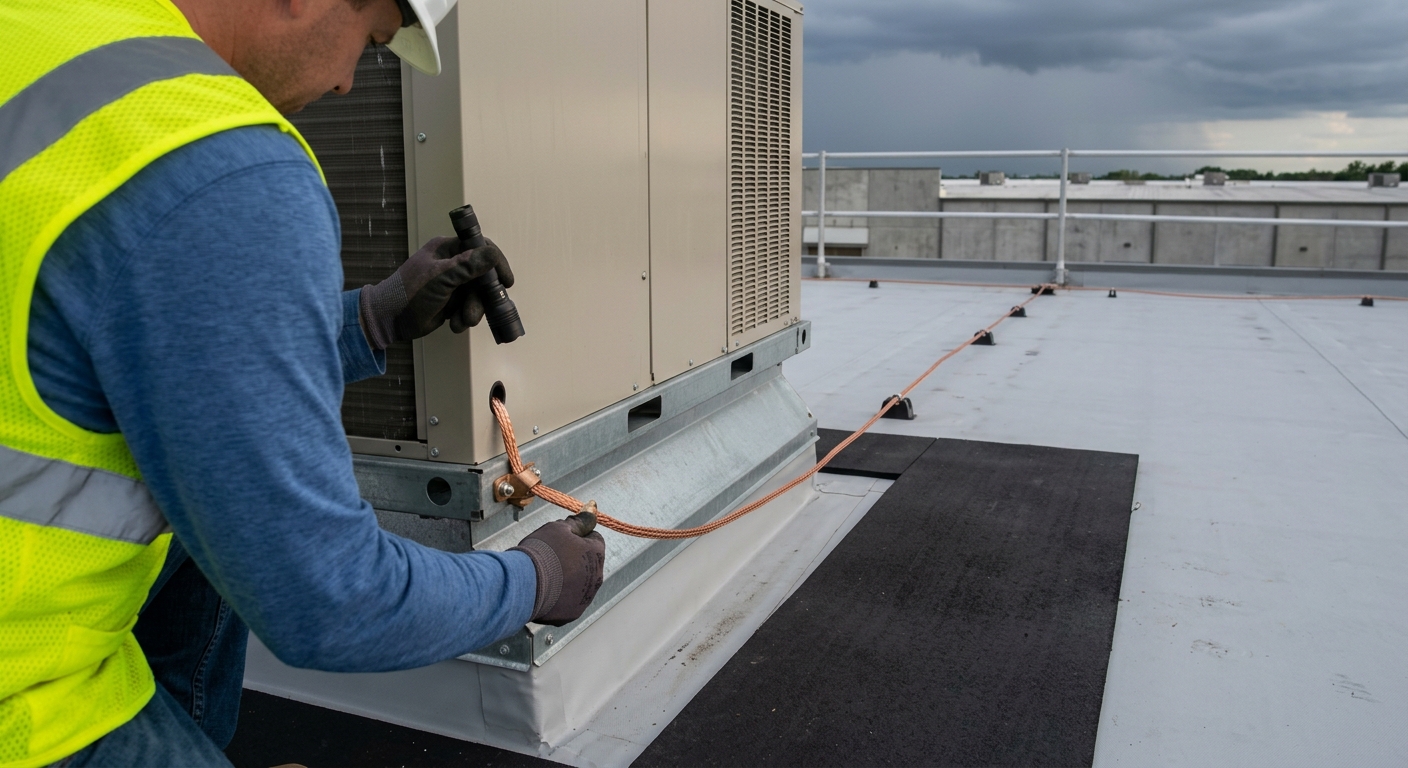
| Bonds to rooftop equipment | A bond at every unit, vent, rail, and metal edge the design requires | Bonds left off after rooftop unit replacement or new equipment | Partly |
| Connectors and fittings | Tightness and listed bimetallic fittings where metals differ | Corrosion at copper-to-aluminum contact in salt air | Yes, at roof level |
| Down conductors and grounding | Continuity to electrodes and earth resistance | Damage at grade from landscaping or paving; concealed corrosion | No; testing required |
| Surge protective devices | Presence and condition at power, data, and communications entrances | Failed or missing devices after a surge or a service change | No; electrical rooms |
UL Master Label, LPI-IP, or a contractor report: which documentation do you need?
Recertification means a third party reinspects an existing system and issues a new certificate, and the right document depends on who will read it. An insurer’s loss control engineer, a building official, a lender, or a lease may name a specific program. Pull the original certificate, identify its standard and program, and ask the requester which program they accept before scheduling.
UL Solutions issues two main documents. A Master Label Certificate covers a complete, fully compliant structure, is published to UL Solutions’ public certificate directory, and is valid for five years. A Letter of Findings covers partial structures or limited-scope work and goes directly to the applicant. UL’s program literature states that damage, or alterations such as work on a roofing or coping system, can invalidate a certificate early. Only UL-listed installers in the program can apply, so contractor choice determines which documents are available.
LPI-IP offers Master Installation, Extended Master Installation, and Reconditioned Master Installation certificates and a Limited Scope Inspection. The LPI reroofing specification for lightning protection systems provides a Reconditioned Master Certificate when a prior LPI-IP certificate or UL Master Label is on file, and a Limited Scope certification when concealed conductors and grounding are undocumented. Keep the original certificate and as-built drawings with the roof warranty file.
A contractor’s own inspection report is a useful maintenance record, but it is self-declared and will not satisfy a party that asked for third-party certification. No certificate promises that a strike will cause no damage; it documents compliance on the inspection date.
| Document | Issued by | Scope | Term | Where it falls short |
|---|---|---|---|---|
| UL Master Label Certificate | UL Solutions, on application by a UL-listed installer | Complete structure, full compliance | Five years from issuance; damage or alteration can void it earlier | Not available for partial or intentionally noncompliant systems; requires a program-listed installer |
| UL Letter of Findings | UL Solutions | Partial structure or limited scope, with listed exceptions | UL literature describes no expiration; not published to the directory | Does not certify the full system |
| LPI-IP Master Installation Certificate | LPI-IP | Complete structure | LPI-IP recommends recertification every three years | Some specifications name UL; confirm which program the requester accepts |
| LPI-IP Reconditioned Master Installation Certificate | LPI-IP | Existing system with a prior certificate, after rework | Recertification recommended every three years | Depends on a prior certificate and documentation of concealed work |
| LPI-IP Limited Scope Inspection | LPI-IP | Part of a structure, or a system with undocumented concealed work | Per program terms | Does not certify concealed grounding it could not verify |
| Contractor inspection report | Installing or maintenance contractor | Whatever the contractor inspected | No standard term | Self-declared; not third-party evidence |
What drives the cost and schedule of lightning protection recertification?
Neither Advanced Roofing nor the certification programs publish a standard recertification price, and a number quoted without the building’s size, access, and condition tells an owner very little. The Lightning Protection Institute has noted that inspection services typically price by the perimeter of the structure, and UL’s program requires a separate certificate or Letter of Findings for each structure, so a campus with a generator enclosure and a parking structure counts as several inspections.
Corrective work causes the largest swing. Missing bonds, corroded fittings, or lifted conductor runs must be corrected before a certificate issues, and undocumented concealed work can limit the outcome to Limited Scope. Buried test points slow grounding tests, and restricted hatches or after-hours rules extend the schedule on occupied buildings.
| Driver | Why it moves scope | Source |
|---|---|---|
| Building perimeter and roof area | More conductor, terminals, and bonds to verify | Lightning Protection Institute inspection guidance |
| Number of structures | Each structure needs its own certificate or Letter of Findings | UL Solutions inspection program requirements |
| Prior certificate and as-built drawings | Decide between a Reconditioned and a Limited Scope result | LPI reroofing specification |
| Rooftop changes since the last certificate | New units, solar arrays, or edge metal need new bonds or extensions | UL program literature; NFPA 780 |
| Deficiencies found | Corrections are completed before a certificate issues | UL Solutions and LPI-IP program terms |
| Access and occupancy rules | Hatch, escort, or after-hours requirements extend the schedule | Owner site rules |
How does reroofing an occupied Florida building affect the lightning protection system?
Reroofing is the event most likely to change a certified system, because rooftop conductors, air terminal bases, and through-roof assemblies come off before the old membrane does. The LPI reroofing specification has the lightning protection contractor install a complete system after the roof is finished, reusing down conductors and grounding that meet the design, while the roofing contractor flashes each penetration to the roof manufacturer’s requirements. FRSA’s January 2018 memo to the Florida Building Commission stated that removing, reinstalling, and recertifying a system on a reroof often costs more than the original installation. Owners planning to begin re-roofing an occupied commercial building should see that line in the bid.
On an occupied building, each roof section is without an intact system from the time its conductors come up until the new runs are reconnected. A workable plan disconnects only the section being torn off, reconnects at the end of each phase, and avoids the summer afternoon thunderstorm pattern where the calendar allows. The property manager should receive a written schedule of disconnected areas. Crane picks break equipment bonds, so the scope for any rooftop air conditioning work should name who restores each bond.
Edge metal is a recurring conflict point. Florida coping and gutters are tested and attached for wind uplift, and the 2024 International Building Code added language, described in the SPRI and LPI white paper on the IBC lightning protection changes, requiring components on tested edge systems to use compatible brackets and fasteners per the edge manufacturer’s instructions. In Miami-Dade and Broward, the High-Velocity Hurricane Zone sections govern the roof assembly, and the attachment method is a question for the engineer of record.
A contractor that handles the membrane, the sheet metal fabrication for coping, and the lightning protection scope removes one handoff at the roof edge, and the owner should still require third-party recertification at close-out. A large contractor built for occupied buildings may also not be the lowest bid for a small recertification with no roof work attached.
What changes when the 9th Edition Florida Building Code takes effect on December 31, 2026?
The 9th Edition (2026) Florida Building Code takes effect December 31, 2026, and the Florida Building Commission’s analysis of changes for the 9th Edition describes it as the 8th Edition updated with the 2024 International Building Code. The permit application date generally determines which edition governs, so a reroof permitted this month and one permitted in 2027 can fall under different text.
FRSA’s March 2, 2026 summary of additional 2026 Florida Building Code changes describes a new Section 1510.8.6 for lightning protection components attached to or through roof coverings, metal edge systems, and gutters. As FRSA summarizes it, they must be installed with compatible brackets, flashing, fasteners, or adhesives, flashing follows the roof covering manufacturer’s instructions, and attachment methods must be designed by a registered design professional to resist design wind loads. Verify the adopted text on floridabuilding.org, and ask the building official how it applies to a system reinstalled after a reroof.
Whether a building must have lightning protection at all is a separate question. As of November 2026, the most recent statewide summary located for this article is FRSA’s 2018 memo, which stated that the code then required it only on hospitals, nursing homes, and schools. Confirm current requirements with the building official and insurer.
Lightning protection recertification checklist for owners and facility teams
Each step below is assigned to the role that usually owns it. Dated rooftop documentation, such as a 360 Roof Walk captured before and after roof work, gives the inspector and the insurer the same record.
- Facility manager: locate the current certificate, its program, standard, and expiration date, and confirm a UL certificate in UL’s public directory.
- Facility manager: list every rooftop change since the certificate date, including reroofing, coping repair, rooftop unit replacements, solar arrays, antennas, and railings.
- Property or asset manager: ask the insurer, the lender, and any tenant whose lease mentions lightning protection which certification program they accept.
- Maintenance lead: add an annual visual check of air terminals, conductors, and bonds to the preventive roof maintenance program.
- Owner: require lightning protection removal, reinstallation, and recertification as a named line item in every reroof bid, with the certificate type due at close-out.
- Engineer of record: confirm the attachment design for lightning protection components on reroofs permitted under the 9th Edition Florida Building Code.
- Facility manager: after a known strike, storm damage, or a rooftop crane pick, request a targeted inspection before the next summer storm season.
- Owner: file the certificate, test results, and as-built drawings with the roof warranty and commercial roof management records.
Frequently Asked Questions
How often should a commercial lightning protection system be inspected in Florida?
NFPA 780 ties the inspection interval to the authority having jurisdiction, and its annex recommends an annual visual inspection with complete inspections on a multi-year cycle. LPI-IP recommends recertification every three years, and a UL Master Label is valid for five. Inspect after any reroof, rooftop equipment change, or known strike, whatever the calendar says.
How long is a UL Master Label certificate valid?
UL Solutions states that a Master Label Certificate is valid for five years from issuance. UL’s program literature also says damage or alterations, including roofing or coping work, can invalidate it sooner. Renewal requires a new inspection through a UL-listed installer, and active certificates appear in UL Solutions’ public directory.
Does reroofing void a lightning protection certification?
Reroofing usually removes rooftop conductors and air terminals, which alters the certified system, and UL’s literature lists roofing and coping changes among alterations that can invalidate a certificate. The system then needs reinstallation and a new inspection. LPI’s reroofing specification provides a Reconditioned Master Certificate when a prior certificate exists and Limited Scope when concealed work is undocumented.
What is the difference between a UL Master Label and an LPI-IP certificate?
Both are third-party certifications of an installed system against national standards. UL Solutions issues Master Label Certificates valid for five years and lists them in a public directory. LPI-IP issues Master Installation, Reconditioned, and Limited Scope certificates and recommends recertification every three years. Confirm which one your insurer, lender, or specification accepts.
Is lightning protection required by the Florida Building Code?
For most commercial buildings, no statewide mandate was identified; FRSA’s 2018 memo said the code then required it only for hospitals, nursing homes, and schools. Insurers, lenders, and leases can require it independently, and the 9th Edition adds attachment and flashing provisions where a system is installed. Confirm current requirements with your building official.
Is lightning protection recertification the same as a milestone or 40-year building recertification?
They are separate programs. Condominium milestone inspections under Florida Statutes Section 553.899 and county building recertifications are structural and electrical safety reviews by licensed engineers or architects. Lightning protection recertification is a third-party inspection against NFPA 780 or UL 96A. A milestone report does not issue a UL or LPI-IP certificate.
A current certificate is the evidence that the system still works
A lightning protection system on a Florida roof is a maintained building system, and its certificate is only as current as its last inspection. NFPA 780 ties the interval to the authority having jurisdiction, UL limits a Master Label to five years, LPI-IP recommends recertification every three, and every reroof or rooftop equipment change reopens the question whatever date the certificate shows. From December 31, 2026, the 9th Edition Florida Building Code adds engineered attachment design for components on roof coverings. Owners who fold lightning protection inspection into the roof maintenance cycle, name recertification in every reroof bid, and keep the as-built record with the roof warranty can show an insurer or building official what is on the roof and when it was verified.
Written by The Technical Team at Advanced Roofing. Founded in 1983, Advanced Roofing is 100% employee-owned and ranked #13 on Roofing Contractor magazine’s 2026 Top 100 list of U.S. roofing contractors, as documented in the company’s 2026 Top 100 ranking announcement.
To schedule an inspection ahead of a reroof or a certificate expiration, request a lightning protection inspection quote or call (800) 638-6869.